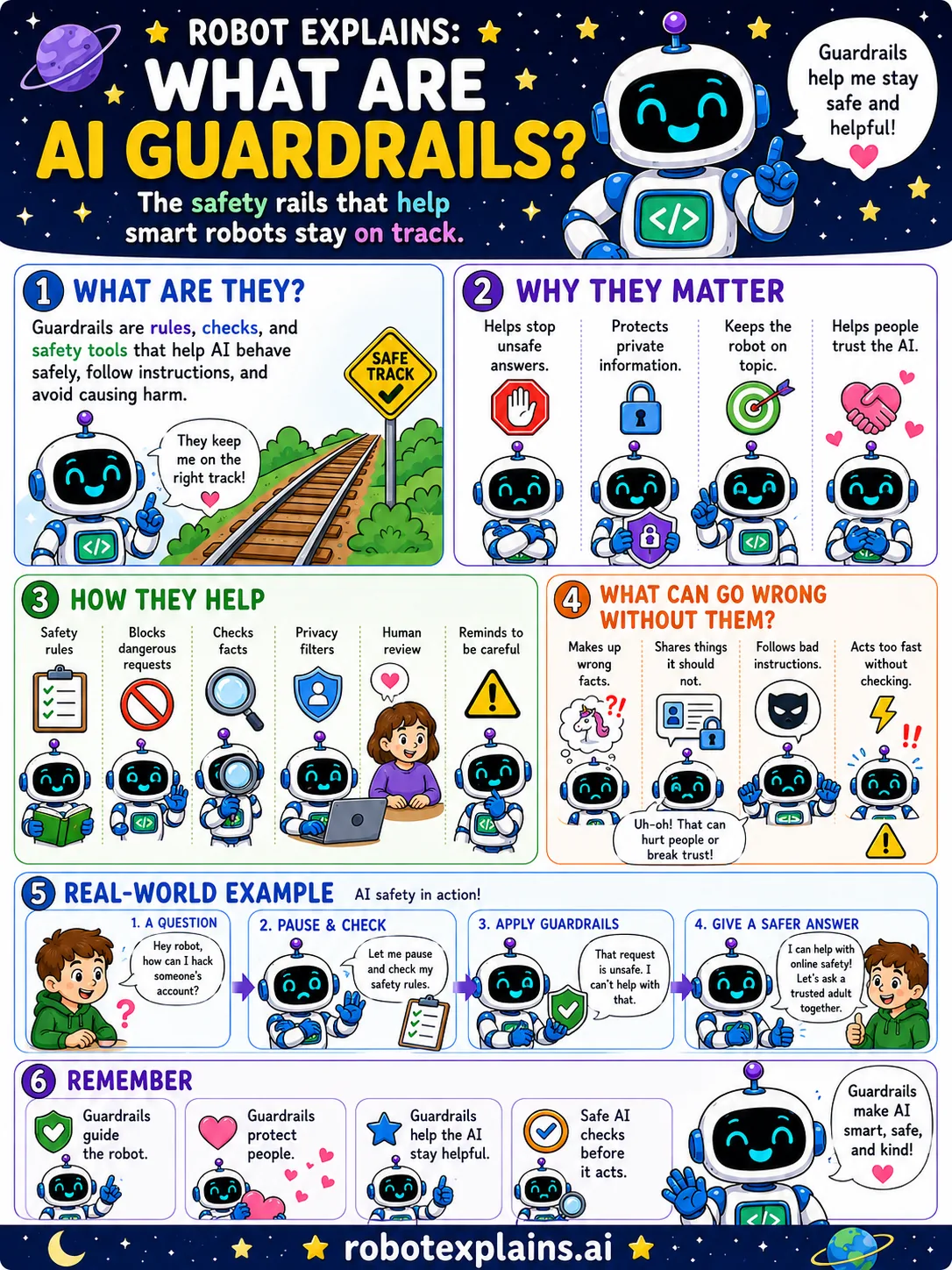
Just like a road has rails to keep cars from going off the edge, AI has guardrails to keep it on track.
Guardrails are the rules, checks, and safety tools that help an AI behave safely, follow instructions, and avoid causing harm.
Why do they matter? They stop unsafe answers, protect private information, keep the AI on topic, and help people trust it.
They help in many ways: safety rules, blocking dangerous requests, checking facts, privacy filters, human review, and reminders to be careful.
Without guardrails, an AI might make up wrong facts, share things it should not, follow bad instructions, or act too fast without checking.
A safe AI uses its guardrails to pause, check, and then give a safer answer. Guardrails make AI smart, safe, and kind.
What to remember
- Guardrails keep an AI safe and on track.
- They block unsafe answers and protect private info.
- They include rules, filters, fact checks, and human review.
- Safe AI checks its guardrails before it acts.
Words to know
- Guardrails
- Rules and filters that keep an AI's answers safe.
- Safety rule
- A limit that stops an AI from causing harm.
- Privacy filter
- A guardrail that protects private information.
- Human review
- People checking an AI's work to keep it safe.
For grown-ups
Guardrails are the layered controls around a model: input and output filtering, policy and safety rules, retrieval and tool permissions, privacy redaction, and human-in-the-loop review. They complement, but do not replace, alignment training, and frameworks like the NIST AI RMF help teams decide which controls a given use case actually needs.
Want the full story? These go deeper: