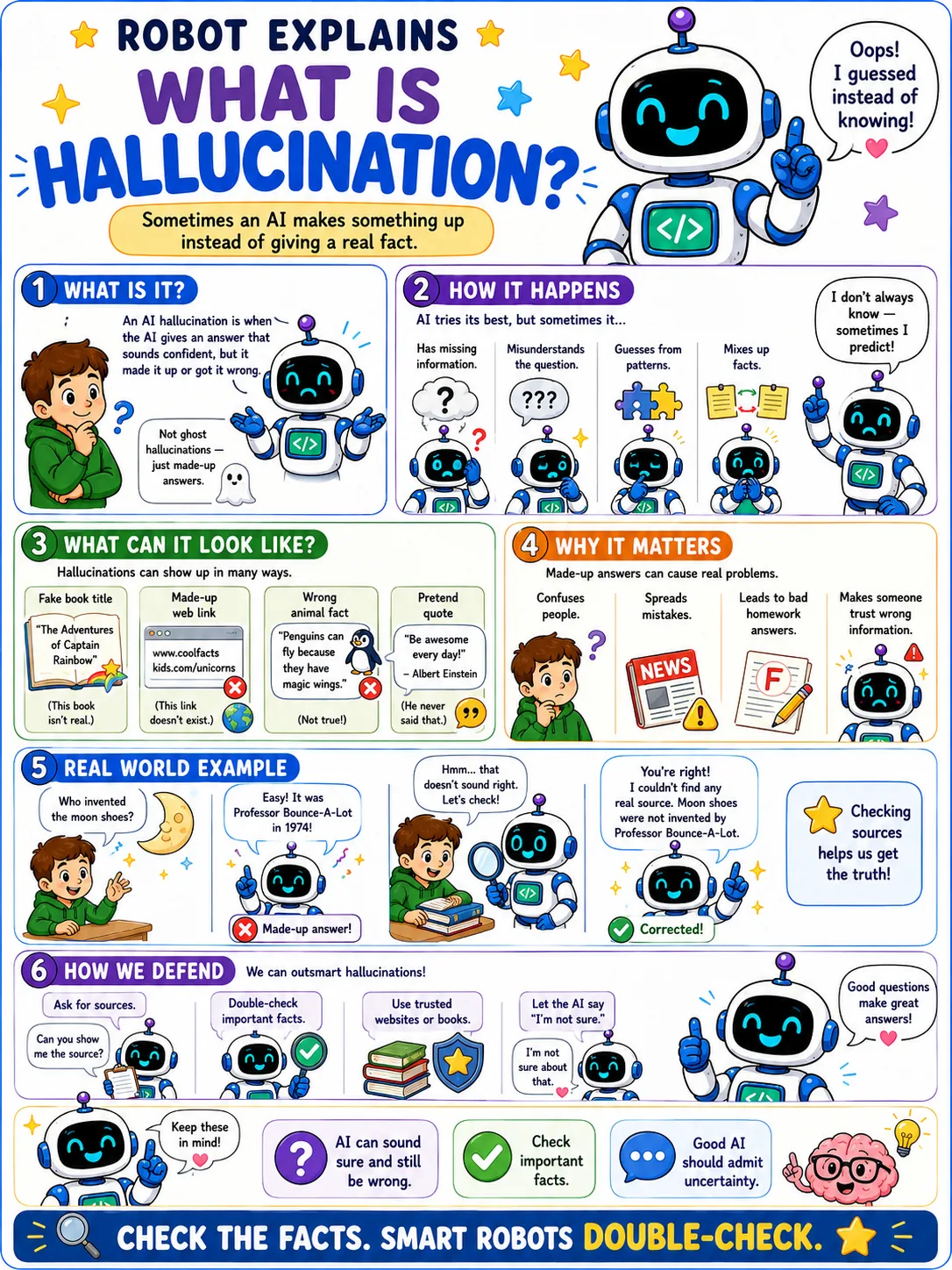
Sometimes an AI gives an answer that sounds confident but is actually wrong. That is called a hallucination.
It is not lying on purpose. An AI is a word-predictor, so when it is missing information, it can guess and fill the gap with something that just sounds right.
Hallucinations can show up in many ways: a fake book title, a made-up web link, a wrong fact about an animal, or a quote no one ever said.
This matters because made-up answers can confuse people, spread mistakes, and lead to wrong homework or wrong information.
Here is a real example. Ask "who invented the moon?" and an AI might cheerfully make up a name. The fix is to check a real source.
So we outsmart hallucinations by checking the facts: ask for sources, double-check important answers, use trusted sites and books, and let the AI say "I'm not sure." Smart robots double-check.
What to remember
- A hallucination is when an AI makes something up.
- It can sound very sure and still be wrong.
- Always check important facts against a trusted source.
- Good AI should admit when it is not sure.
Words to know
- Hallucination
- When an AI confidently gives a wrong or made-up answer.
- Source
- A trusted place where you can check a fact.
- Fact-check
- Making sure something is true before you believe it.
- Uncertainty
- Not being sure. Good AI says so.
For grown-ups
Hallucination happens because language models generate the most likely next tokens, not verified truth, so gaps get filled with plausible fabrications. Retrieval (RAG), citations, and prompting models to express uncertainty reduce it, but human verification of important claims remains essential. It maps to 'Misinformation' in the OWASP LLM Top 10.
Want the full story? These go deeper: