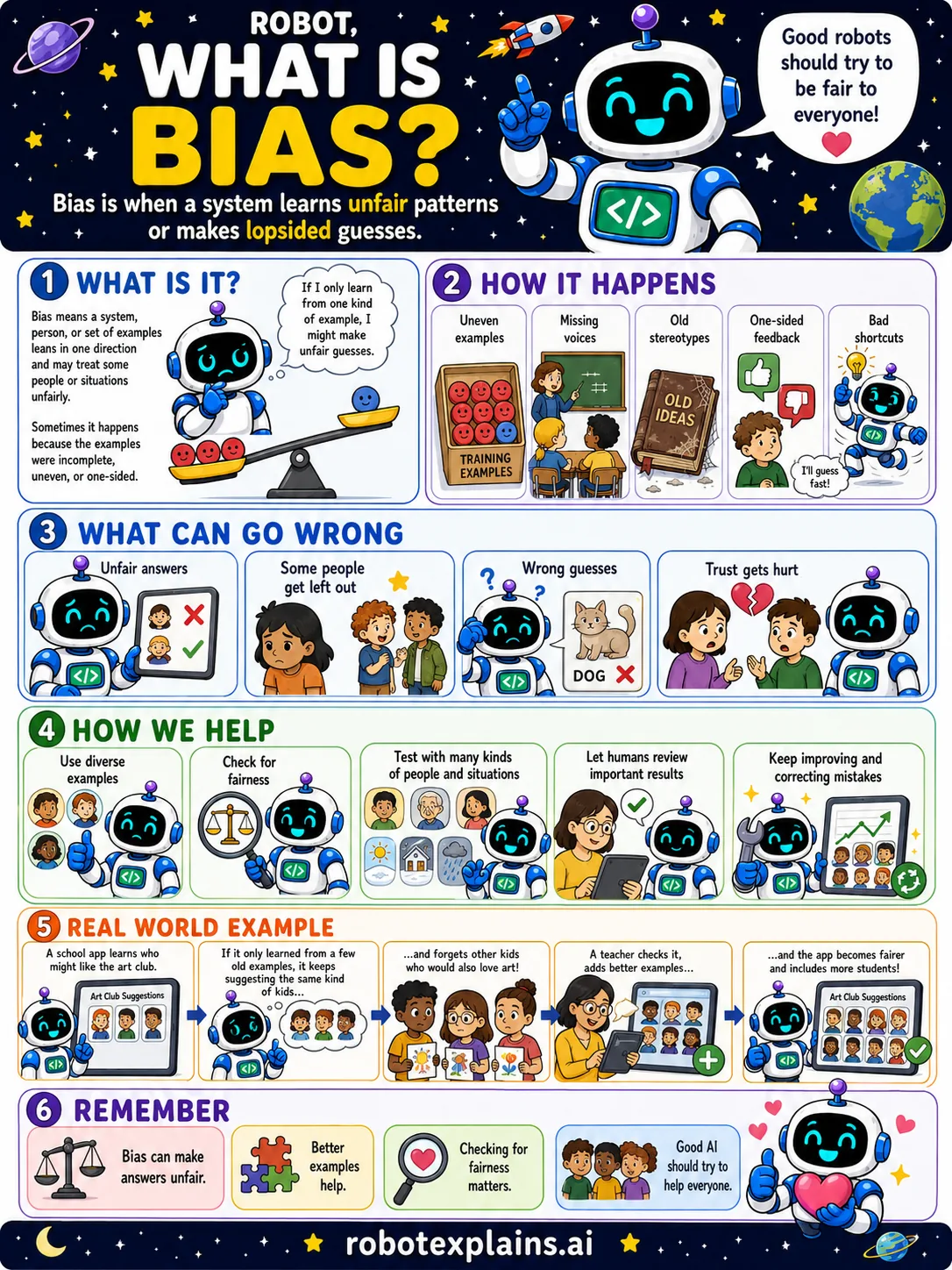
Bias is when an AI learns unfair patterns and starts making lopsided guesses, ones that are not fair to everyone.
It usually happens because of the examples the AI learned from. If those examples are uneven, missing some voices, full of old stereotypes, or one-sided, the AI can pick up unfair ideas.
That causes problems. The AI might give unfair answers, leave some people out, make wrong guesses, and lose people's trust.
We help by using diverse examples, checking for fairness, and testing with many kinds of people and situations. Humans review the results, and we keep improving.
For example, a school app only learned from a few old examples, so it kept suggesting the same kind of club. With better, broader examples, it gets fairer for everyone.
Remember: bias can make answers unfair, better examples help, and good AI should try to help everyone.
What to remember
- Bias is when an AI learns unfair patterns.
- It often comes from uneven or missing examples.
- It can leave people out or make wrong guesses.
- Diverse examples and fairness checks help fix it.
Words to know
- Bias
- When a system makes unfair or lopsided guesses.
- Uneven examples
- Training data that leaves some groups out.
- Fairness
- Treating all people and situations fairly.
- Diverse examples
- A wide, balanced mix of training data.
For grown-ups
Bias in AI arises when training data or design skews results against certain groups or cases, through unrepresentative samples, historical stereotypes, or feedback loops. Mitigations include diverse, representative data, fairness testing across subgroups, and human review. It is both a technical and an ethical concern.
Want the full story? These go deeper: