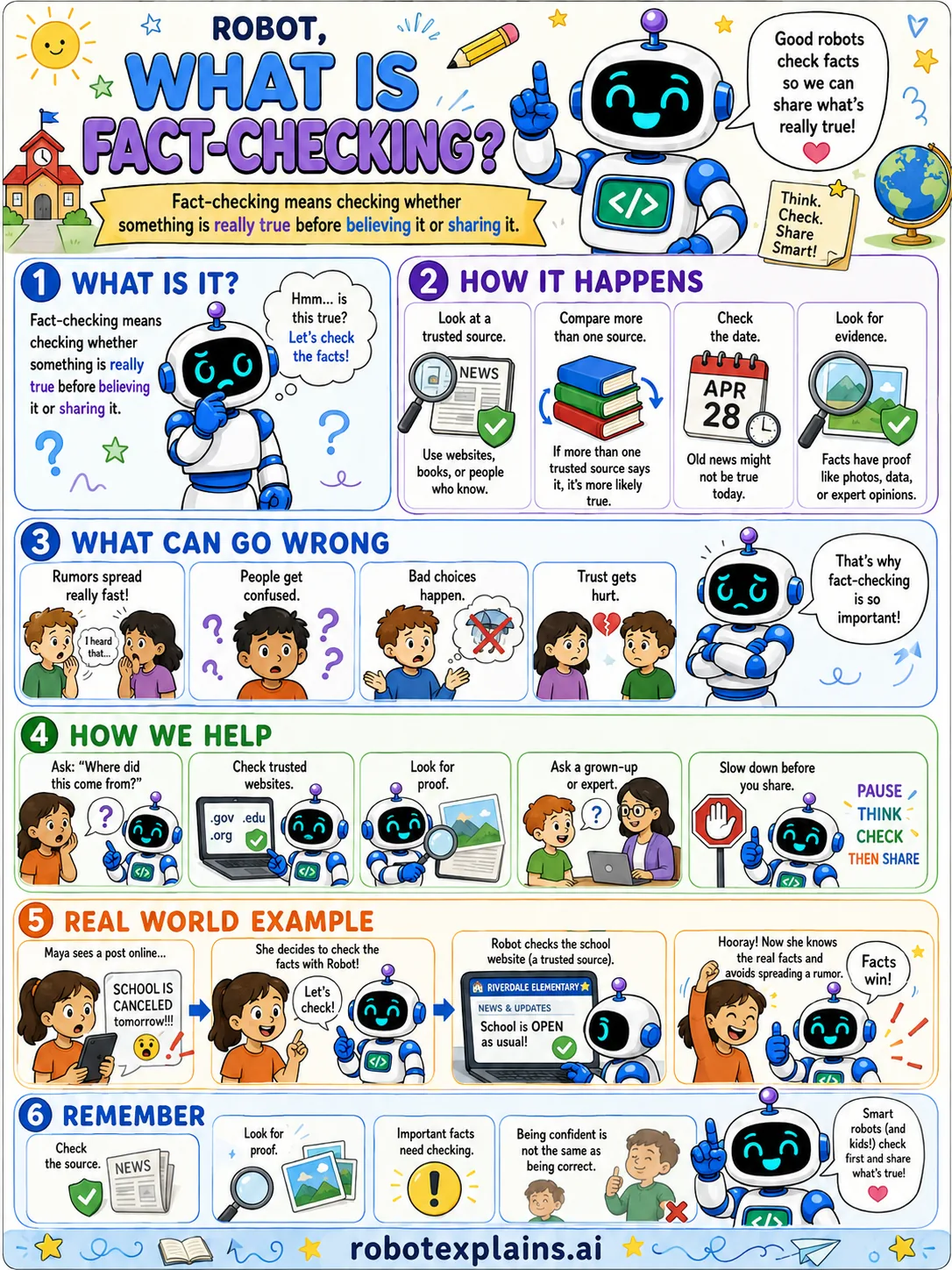
Fact-checking means making sure something is really true before you believe it or share it.
It is a simple habit. Look at a trusted source. Compare more than one source. Check the date, because old news might not be true today. And look for evidence, like facts, photos, or expert opinions.
Why bother? Without checking, rumors spread fast, people get confused, and bad choices happen.
So when you see a surprising claim, ask: "Where did this come from?" Check trusted websites, look for proof, ask a grown-up or expert, and slow down before you share.
For example, you see a post that school is canceled tomorrow. Instead of sharing it, you check the school's real website, and find out school is open as usual.
Remember: check the source, look for proof, and remember that sounding confident is not the same as being correct. Pause, think, check, then share.
What to remember
- Fact-checking is checking if something is really true.
- Use trusted sources and look for proof.
- Sounding confident is not the same as being correct.
- Pause, think, check, then share.
Words to know
- Fact-check
- To confirm something is true before believing it.
- Source
- A trusted place a fact comes from.
- Evidence
- Proof that backs up a claim.
- Date
- When something was written; old news can be out of date.
For grown-ups
Fact-checking is verifying claims against reliable, independent sources before accepting or sharing them. Key habits: trace the origin, corroborate across multiple trustworthy sources, check the date, and look for evidence. It is the human counterweight to AI hallucination and online misinformation.
Want the full story? These go deeper: