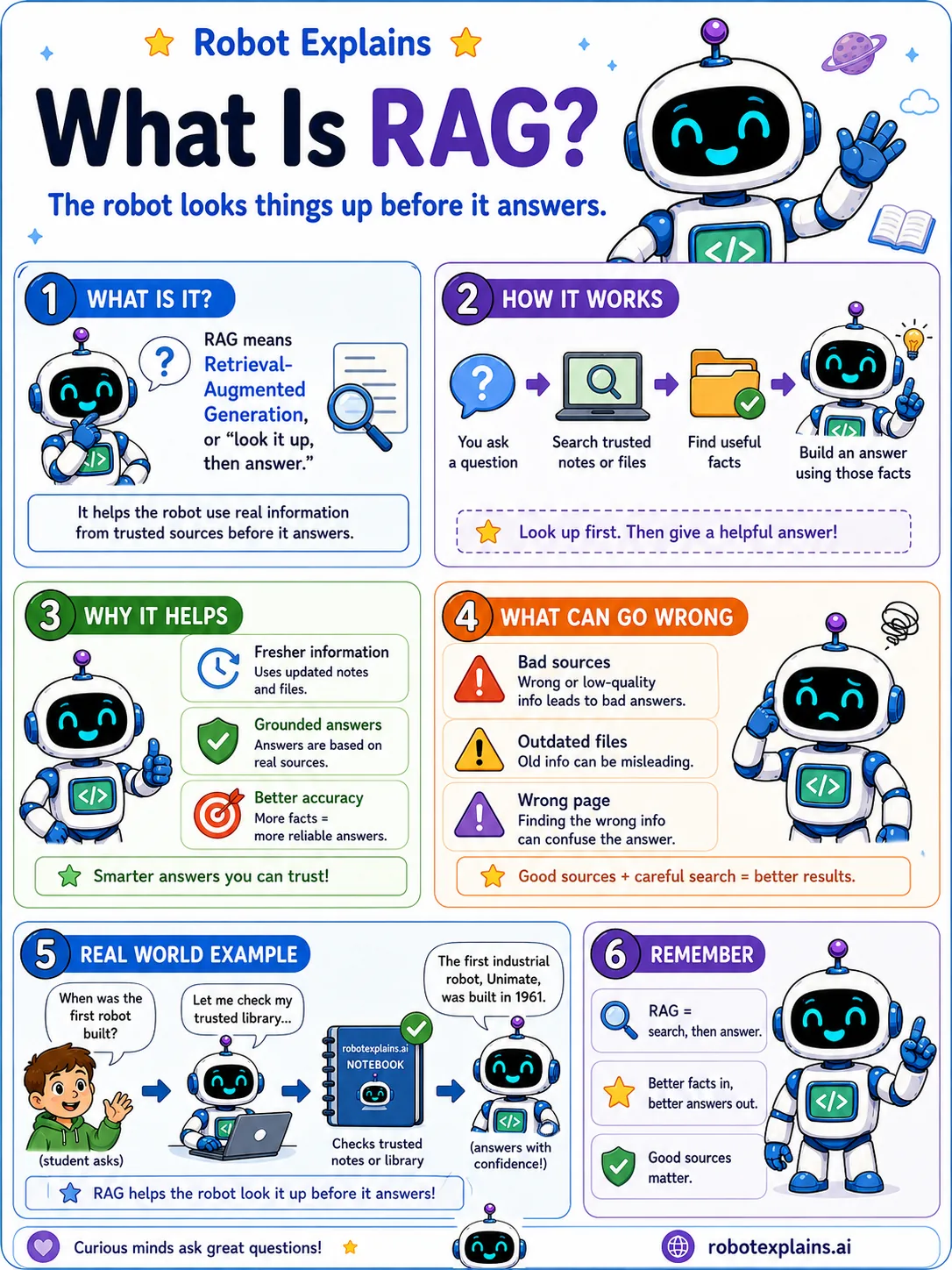
Normally an AI answers from what it already learned. RAG gives it a better trick: look things up first, then answer.
RAG stands for Retrieval-Augmented Generation. That is a big name for "search, then answer."
Here is how it works. You ask a question, the AI searches trusted notes or files, finds the useful facts, and then builds its answer using those facts.
This helps a lot. The AI can use fresher, up-to-date information, its answers are grounded in real sources, and it is more accurate.
It can still go wrong if the sources are bad, the files are outdated, or it grabs the wrong page. Good sources plus careful search give the best results.
So RAG makes an AI more trustworthy. It looks things up first, the way a careful researcher checks the library before answering.
What to remember
- RAG means search first, then answer.
- The AI uses trusted notes and files to find facts.
- It gives fresher, more grounded, more accurate answers.
- Good sources matter; bad sources still cause mistakes.
Words to know
- RAG
- Retrieval-Augmented Generation, or look it up, then answer.
- Retrieval
- Searching for useful facts.
- Source
- A trusted place the AI looks things up in.
- Grounded
- An answer based on real, found facts.
For grown-ups
RAG augments generation by retrieving relevant documents at query time and conditioning the model on them, improving freshness and grounding while reducing hallucination. Quality depends on the retriever and the corpus; stale, wrong, or poisoned sources degrade answers, so source curation and citation matter.
Want the full story? These go deeper: