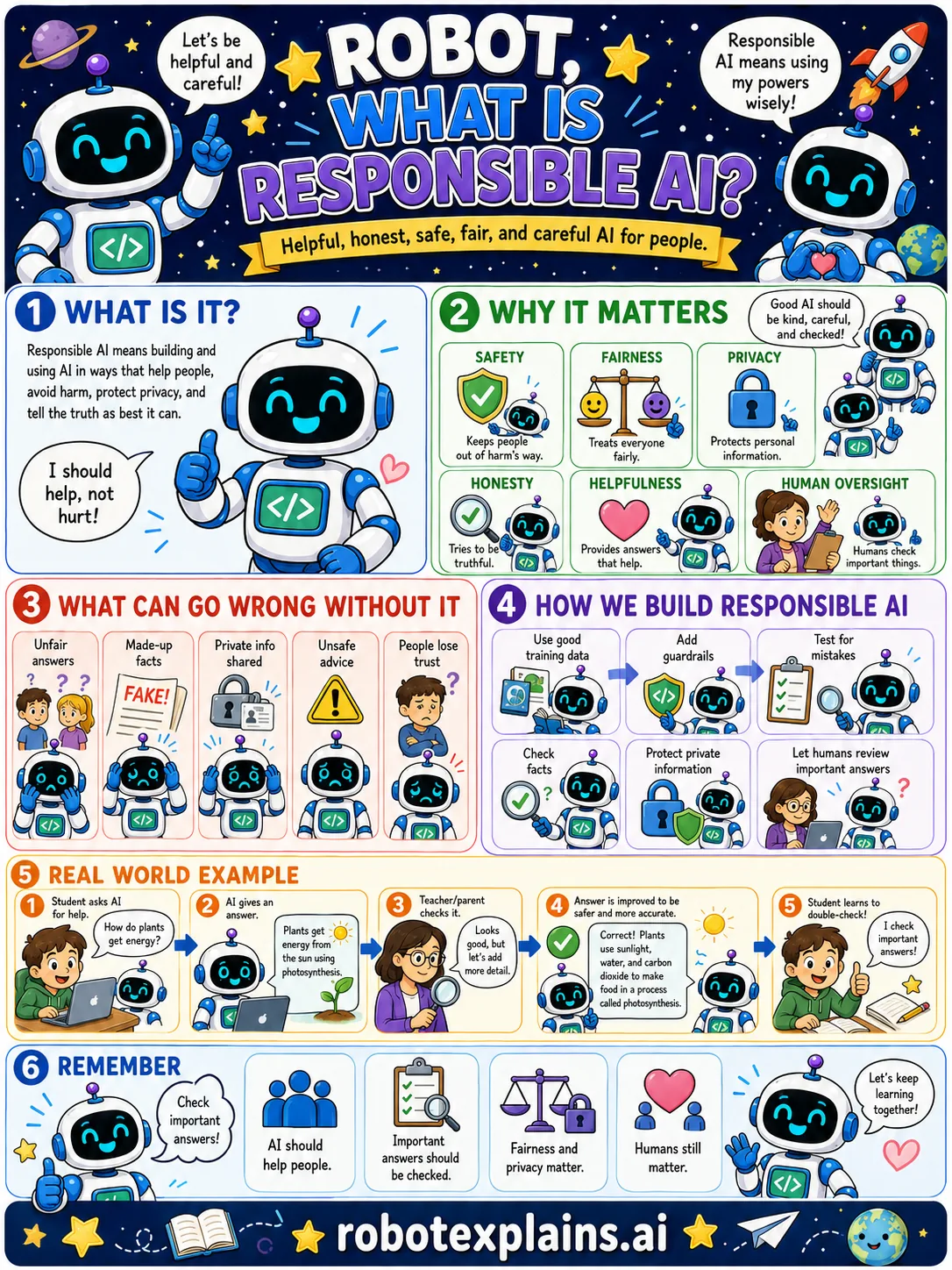
Responsible AI means building and using AI in ways that help people and avoid harm. In short: helpful, honest, safe, and fair.
Why does it matter? Good AI should keep people safe, treat everyone fairly, protect private information, tell the truth, and be genuinely helpful, with people watching over it.
Without care, AI can go wrong. It might give unfair answers, make up facts, share private information, or give unsafe advice, and people stop trusting it.
So we build responsibly: use good training data, add guardrails, test for mistakes, check facts, protect private info, and let humans review important results.
For example, an AI helps with a science project, a grown-up checks the answer, and the AI gets better and safer over time.
The big idea: AI should help people, important answers should be checked, and humans still matter. Fairness and privacy matter too.
What to remember
- Responsible AI is helpful, honest, safe, and fair.
- It is built with good data, guardrails, and testing.
- Important answers should still be checked by people.
- Fairness, privacy, and human oversight all matter.
Words to know
- Responsible AI
- Building and using AI in ways that help people and avoid harm.
- Fairness
- Treating everyone fairly, not leaving people out.
- Oversight
- People watching over and guiding AI.
- Trust
- Believing AI will be helpful and honest.
For grown-ups
Responsible AI is the practice of building and deploying systems that are safe, fair, transparent, private, and accountable, with humans in the loop. It draws on good data, guardrails, testing, and oversight. Frameworks like the NIST AI RMF turn these principles into concrete, checkable practices.
Want the full story? These go deeper: