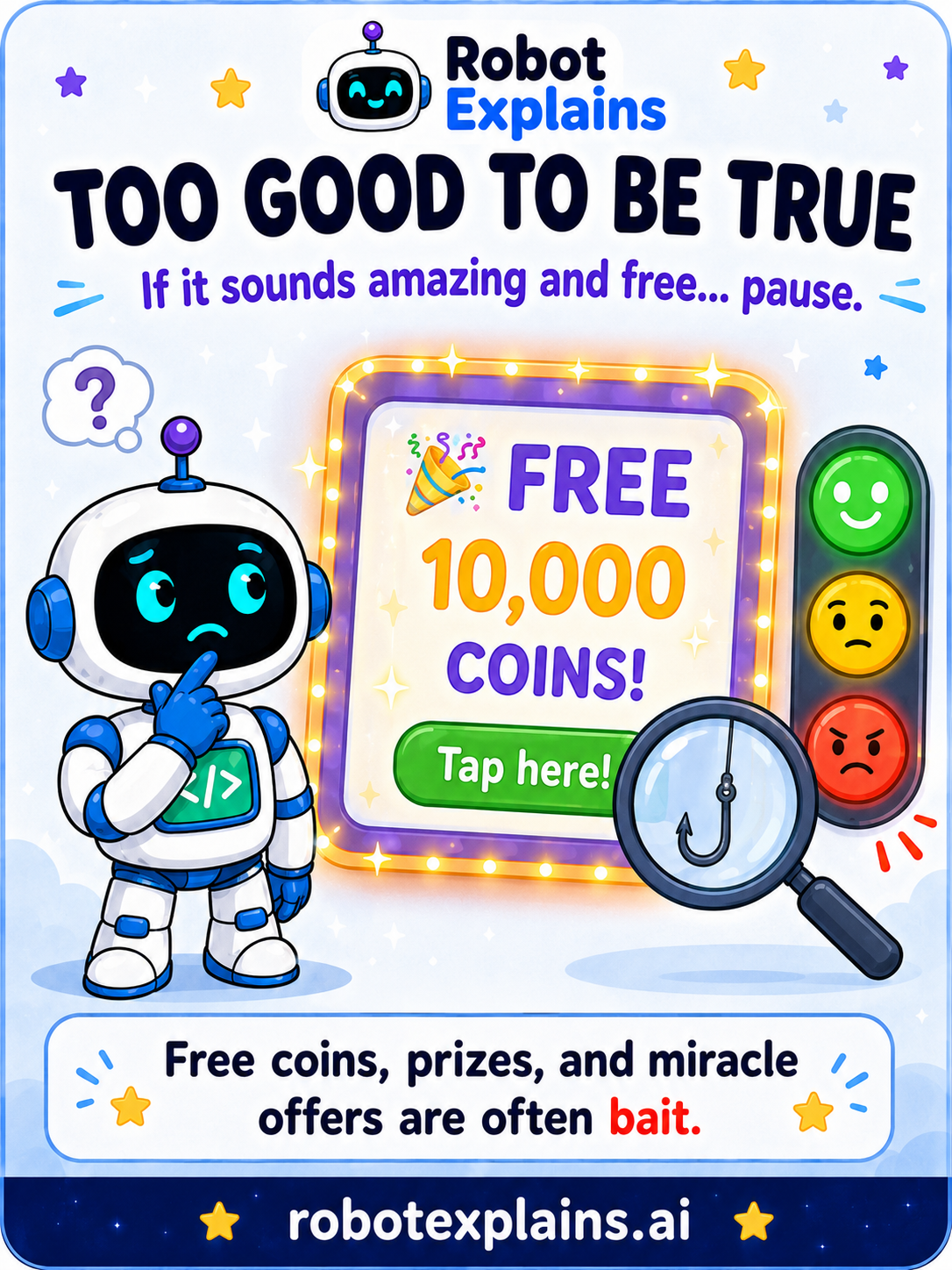
"🎉 You won 10,000 free coins! Tap here!" Wow — that sounds amazing! And that's exactly the point. When something online sounds too wonderful, there's usually a catch hiding behind it.
What does "too good to be true" mean? It means an offer promises something so big, so free, or so easy that it doesn't quite make sense. The exciting prize is the bait — something shiny dangled in front of you to make you tap fast.
Why it works. A big prize gives you a rush of excitement, and excitement makes you forget to check. While you're staring at the coins, you might miss that a stranger is asking for your password, your parent's card, or a tap on a mysterious link.
The simple rule. If it sounds too good to be true, it almost always is. Real prizes don't need your password. Real gifts don't ask you to hurry. Free coins from a stranger are usually a hook.
Green, yellow, red.
- 🟢 Green: a small reward inside a game you already play, with no strings.
- 🟡 Yellow: "Free stuff — just sign up!" — slow down and check who's asking.
- 🔴 Red: "You won! Enter your password / your parent's card to claim it" — stop and tell a grown-up.
What to do. Feel the excitement, then press your pause button. Ask: who is really offering this, and why? If you can't tell, it's a no — and that's a great choice.
Practice it. Try the Mission The Too-Good Ad and see if you can spot the bait.
Remember: excitement is fun, but it's also a signal to slow down. If it feels too good to be true, pause and check. Be curious, not careless!
What to remember
- If it sounds too good to be true, it usually is.
- Free coins, prizes, and miracle offers are common bait.
- The prize is the hook — check who's really asking and why.
- When it feels too exciting to wait, that's your signal to pause.
Explain it back
You understand something best when you can teach it. Finish these out loud — to a friend, a grown-up, a little brother or sister, or even the mirror:
- "Too good to be true" means…
- One kind of bait is…
- If an offer feels amazing and free, I should…
Words to know
- Bait
- Something shiny used to trick you into tapping or sharing.
- Offer
- A deal that promises you something, like coins or a prize.
- Scam
- A trick to get your money, information, or trust.
- Hook
- The catch hidden behind a too-good offer.