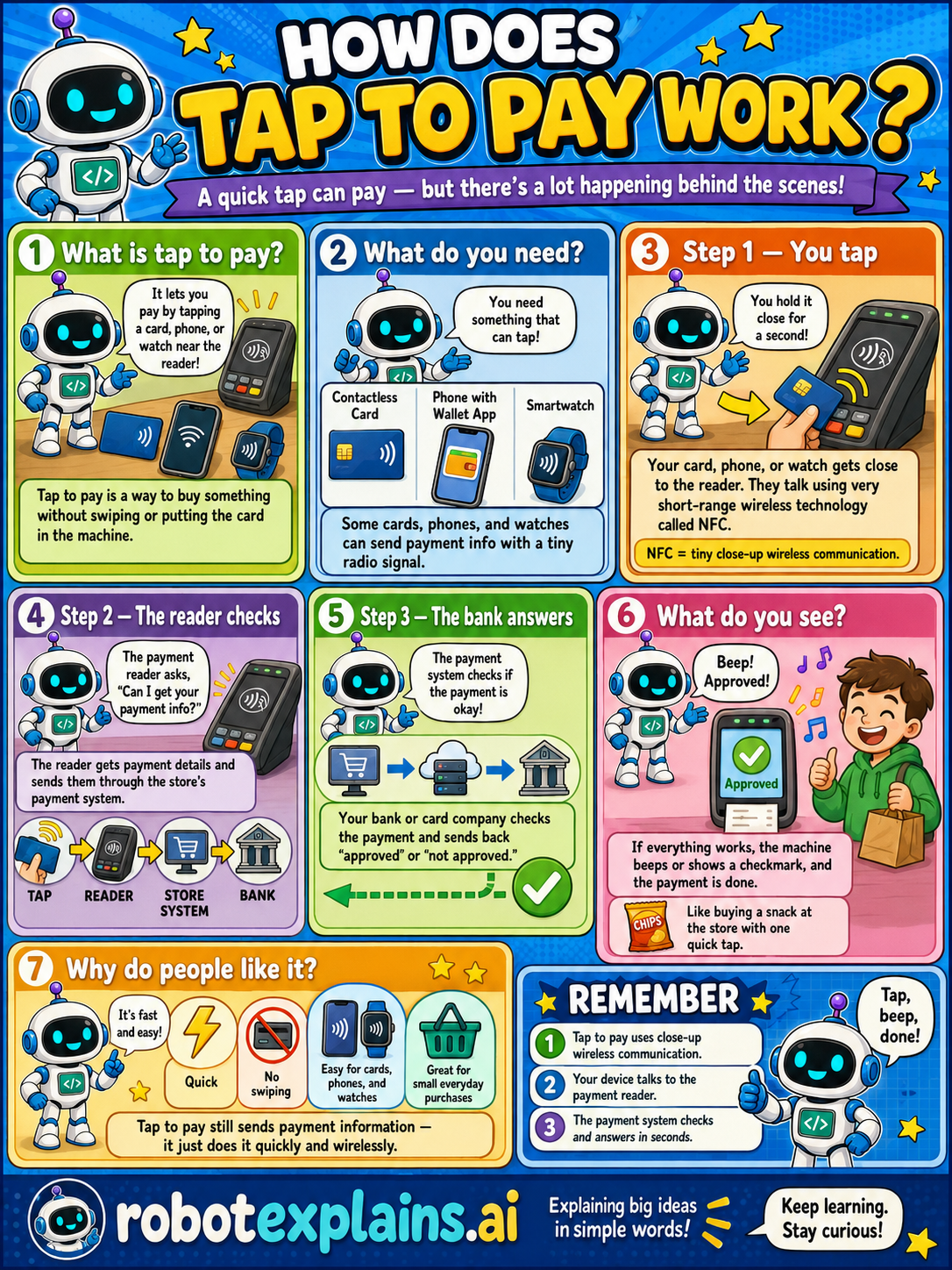
A quick tap can pay, but there's a lot happening behind the scenes! Let's see how tap to pay works.
What is tap to pay? It lets you pay by tapping a card, phone, or watch near the reader, no swiping or putting the card in the machine. Tap to pay is a way to buy something without swiping or inserting the card.
What do you need? Something that can tap! A contactless card, a phone with a wallet app, or a smartwatch. Some cards, phones, and watches can send payment info with a tiny radio signal.
Step 1, you tap. You hold it close for a second! Your card, phone, or watch gets close to the reader. They talk using short-range wireless technology called NFC. (NFC = tiny close-up wireless communication.)
Step 2, the reader checks. The payment reader asks, "Can I get your payment info?" The reader gets payment details and sends them through the store's payment system, tap, reader, store system, bank.
Step 3, the bank answers. The payment system checks if the payment is okay. Your bank or card company checks the payment and sends back "approved" or "not approved."
What do you see? Beep! Approved! If everything works, the machine beeps or shows a checkmark, and the payment is done, like buying a snack at the store with one quick tap.
Why do people like it? It's fast and easy, quick, no swiping, easy for cards, phones, and watches, and great for everyday purchases. Tap to pay still sends payment information, it just does it quickly and wirelessly.
Remember: you tap to send payment info by short-range wireless, your device talks to the reader, and the payment system checks and answers in seconds. Tap, beep, done!
What to remember
- You tap to send payment info by short-range wireless.
- Your device talks to the store's reader.
- The payment system checks and answers in seconds.
- Tap, beep, done, but a lot happens behind the scenes.
Words to know
- Tap to pay
- Paying by holding a card or phone near a reader.
- NFC
- Short-range wireless that carries payment info.
- Reader
- The machine that takes a tap payment.
- Bank
- The company that checks and approves the payment.
For grown-ups
Contactless payment uses NFC: holding the card/phone near the reader transmits a one-time, tokenized payment credential over a few centimeters; the reader forwards it through the store's system to the card network and bank, which authorize or decline in seconds. The real card number isn't exposed. This mechanism (short-range radio plus a bank check) is what makes the tap-to-pay safety lesson's 'check the amount, trusted reader' advice make sense.
Want the full story? These go deeper: