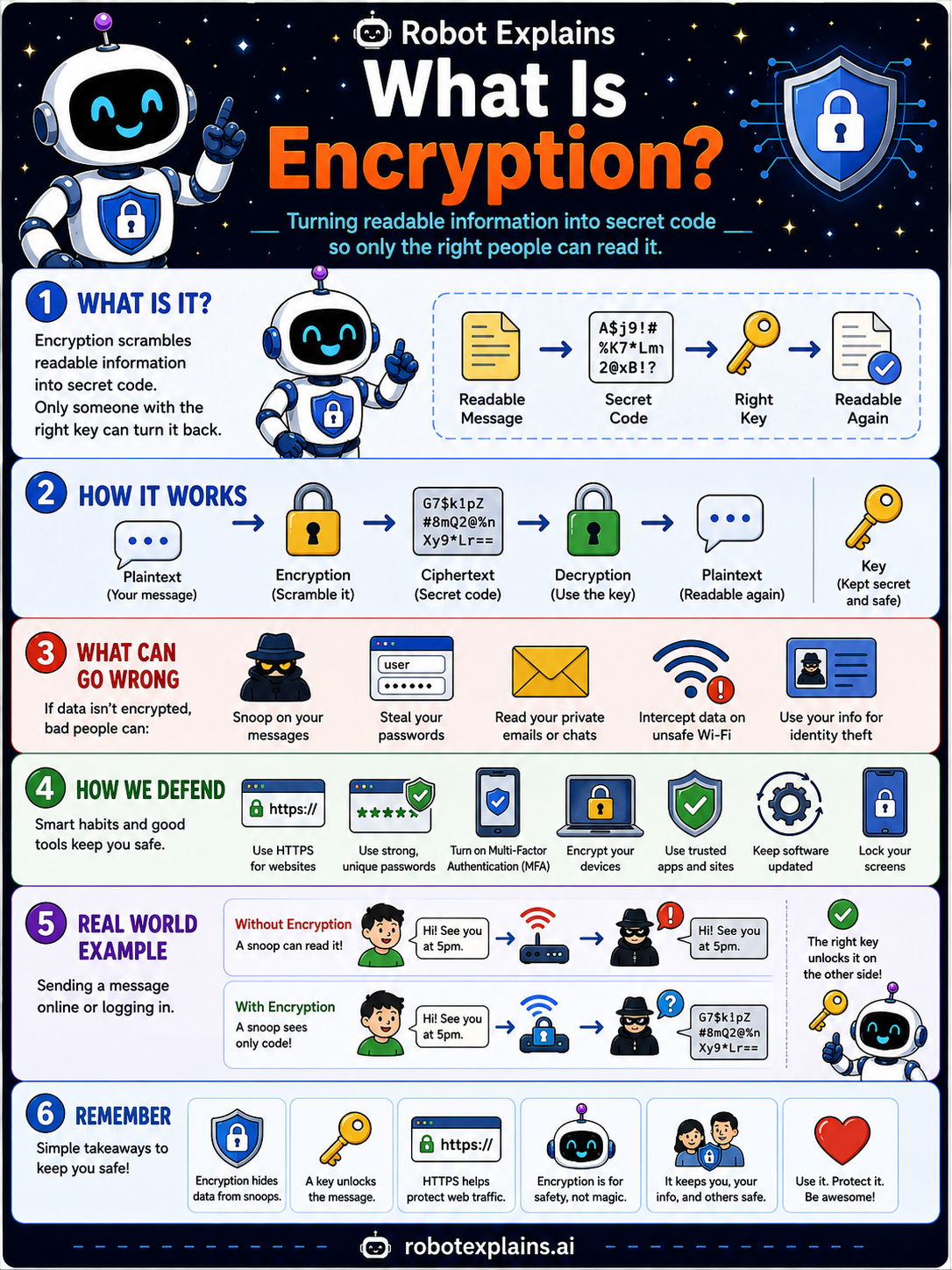
Encryption turns readable information into secret code, so only the right people can read it.
It scrambles a readable message into secret code. Only someone with the right key can turn it back.
Here is how it works. You start with plaintext (your readable message). Encryption scrambles it into ciphertext (the secret code). Decryption uses the key to turn it back into plaintext. The key is kept secret and safe.
Why does it matter? Without encryption, bad actors could snoop on your messages, steal your passwords, read your private emails, intercept data on unsafe Wi-Fi, or use your info for identity theft.
You already rely on it: HTTPS encrypts websites, and you can encrypt your devices, use trusted apps, and lock your screens to stay safe.
Remember: encryption hides data from snoops, a key unlocks the message, HTTPS uses it, and it is for safety, not magic.
What to remember
- Encryption scrambles data so only the right key can read it.
- A key locks and unlocks the message.
- HTTPS uses encryption to protect web traffic.
- It keeps your info safe from snoops.
Words to know
- Encryption
- Scrambling data into secret code.
- Plaintext
- The readable message before encryption.
- Ciphertext
- The scrambled, unreadable version.
- Key
- The secret that locks and unlocks the data.
For grown-ups
Encryption transforms plaintext into ciphertext using a key, so only holders of the right key can recover it. It protects data in transit (HTTPS/TLS) and at rest (disk and device encryption). It is foundational to privacy and security, but only as strong as the surrounding key management and practices.
Want the full story? These go deeper: