A megabyte and a gigabyte both measure storage, but a gigabyte is much bigger. What do the numbers mean?
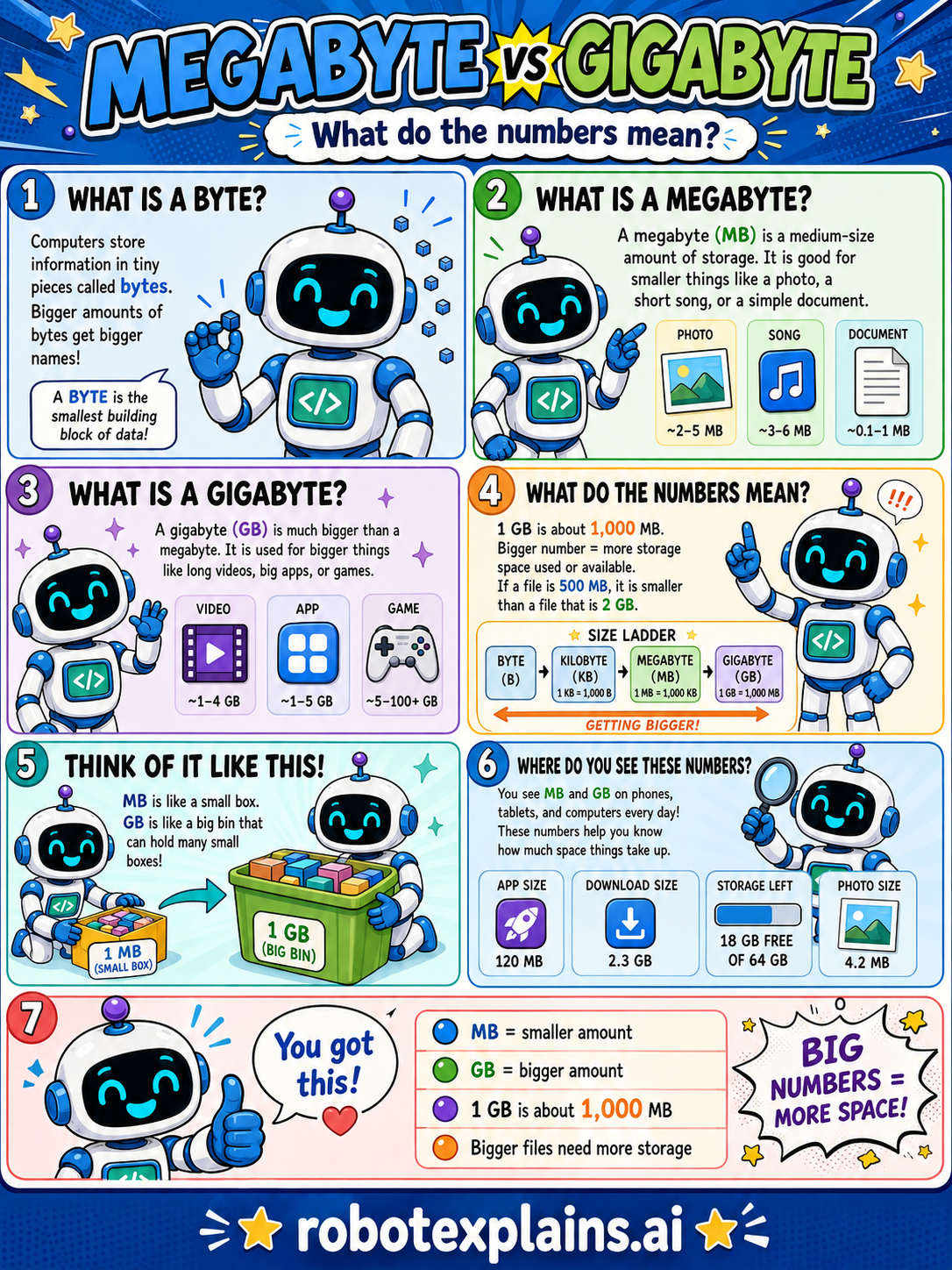
What is a byte? Computers store information in tiny pieces called bytes. Bigger amounts of bytes get bigger names. A byte is the smallest building block of data.
What is a megabyte? A megabyte (MB) is a medium-size amount of storage. It's good for smaller things like a photo (about 2 to 5 MB), a short song (about 3 to 6 MB), or a simple document.
What is a gigabyte? A gigabyte (GB) is much bigger than a megabyte. It's used for bigger things like long videos, big apps, or games (often 5 to 100+ GB).
What do the numbers mean? 1 GB is about 1,000 MB. A bigger number means more storage space used or available. If a file is 500 MB, it's smaller than a file that is 1 GB.
Think of it like this. MB is like a small box. GB is like a big bin that can hold many small boxes. The size ladder gets bigger: byte → kilobyte → megabyte → gigabyte.
Where do you see these numbers? You see MB and GB on phones, tablets, and computers every day, in app sizes, download sizes, storage left, and photo sizes.
Remember: MB = a smaller amount, GB = a bigger amount, 1 GB is about 1,000 MB, and bigger files need more storage. Big numbers = more space!
What to remember
- A megabyte (MB) is a smaller amount of storage.
- A gigabyte (GB) is a bigger amount.
- 1 GB is about 1,000 MB.
- Bigger files need more storage space.
Words to know
- Byte
- The smallest building block of stored data.
- Megabyte (MB)
- A medium amount of storage, good for small files.
- Gigabyte (GB)
- A much bigger amount, about 1,000 MB.
- Storage
- Space a device uses to keep files.
For grown-ups
Both measure digital storage; the difference is scale. A megabyte is roughly a million bytes — fine for a photo, a song, or a document. A gigabyte is about a thousand megabytes — the right unit for videos, apps, and games. The ladder continues (kilobyte → megabyte → gigabyte → terabyte), each step ~1,000×. Practical literacy: app sizes, downloads, and 'storage left' are all read in MB and GB, and bigger numbers mean more space used or needed.
Want the full story? These go deeper: