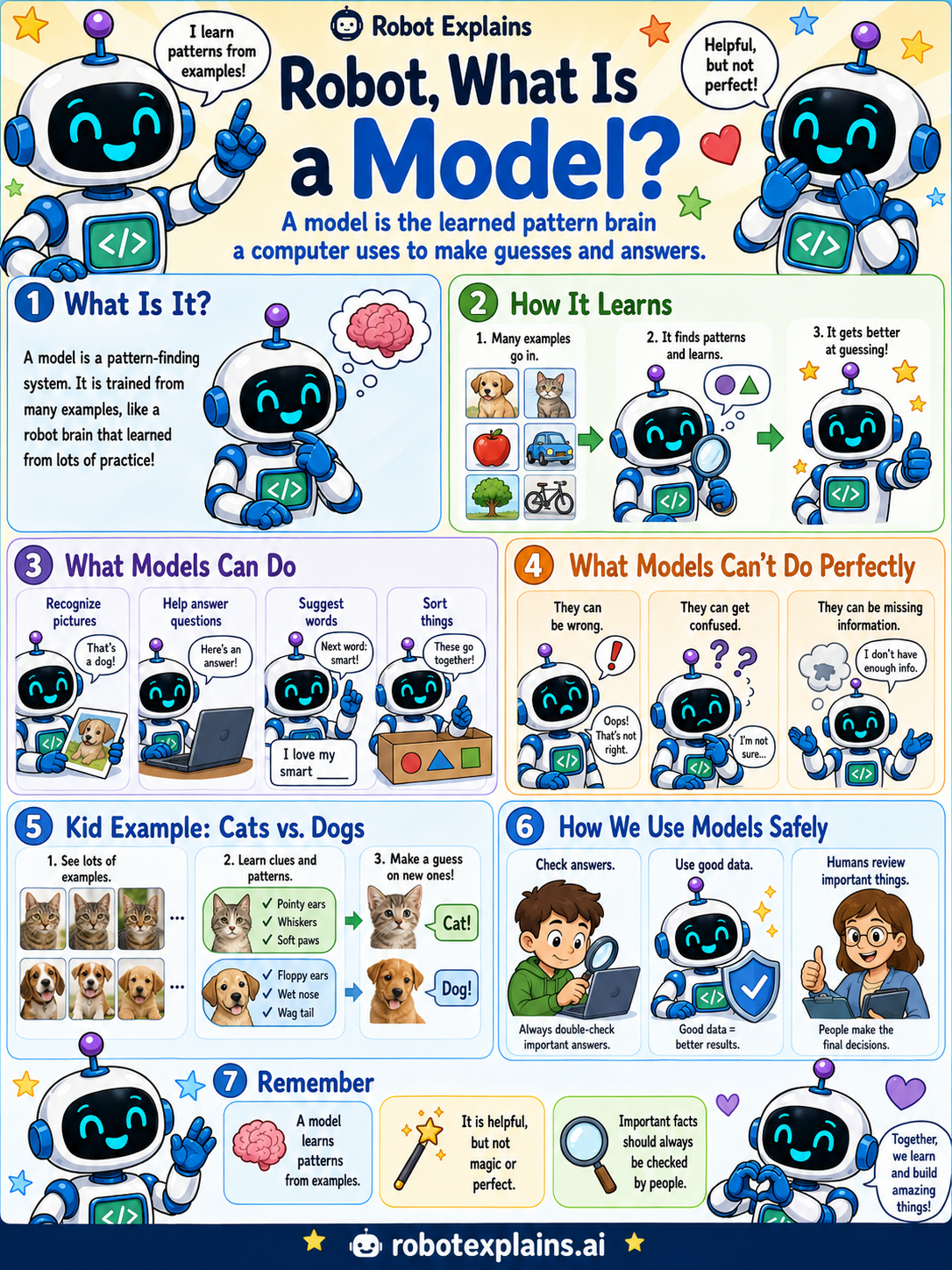
A model is a pattern-finding system. It is trained from many examples, like a robot brain that learned from lots of practice. It is the learned pattern brain a computer uses to make guesses and answers.
How does it learn? Many examples go in, the model finds patterns and learns, and it gets better at guessing.
What can models do? Recognize pictures, help answer questions, suggest words, and sort things into groups.
What can't models do perfectly? They can be wrong, they can get confused, and they can be missing information they were never taught.
Here is a kid example: cats versus dogs. The model sees lots of examples, learns the clues (pointy ears, whiskers, soft paws, or floppy ears, wet nose, wag tail), and then makes a guess on new pictures, "Cat!" or "Dog!"
How do we use models safely? Check the answers, use good data (good data makes better results), and have people review the important decisions.
Remember: a model learns patterns from examples, it is helpful but not magic or perfect, and important facts should always be checked by people.
What to remember
- A model learns patterns from lots of examples.
- It uses those patterns to make guesses and answers.
- Models can be wrong, so double-check important things.
- Good data in means better answers out.
Words to know
- Model
- A pattern-finding system trained from examples.
- Training
- Teaching a model by showing it examples.
- Pattern
- A repeating clue the model learns.
- Prediction
- The model's best guess at an answer.
For grown-ups
A model is the artifact produced by training a machine-learning system on data, a set of learned parameters that map inputs to predictions. Quality depends heavily on the training data ('garbage in, garbage out'), and outputs are probabilistic guesses, not guaranteed facts, so human review matters for important decisions.
Want the full story? These go deeper: