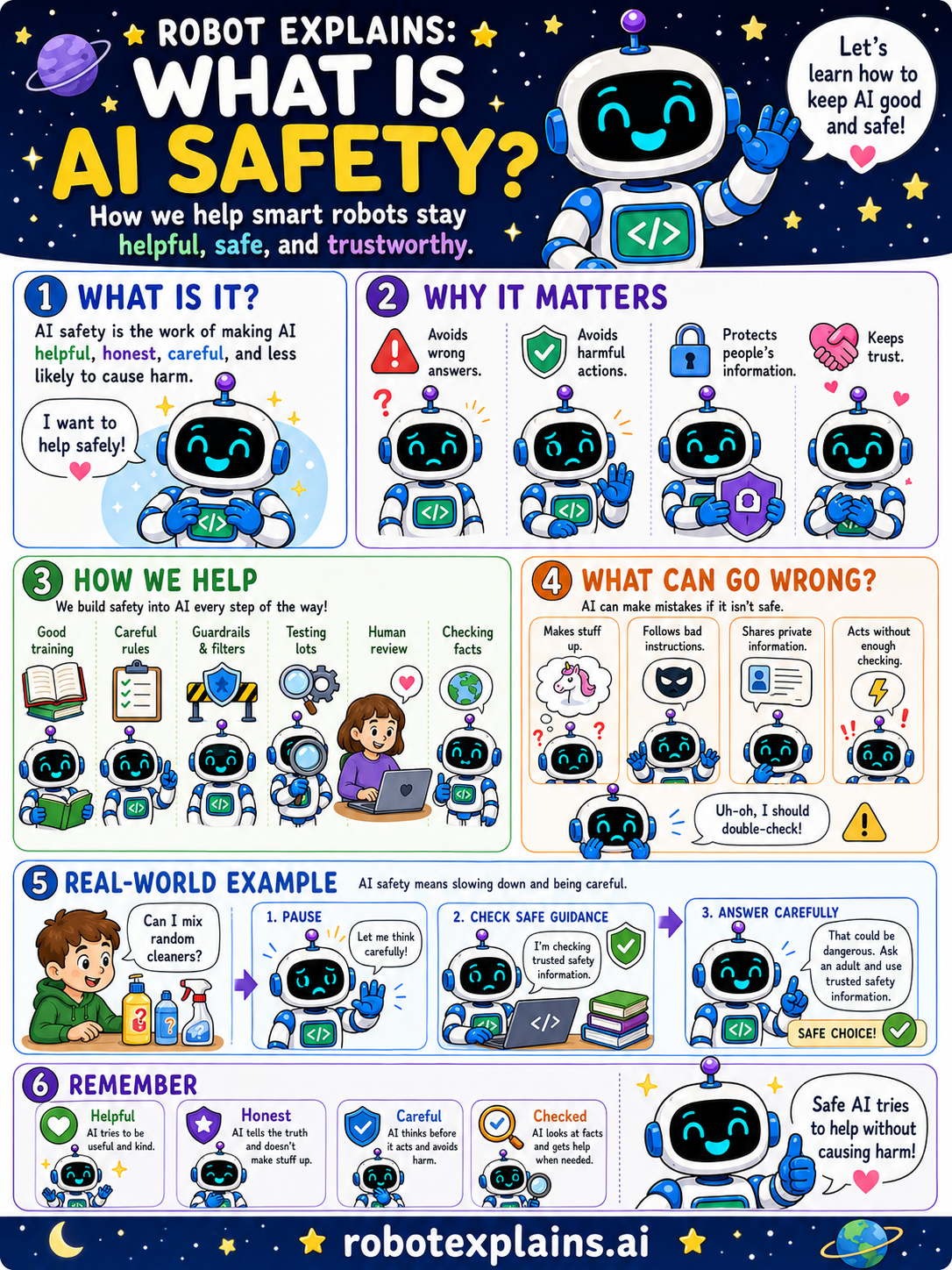
AI is powerful, and like anything powerful, it needs to be used carefully. AI safety is the work of making sure AI stays helpful, honest, and kind.
Why does it matter? Good AI safety helps AI avoid wrong answers, avoid harmful actions, protect people's information, and keep people's trust.
People build safety into every step. They use good training, careful rules called guardrails, lots of testing, human review, and fact-checking.
AI can still make mistakes if we are not careful. It might make things up, follow bad instructions, share things it should not, or act without checking first.
Here is a real example. Imagine you ask an AI to do something risky. A safe AI pauses, checks its safety guidance, and answers carefully, or simply says, "I'm not sure, let's check."
So AI safety is a team effort, between the people who build AI and the AI itself, all working to keep it helpful without causing harm.
What to remember
- AI safety keeps AI helpful, honest, and safe.
- It is built in at every step: training, rules, testing, and review.
- Safe AI checks important facts and admits when it is unsure.
- It is a team effort between people and AI.
Words to know
- AI safety
- The work of making AI helpful and keeping it from causing harm.
- Guardrails
- Rules and filters that keep an AI's answers safe.
- Human review
- People checking an AI's work to keep it on track.
- Trust
- Believing an AI will be helpful and honest.
For grown-ups
AI safety spans alignment (getting models to do what we intend), robustness (resisting misuse and adversarial inputs), and oversight (testing, red-teaming, monitoring, and human review). Frameworks like the NIST AI Risk Management Framework give teams a structured way to identify and reduce these risks across an AI system's whole lifecycle.
Want the full story? These go deeper: