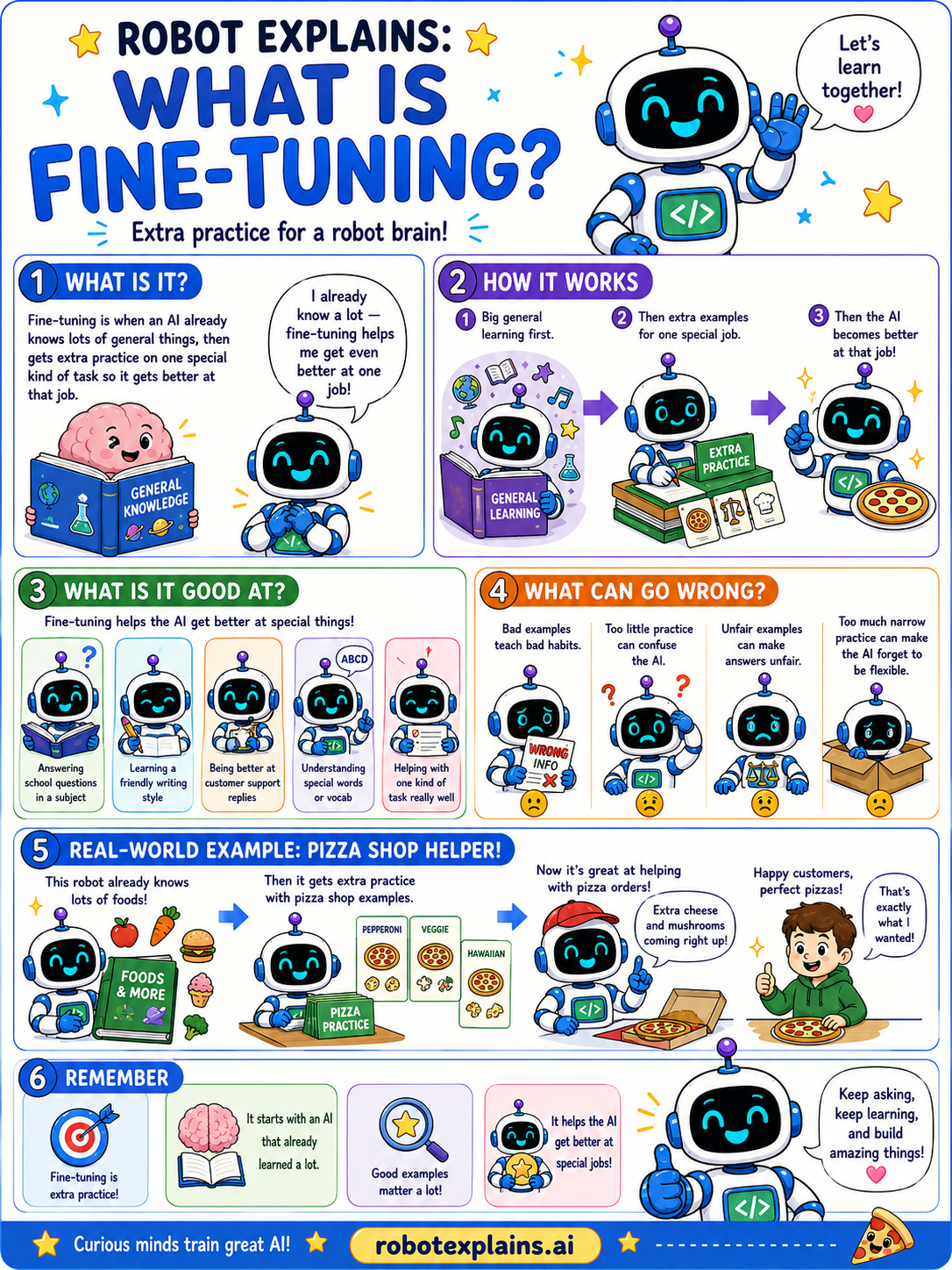
Fine-tuning is when an AI that already knows a lot of general things gets extra practice on one special job, so it gets even better at it.
Think of it in two parts. First, big general learning, where the AI learns about the world. Then, extra practice with examples for one specific task.
For example, an AI already knows about lots of foods. Give it extra practice with pizza-shop examples, and it becomes a great pizza-shop helper.
Fine-tuning helps an AI get better at special things: answering school questions, learning a friendly style, or helping with one kind of task.
It can go wrong, though. Bad examples teach bad habits, too little practice can confuse the AI, and unfair examples make unfair answers.
So, like everything in AI, good examples matter. Fine-tuning turns a smart general helper into an expert at one job.
What to remember
- Fine-tuning is extra practice on one special job.
- It starts with an AI that already learned a lot.
- Good examples make it an expert; bad ones teach bad habits.
- It is how a general AI becomes a specialist.
Words to know
- Fine-tuning
- Extra training to make an AI better at a specific task.
- General learning
- The broad knowledge an AI starts with.
- Example
- One practice item for the special job.
- Specialist
- An AI that is extra good at one thing.
For grown-ups
Fine-tuning adapts a pre-trained model to a narrower task or style using a smaller, curated dataset, adjusting weights so it performs better in that domain. Done well it boosts task accuracy and tone; done poorly it overfits, forgets, or amplifies bias. It is one option alongside prompting and retrieval.
Want the full story? These go deeper: