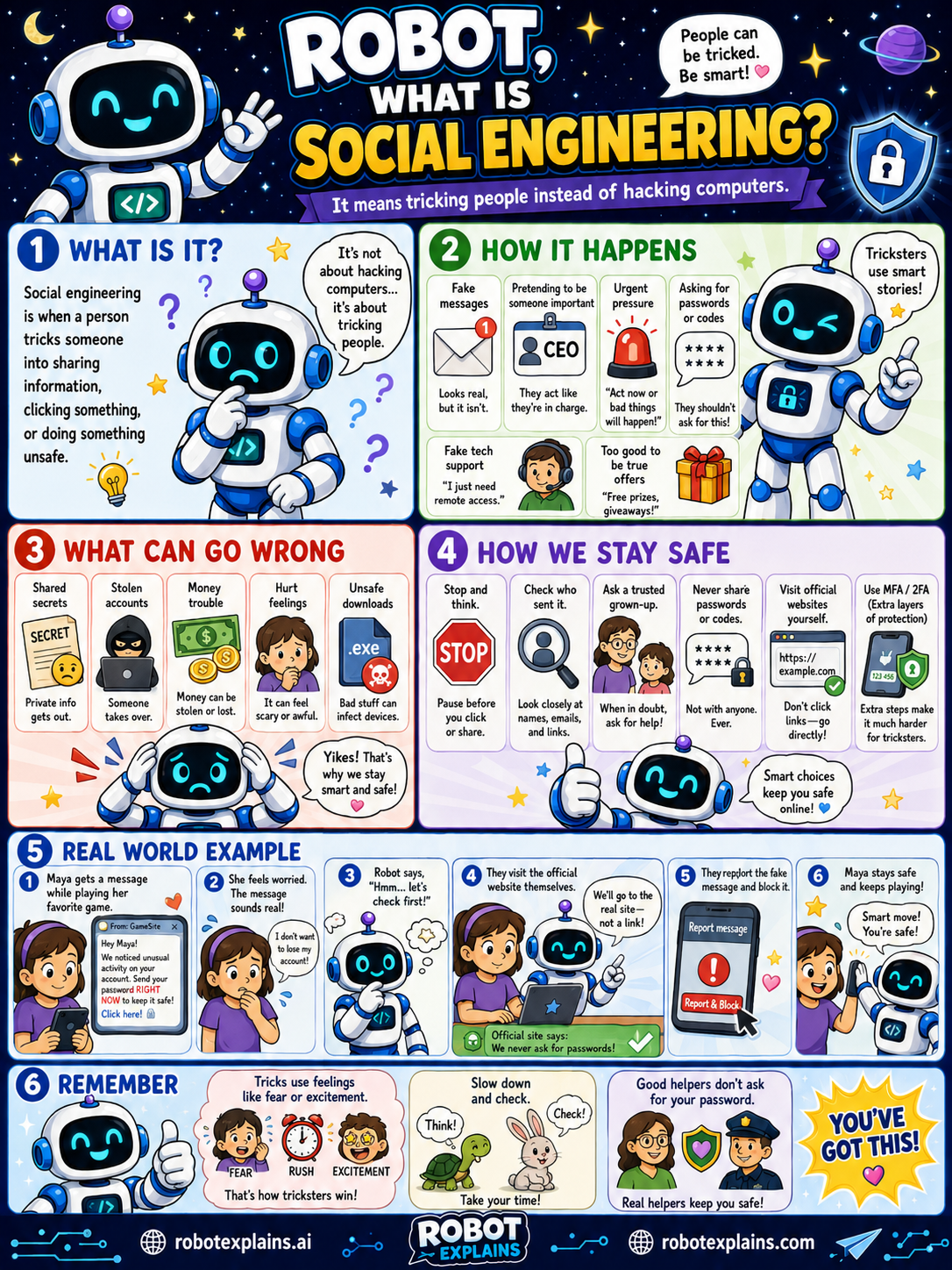
Social engineering is a sneaky trick, but it is not about hacking computers. It is about tricking people.
Instead of breaking into a machine, the trickster fools a person into sharing information, clicking something, or doing something unsafe.
It often works by playing with feelings. The message might be a fake from someone important, an urgent demand to act now, or a request for your password or a code.
If it works, it can lead to shared secrets, stolen accounts, money trouble, or unsafe downloads.
To stay safe: stop and check who really sent it, ask a trusted grown-up, never share passwords or codes, and visit official websites yourself instead of using their link. MFA adds extra protection.
Remember: tricks use feelings like fear, rush, and excitement, so slow down and check. Good helpers never ask for your password.
What to remember
- Social engineering tricks people, not computers.
- Tricks use feelings: fear, rush, or excitement.
- Slow down and check who really sent it.
- Real helpers never ask for your password.
Words to know
- Social engineering
- Tricking a person into doing something unsafe.
- Pretexting
- Pretending to be someone you trust.
- Urgency
- A fake rush meant to stop you thinking.
- Verify
- To check that something is really real.
For grown-ups
Social engineering manipulates people rather than exploiting code, via pretexting, authority, urgency, and fear, to extract secrets or access. It underpins phishing and many breaches. Defenses are human: slow down, verify through known channels, and never share credentials or one-time codes, no matter who appears to be asking.
Want the full story? These go deeper: