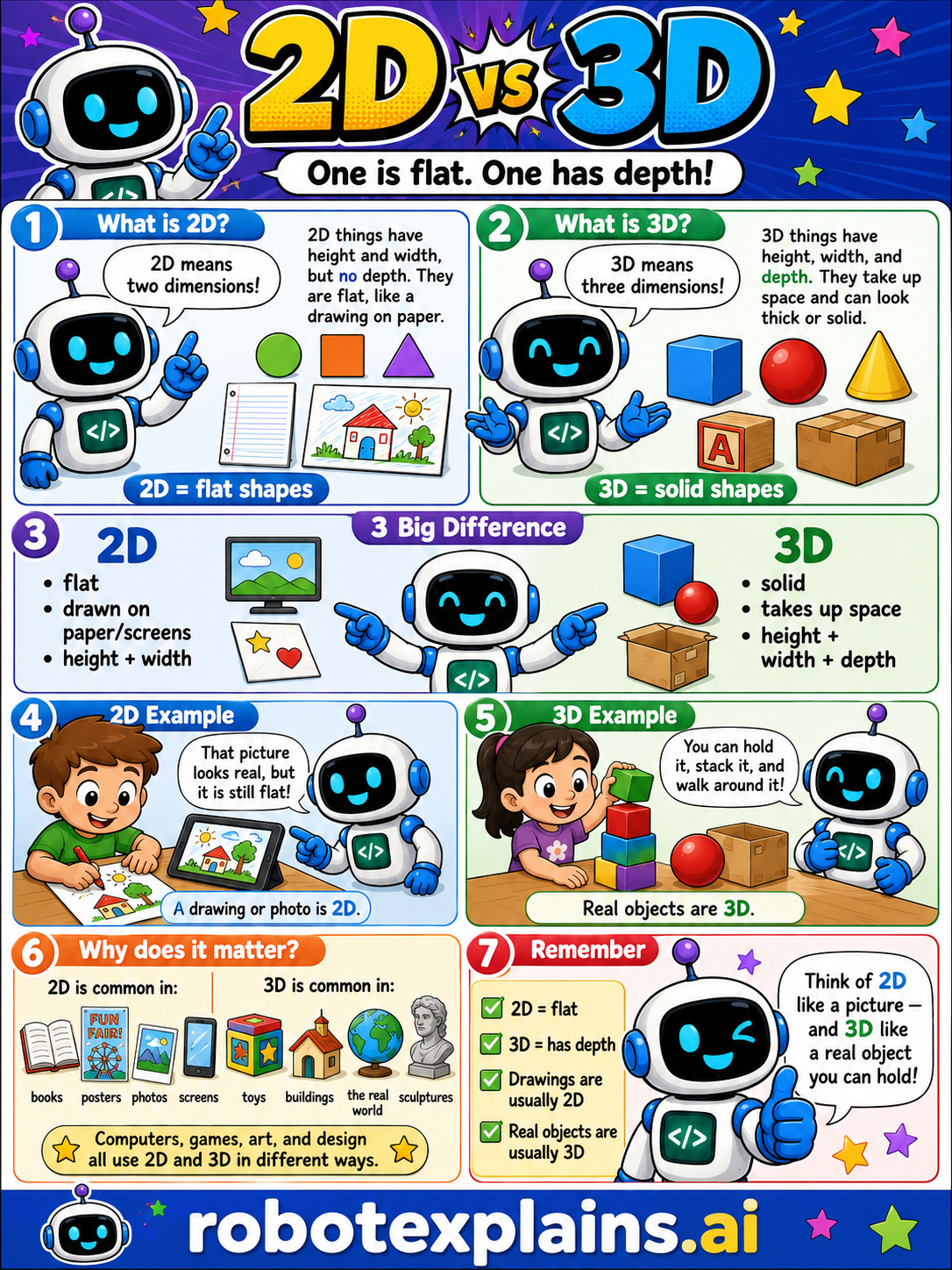
2D is flat. 3D has depth! That's the difference.
What is 2D? 2D means two dimensions. 2D things have height and width, but no depth. They're flat, like a drawing on paper. (2D = flat shapes.)
What is 3D? 3D means three dimensions. 3D things have height, width, and depth. They take up space and can look thick or solid. (3D = solid shapes.)
The big difference. 2D is flat, drawn on paper or screens, with height and width. 3D is solid, takes up space, with height, width, and depth.
2D example. A picture looks real, but it's still flat! A drawing or photo is 2D.
3D example. You can hold it, stack it, and walk around it! Real objects are 3D.
Why does it matter? 2D is common in books, posters, photos, and screens. 3D is common in toys, buildings, the real world, and sculptures. Computers, games, art, and design all use 2D and 3D in different ways.
Remember: 2D = flat, 3D = has depth, drawings are usually 2D, and real objects are usually 3D. Think of 2D like a picture, and 3D like a real object you can hold!
What to remember
- 2D is flat: height and width only.
- 3D has depth: height, width, and depth.
- Drawings and photos are usually 2D.
- Real objects you can hold are usually 3D.
Words to know
- 2D
- Flat, with two dimensions: height and width.
- 3D
- Solid, with three dimensions: height, width, and depth.
- Dimension
- A way to measure size, like height or width.
- Depth
- The third dimension that makes something solid.
For grown-ups
Dimensionality. 2D (two-dimensional) has height and width only — drawings, photos, screens, maps. 3D (three-dimensional) adds depth, so it occupies real space and can be viewed from many sides — sculptures, toys, the physical world, and 3D models in games and printing. Screens are 2D surfaces that can *depict* 3D scenes. The anchor for kids: 2D is a picture; 3D is something you can walk around and hold.
Want the full story? These go deeper: