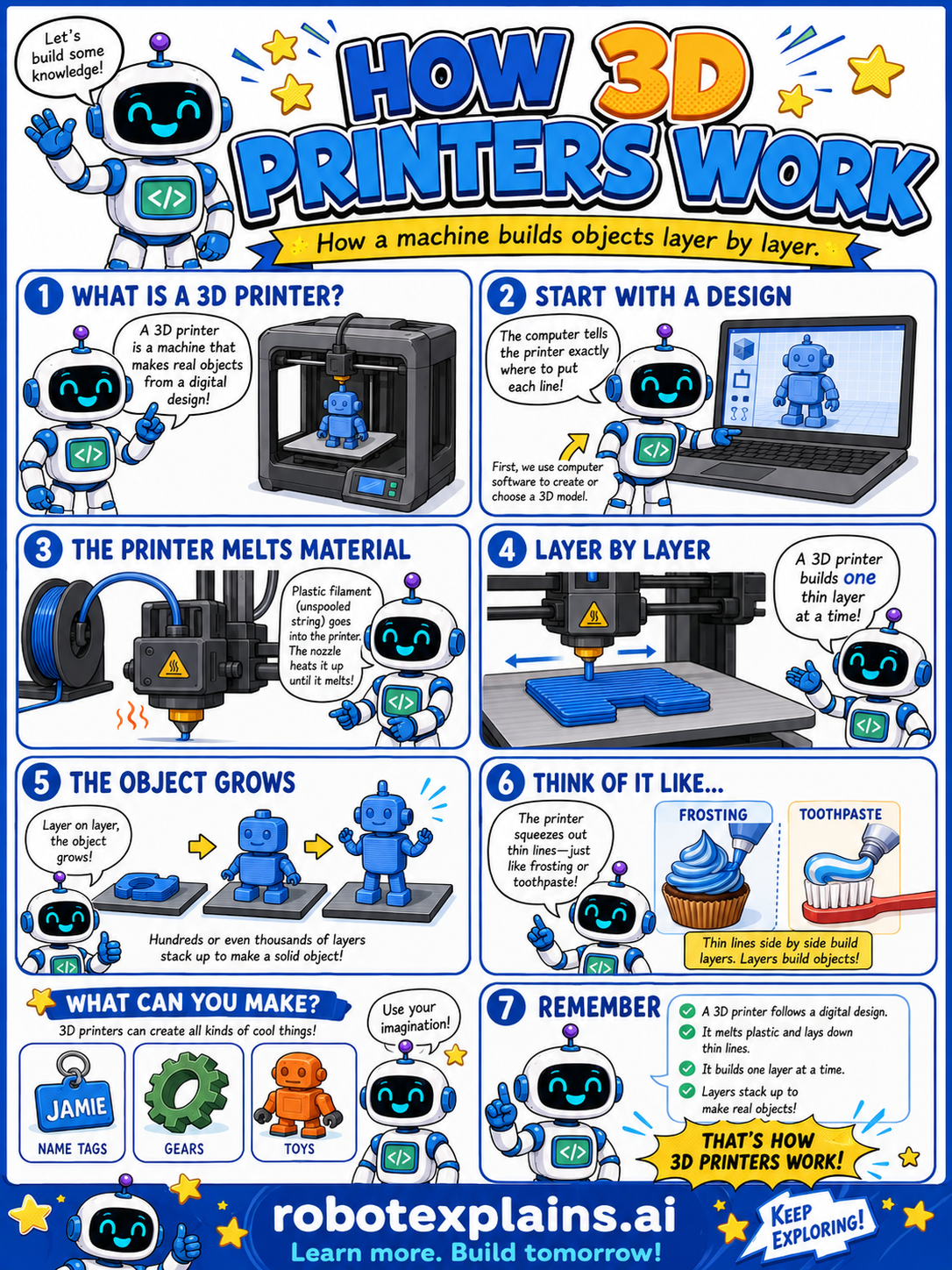
A 3D printer is a machine that builds real objects from a digital design, one thin layer at a time.
Start with a design. First, someone uses computer software to create or choose a 3D model. The computer tells the printer exactly where to put each line.
The printer melts material. Plastic filament (a coiled string) goes into the printer. The nozzle heats it up until it melts.
Layer by layer. The printer builds one thin layer at a time, squeezing out melted material in lines.
The object grows. Layer by layer, the object grows. Hundreds or even thousands of layers stack up to make a solid object!
Think of it like frosting or toothpaste. The printer squeezes out thin lines, just like frosting a cake or a line of toothpaste. Those thin lines, side by side, build up layers and shapes.
What can you make? 3D printers can make all kinds of cool things, like name tags, gears, and toys. Use your imagination!
Remember: a 3D printer follows a digital design, melts material and lays down thin lines, and stacks layers to make real objects. That's how 3D printers work!
What to remember
- A 3D printer follows a digital design.
- It melts material and lays down thin lines.
- It builds one thin layer at a time.
- Layers stack up to make a real object.
Words to know
- 3D printer
- A machine that builds real objects from a design.
- Design
- A digital model that tells the printer what to make.
- Filament
- The plastic string the printer melts.
- Layer
- One thin line of material stacked to build the shape.
For grown-ups
3D printing (additive manufacturing) builds objects layer by layer from a digital 3D model. A common type, FDM, melts plastic filament and extrudes it along paths the software computes, fusing successive thin layers into a solid object. It enables rapid prototyping, custom parts, and hands-on STEM learning. For kids: it's like squeezing frosting or toothpaste in thin lines that stack up into a shape.
Want the full story? These go deeper: