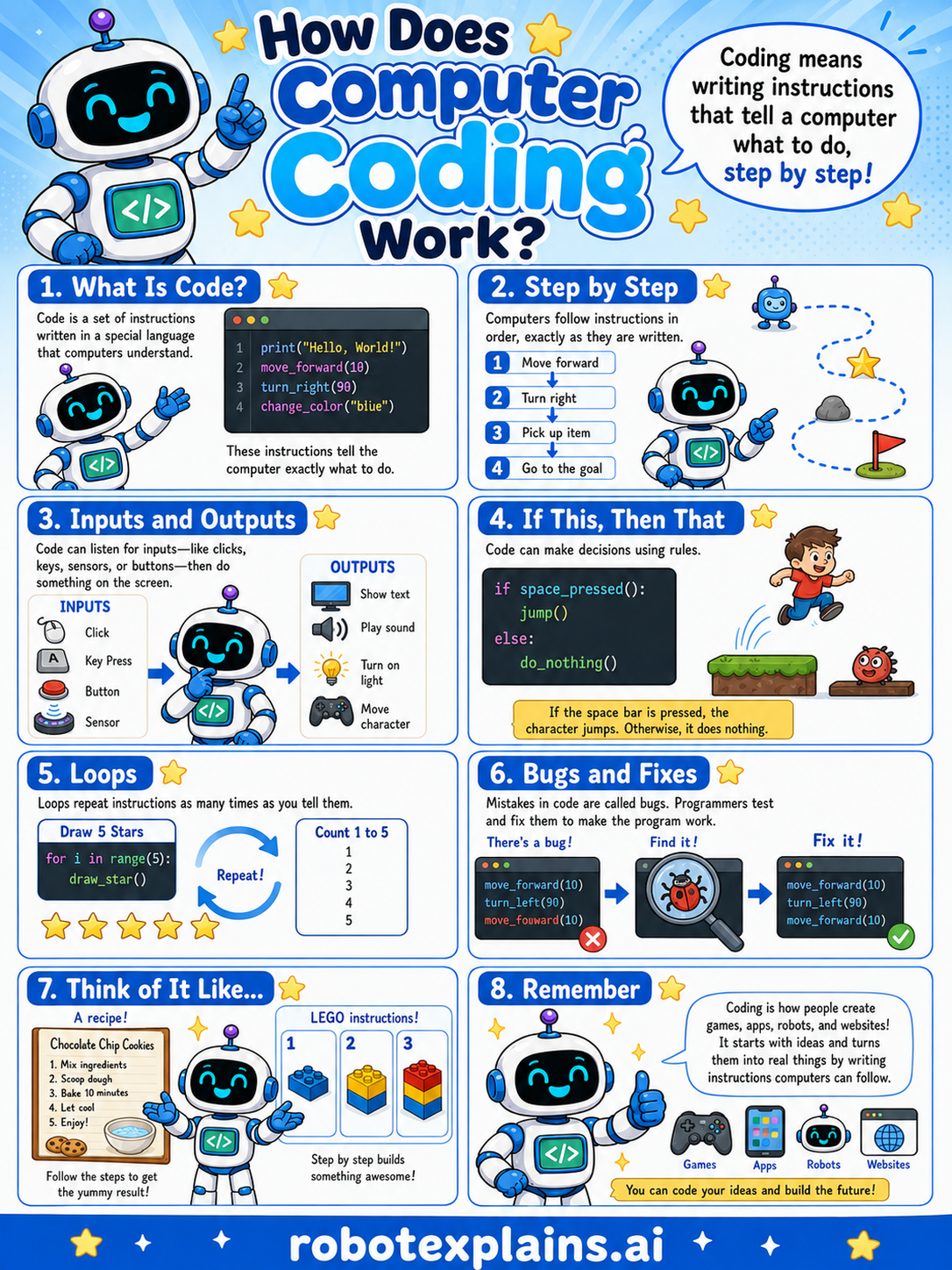
Coding (also called programming) means writing step-by-step instructions that tell a computer exactly what to do.
What is code? Code is a set of instructions written in a special language the computer understands. The computer follows those instructions exactly, one step at a time, in the order you wrote them.
Inputs and outputs. Code can listen for inputs, like a click, a key press, or a button. Then it makes outputs happen, like showing text, playing a sound, or moving a character.
If this, then that. Code can make decisions using rules. For example: if the space bar is pressed, then the character jumps; otherwise, it does nothing.
Loops. A loop repeats instructions as many times as you tell it, so you don't have to write the same thing over and over.
Bugs and fixes. A bug is a mistake in the code. Programmers test their programs to find bugs and then fix them, a little like proofreading a story.
Think of it like a recipe or LEGO instructions: you follow the steps in order, and step by step you build something that works.
Remember: coding is writing instructions step by step, the computer follows them exactly, code uses inputs, loops, and rules, and good programmers test and fix their bugs. You can use your ideas to build the future!
What to remember
- Coding is writing instructions step by step.
- Computers follow the instructions exactly, in order.
- Code uses inputs, loops, and rules like “if this, then that.”
- Programmers test their code and fix the bugs.
Words to know
- Code
- The set of instructions a computer can follow.
- Loop
- Instructions that repeat as many times as you say.
- Bug
- A mistake in the code that needs fixing.
- Program
- A set of code that does a job, like a game or app.
For grown-ups
Programming expresses a task as explicit, ordered instructions in a formal language. The core building blocks are sequence, input/output, conditionals (if/then), and loops. Software is iterative — programmers write, run, test, and debug. The mental model that matters most for kids is that computers do exactly what they are told, in order, which is why clear thinking matters more than memorizing syntax.
Want the full story? These go deeper: