Most of the internet travels as light. Not electricity — actual light, blinking faster than you could ever see, racing down threads of glass. Let's find out how!
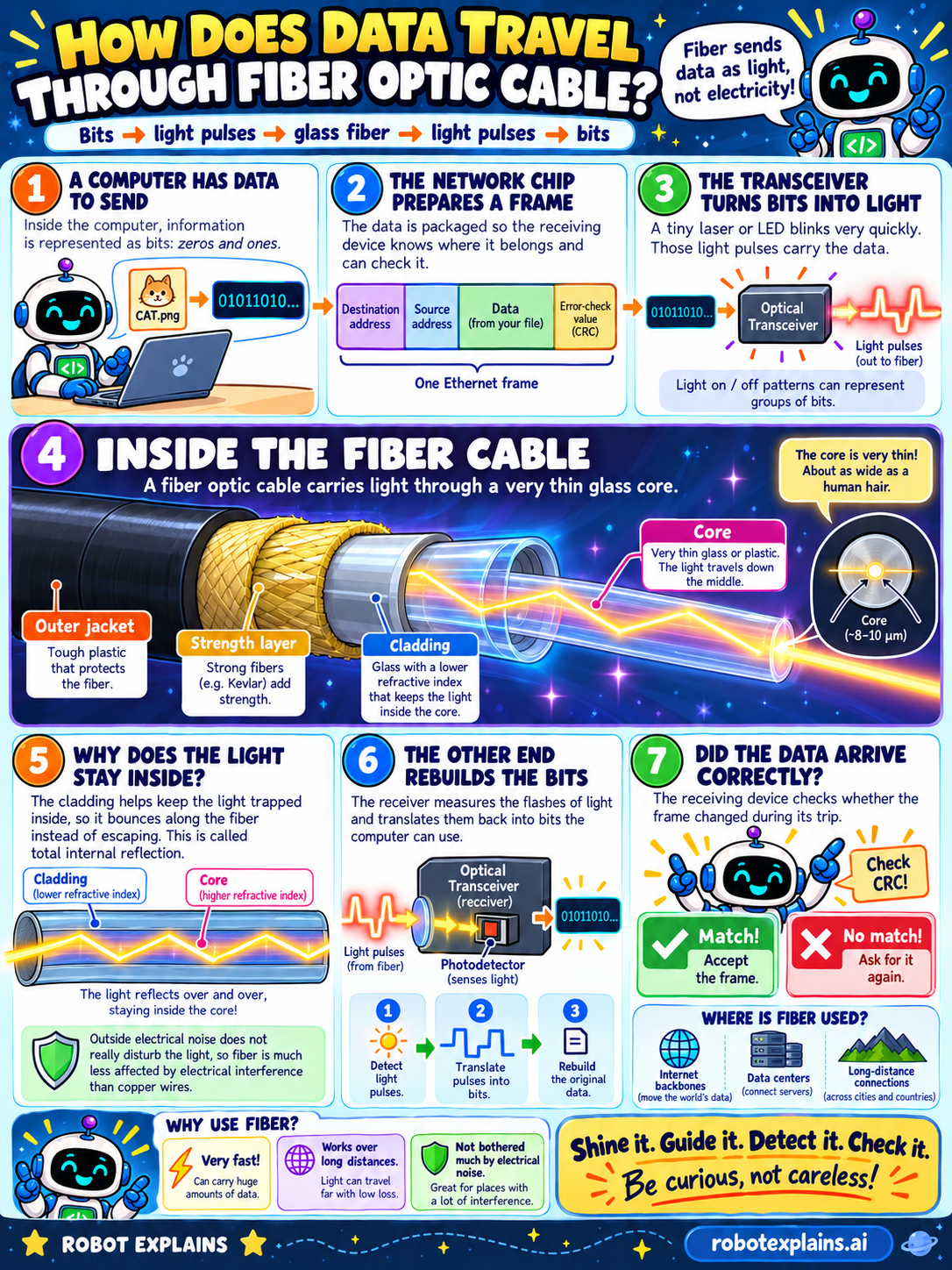
Where does it start? Inside the computer, information is stored as bits — zeros and ones. If Robot wants to send a file like CAT.png, it's really a long string of bits: 01011010…
First, the network chip builds a frame. The data is packaged so the receiving device knows where it belongs and can check it. A frame holds a destination address, a source address, the data, and an error-check value called a CRC — a little fingerprint for catching mistakes.
Next: turning bits into light. An optical transceiver uses a tiny laser or LED that blinks very, very quickly. Those pulses of light carry the data. A light-on / light-off pattern can stand for groups of bits — so flashing light becomes a message.
Now, inside the fiber cable. A fiber optic cable is built in layers: a tough outer jacket to protect it, a strength layer (often strong fibers like Kevlar), cladding (a glass layer), and at the very center a core of thin glass. The core is incredibly thin — about as wide as a single human hair! The light travels straight down that middle.
Why doesn't the light leak out? Here's the clever part. The cladding is made so light reflects off the boundary instead of escaping, so the light keeps bouncing along the core all the way to the other end. Scientists call this total internal reflection. And because the signal is light, not electricity, outside electrical noise barely disturbs it — so fiber is much calmer than copper wires in noisy places.
The other end rebuilds the bits. A photodetector at the receiving transceiver senses the flashes of light. It detects the pulses, translates them back into zeros and ones, and rebuilds the original data: 01011010…
Last step: did the data arrive correctly? The receiving device checks the CRC. If it matches, the frame is accepted. If it doesn't match, the device can ask for it again. Where is all this fiber? In internet backbones that move the world's data, inside data centers connecting servers, and in long-distance connections across cities and countries.
What should we remember? Shine it, guide it, detect it, check it. Fiber turns bits into pulses of light, guides them down a hair-thin glass core by bouncing, reads them back into bits, and checks a CRC. Be curious, not careless!
What to remember
- Fiber sends data as flashes of light instead of electricity.
- A tiny laser or LED blinks the bits into pulses of light.
- The light travels down a glass core as thin as a human hair.
- Total internal reflection keeps the light bouncing inside the core.
- Fiber is fast, works over long distances, and ignores electrical noise.
Words to know
- Fiber optic cable
- A cable that carries data as light through thin glass.
- Transceiver
- A device that turns bits into light and light back into bits.
- Core
- The thin glass center the light actually travels down.
- Cladding
- A glass layer around the core that keeps the light trapped inside.
- Total internal reflection
- When light keeps bouncing inside the core instead of escaping.
For grown-ups
Fiber optic cable transmits data as pulses of light rather than electrical signals. The payload is framed with addresses and a CRC just like Ethernet, then an optical transceiver (a laser or LED) modulates the bits into light. The light travels down a very thin glass core — single-mode cores are roughly 8–10 microns, about the width of a human hair — surrounded by cladding with a lower refractive index. That index difference causes total internal reflection, so the light bounces along the core with very low loss instead of leaking out. Because the signal is light, fiber is immune to electromagnetic interference and can carry enormous bandwidth over long distances, which is why it's used for internet backbones, data-center links, and long-haul connections. At the far end a photodetector senses the flashes, decodes them back to bits, and the CRC is checked.
Want the full story? These go deeper: