Online ads are messages on apps and websites, let's see what happens when you click!
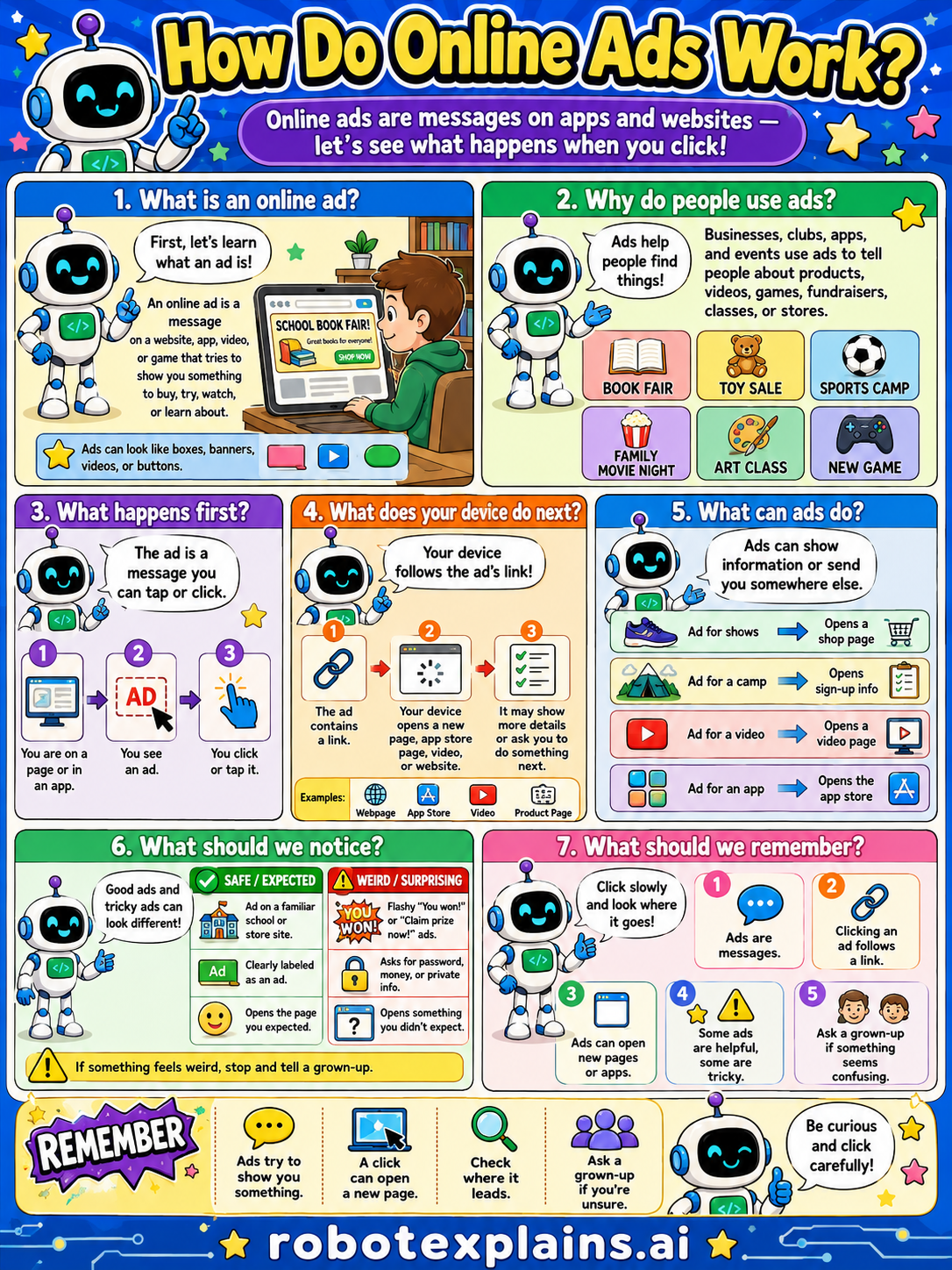
What is an online ad? First, let's learn what an ad is. An online ad is a message on a website, app, video, or game that tries to show you something to buy, try, watch, or learn about. Ads can look like boxes, banners, videos, or buttons.
Why do people use them? Ads help people find things! Businesses, clubs, apps, and events use ads to tell people about products, videos, games, fundraisers, classes, or stores, like a book fair, toy sale, sports camp, family movie night, art class, or a new game.
What happens first? The ad is a message you can tap or click. You are on a page or in an app, you see an ad, and you click it.
What does your device do next? Your device follows the ad's link. The ad opens a new page, app, store, page, video, or website. It may show more details or do something.
What can ads do? They can show you information or send you somewhere else, an ad opens a shop page, a sign-up page, a video page, or the app store.
What should we notice? Good ads and tricky ads can look different. Safe and expected: a familiar store, an ad clearly labeled, an ad you expected. Weird and surprising: a flashy "you won! claim now!" ad, asking for money or private info, a download you didn't expect. If something feels weird, stop and tell a grown-up.
What should we remember? Ads are messages, clicking an ad follows a link, ads can open new pages or apps, some ads are helpful and some are tricky, and if something seems confusing, ask a grown-up. Be curious and click carefully!
What to remember
- Ads are messages that want you to do something.
- Businesses use ads to reach people.
- Clicking an ad sends your device to follow its link.
- Most are normal, but check where it leads.
Words to know
- Advertisement
- A message that wants you to buy or try something.
- Link
- The address an ad sends your device to.
- Pop-up
- An ad that suddenly appears.
- Business
- A company that pays to show ads.
For grown-ups
Online ads are paid placements served into pages and apps, usually linking to a destination (a product page, sign-up, app store, or video). They're targeted and monetized, and most are legitimate, but the same click-to-go mechanism is what malvertising and scams exploit. Teaching how an ad actually works (a clickable message that sends you somewhere) sets up the judgment taught in the safety pair.
Want the full story? These go deeper: