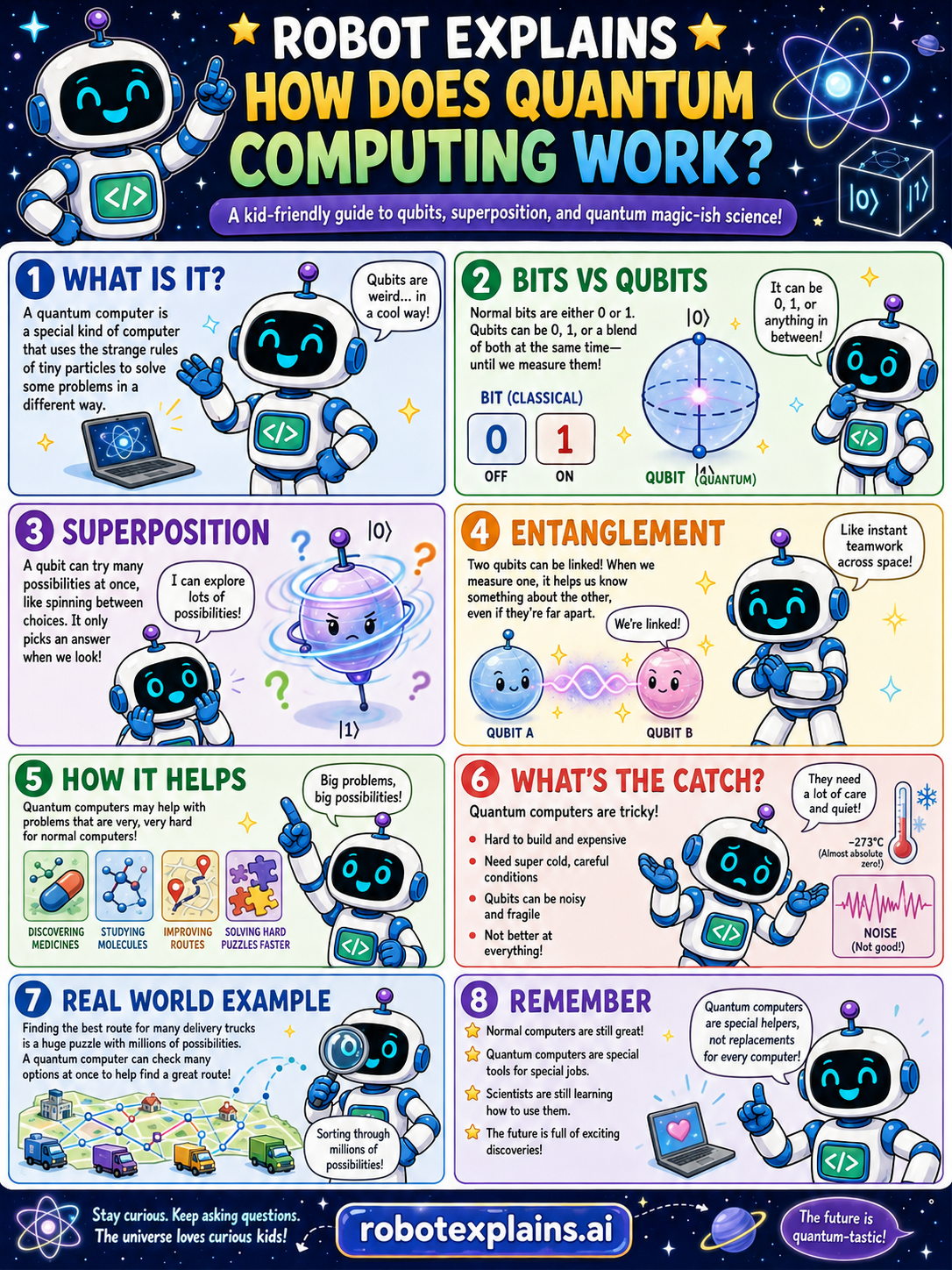
A quantum computer is a special kind of computer that uses the strange rules of tiny particles to solve some problems in a different way. Qubits are weird, in a cool way!
Bits vs Qubits: normal bits are either 0 or 1. A qubit can be 0, 1, or a blend of both at the same time, until we measure it.
Superposition: a qubit can try many possibilities at once, like spinning between choices. It only picks an answer when we look.
Entanglement: two qubits can be linked. When we measure one, it helps us know something about the other, even if they're far apart, like instant teamwork across space.
How does it help? Quantum computers may help with problems that are very, very hard for normal computers, like discovering medicines, studying molecules, improving routes, and solving hard puzzles faster.
What's the catch? Quantum computers are tricky. They're hard to build and expensive, need super-cold and careful conditions, can be noisy and fragile, and aren't better at everything. They need a lot of care and quiet.
Here is a real example. Finding the best route for many delivery trucks is a huge puzzle with millions of possibilities. A quantum computer can check many options at once to help find a great route.
Remember: normal computers are still great, quantum computers are special tools for special jobs, scientists are still learning how to use them, and the future is full of exciting discoveries.
What to remember
- Normal computers are still great for everyday jobs.
- Quantum computers use qubits that can be 0, 1, or a blend.
- They're special tools for special, very hard problems.
- Scientists are still learning how to use them.
Words to know
- Quantum computer
- A computer that uses the rules of tiny particles.
- Qubit
- A quantum bit that can be 0, 1, or a blend.
- Superposition
- Being in many states at once until measured.
- Entanglement
- Linked qubits that share information.
For grown-ups
Quantum computers use qubits, which can exist in superpositions of 0 and 1 and become entangled, to explore many possibilities at once for specific problems (simulation, optimization, factoring). They're fragile, error-prone, and need extreme cooling; they complement, not replace, classical computers.
Want the full story? These go deeper: