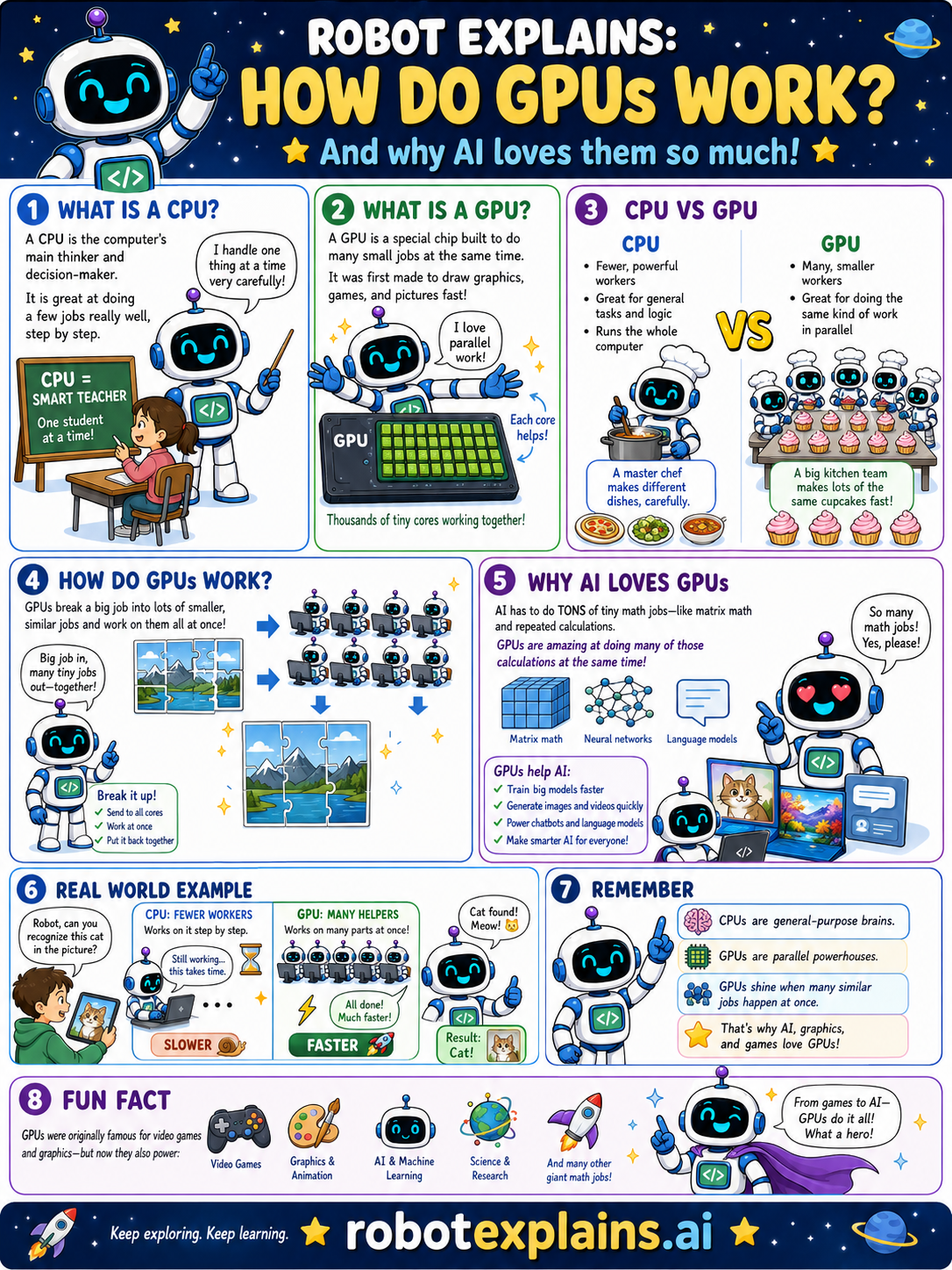
First, meet the CPU: the computer's main thinker and decision-maker. It's great at doing a few jobs really well, step by step, like a smart teacher helping one student at a time.
A GPU is a special chip built to do many small jobs at the same time. It was first made to draw graphics, games, and pictures fast, and it has thousands of tiny cores working together.
CPU vs GPU: a CPU has fewer, powerful workers and is great for general tasks and running the whole computer, like a master chef carefully making different dishes. A GPU has many smaller workers great for doing the same kind of work in parallel, like a big kitchen team making lots of the same cupcakes fast.
How do GPUs work? They break a big job into lots of smaller, similar jobs and work on them all at once, break it up, work on the pieces together, then put it back together.
Why does AI love GPUs? AI has to do tons of tiny math jobs, and GPUs are amazing at doing many of those calculations at the same time. GPUs help AI train big models faster, generate images and videos quickly, power chatbots and language models, and make smarter AI for everyone.
Remember: CPUs are general-purpose tools, GPUs are parallel powerhouses, GPUs shine when many similar jobs happen at once, and that's why AI, graphics, and games love GPUs.
What to remember
- A CPU has a few powerful workers for general jobs.
- A GPU has many small workers doing similar jobs at once.
- GPUs shine when lots of similar jobs run in parallel.
- That's why AI, graphics, and games love GPUs.
Words to know
- GPU
- Graphics Processing Unit: many small parallel workers.
- CPU
- The main thinker, a few powerful workers.
- Core
- One worker inside a chip.
- Parallel
- Doing many jobs at the same time.
For grown-ups
A GPU (graphics processing unit) has thousands of small cores that perform many calculations in parallel, originally for rendering graphics, now ideal for the massively parallel matrix math behind AI training and inference. A CPU has fewer, more powerful cores tuned for general, sequential tasks.
Want the full story? These go deeper: