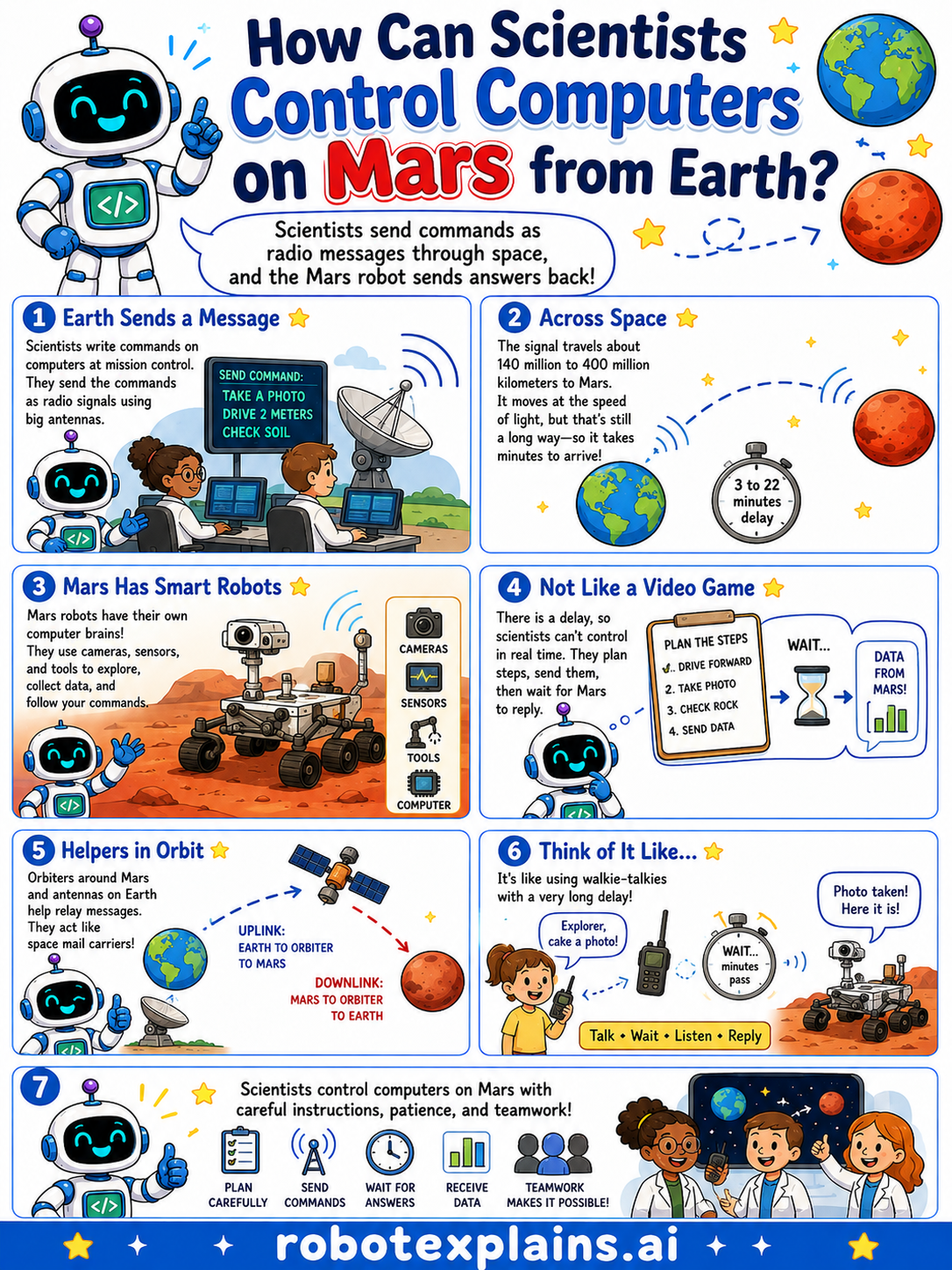
Scientists control robots on Mars by sending commands as radio messages through space, and the Mars robot sends answers back!
Earth sends a message. Scientists write commands on computers at mission control. They send the commands as radio signals using big antennas.
Across space. The signal travels millions of kilometers to Mars. It moves at the speed of light, but that's still a long way, so it takes minutes to arrive.
Mars has smart robots. Mars robots have their own computer brains. They use cameras, sensors, and tools to explore, collect data, and follow the commands.
Not like a video game. Because of the delay, scientists can't steer in real time. They plan the steps, send them, and then wait for Mars to reply. It's like using walkie-talkies with a very long delay.
Helpers in orbit. Spacecraft orbiting Mars help relay messages between the rover and Earth, like space mail carriers.
Remember: scientists control computers on Mars with careful instructions, patience, and teamwork. Plan, send, wait, receive, repeat, teamwork makes it possible!
What to remember
- Commands travel to Mars as radio messages through space.
- The signal takes several minutes to arrive, even at light speed.
- Mars robots are smart and follow plans on their own.
- It takes careful planning, patience, and teamwork.
Words to know
- Signal
- A message sent as radio waves through space.
- Radio waves
- Invisible waves that carry information very fast.
- Delay
- The wait while a signal travels a long way.
- Rover
- A robot that drives and explores on another world.
For grown-ups
Mars missions are commanded by radio from Earth via large antennas (the Deep Space Network), often relayed through orbiters. Even at the speed of light, one-way travel time ranges from a few minutes to over twenty depending on planetary distance, so real-time joysticking is impossible. Rovers run stored command sequences and onboard autonomy, then downlink data. The lesson for kids: distance means delay, so the robots must be smart and the people must plan carefully.
Want the full story? These go deeper: