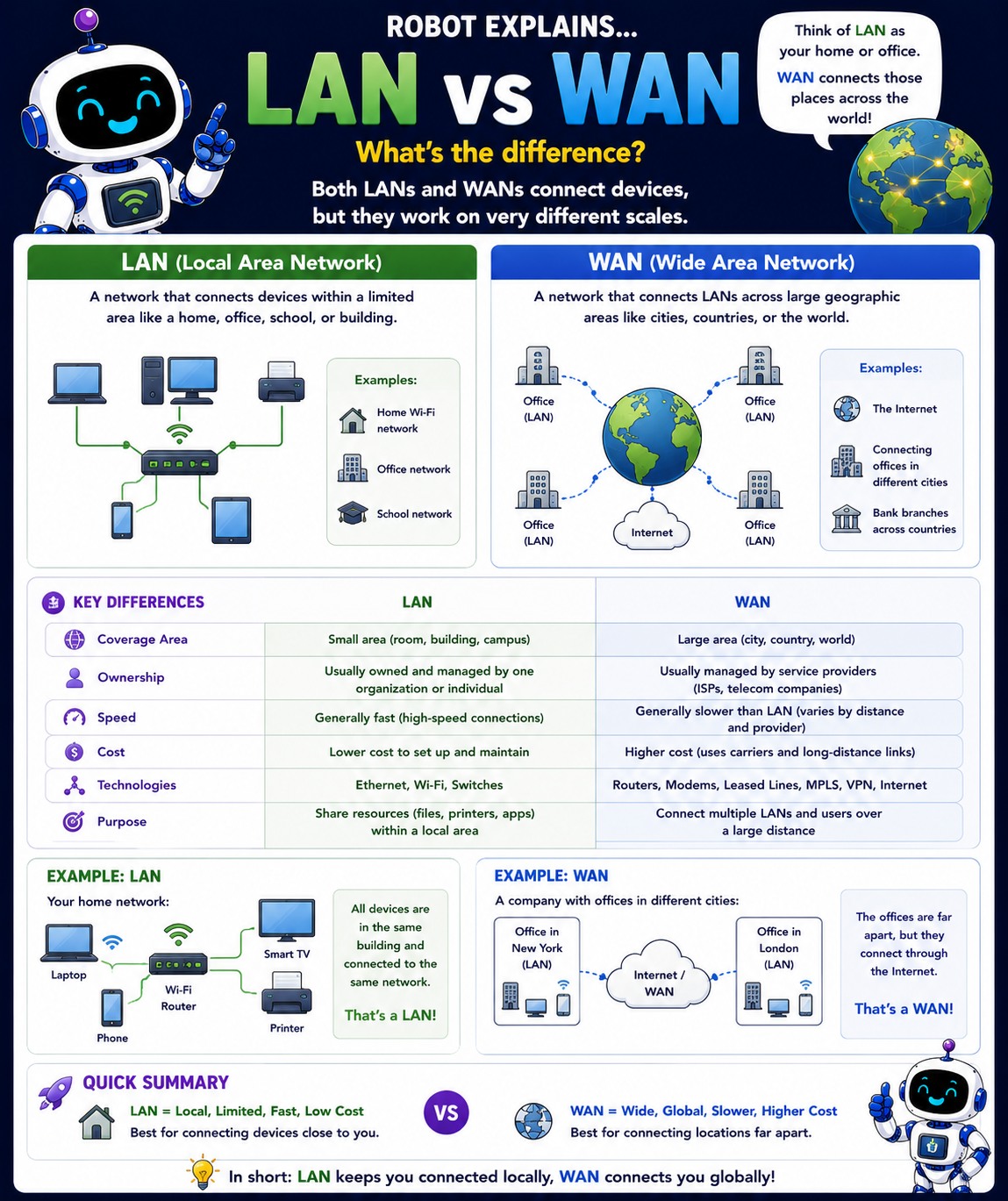
LANs and WANs both connect devices, but they work at very different scales. Think of a LAN as your home or office, and a WAN as what connects those places across the world.
LAN (Local Area Network): a network that connects devices within a limited area, like a home, office, school, or building. Examples include your home Wi-Fi, an office network, and a school network.
WAN (Wide Area Network): a network that connects LANs across large geographic areas, like cities, countries, or the whole world. Examples include the internet, connecting offices in different cities, and bank branches across countries.
Key differences:
- Coverage: LAN is a small area; WAN is a large area (city, country, world).
- Ownership: a LAN is usually owned by one person or organization; a WAN is usually managed by service providers (ISPs, telecom companies).
- Speed: LANs are generally fast; WANs are generally slower and vary by distance.
- Cost: LANs cost less to set up and maintain; WANs cost more.
- Technologies: LANs use Ethernet, Wi-Fi, and switches; WANs use routers, modems, leased lines, and VPNs.
- Purpose: a LAN shares resources locally; a WAN connects multiple LANs and users over distance.
Examples: your home network, where all devices are in the same building, is a LAN. A company with offices in different cities, connected through the internet, is using a WAN.
Remember: LAN means local, limited, fast, and low cost; WAN means wide, global, slower, and higher cost. A LAN keeps you connected locally, and a WAN connects you globally.
What to remember
- A LAN connects devices in one place (home, office, school).
- A WAN connects networks across cities, countries, the world.
- LANs are usually faster and lower cost.
- The internet is the biggest WAN of all.
Words to know
- LAN
- Local Area Network, devices in one place.
- WAN
- Wide Area Network, networks across distances.
- Network
- Devices connected so they can share.
- ISP
- The provider that helps run a WAN link.
For grown-ups
A LAN connects devices within a limited area (home, office, campus), typically owned/managed by one party, and is fast and low-cost (Ethernet/Wi-Fi). A WAN links LANs across large distances (cities to global), usually via service providers, and is slower and costlier. The internet is the largest WAN.
Want the full story? These go deeper: