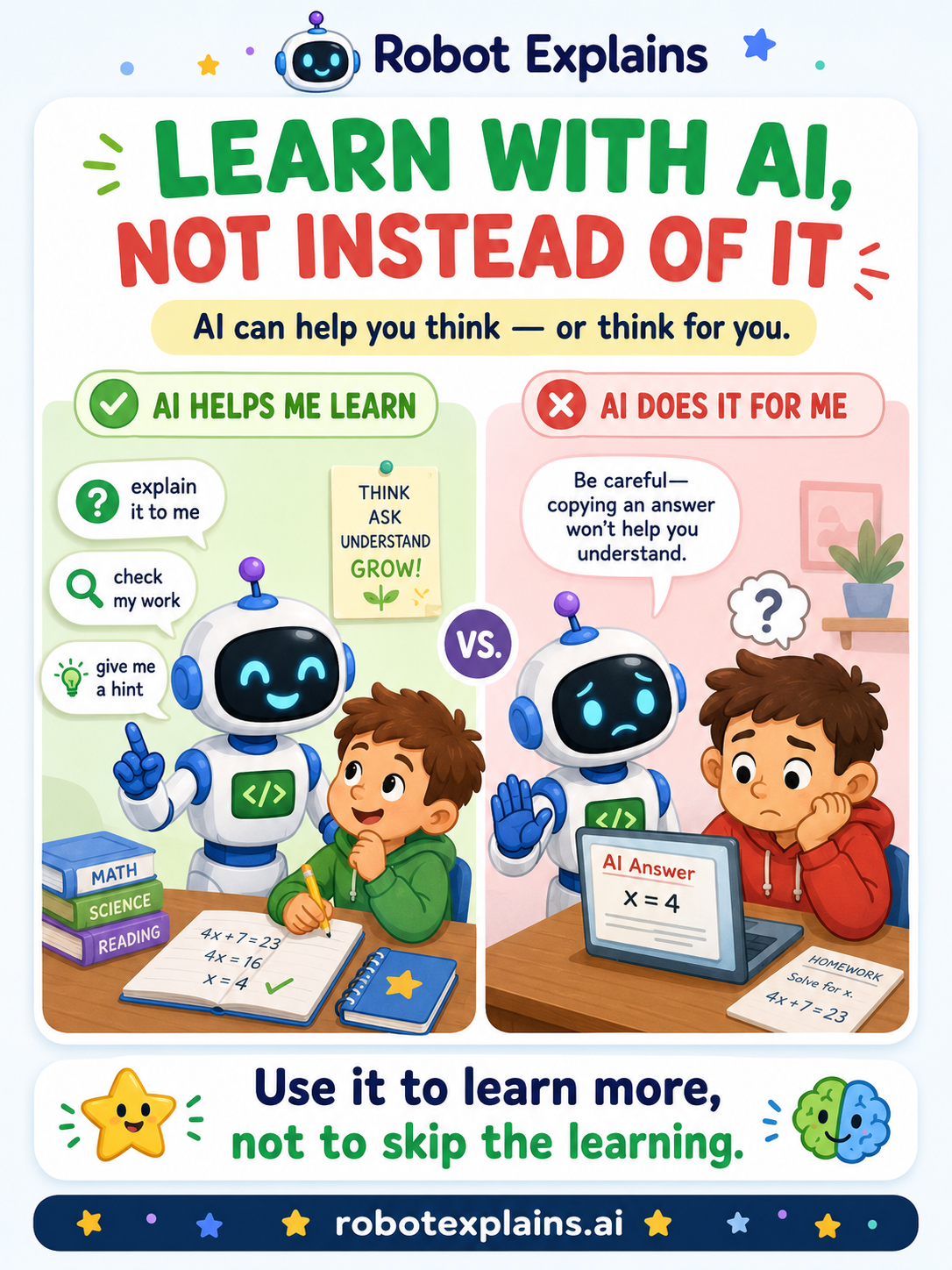
AI can be an amazing study buddy. It can explain a hard idea three different ways, give you a hint when you're stuck, and check your work at midnight. But it can also just… hand you the answer. So here's the big question: are you using AI to learn, or to skip learning?
Two very different uses. Same tool, opposite results:
- Learn with AI 🟢: "Explain this like I'm 10." "Give me a hint, not the answer." "Check my work and tell me why it's wrong." "Quiz me." You end up understanding more.
- Skip the learning 🔴: "Just write it for me." Copy, paste, done. You end up with an answer you couldn't explain and a skill you don't have yet.
The honesty test. After AI helps, ask yourself: could I explain this to a friend, or do it again on my own? If yes, you learned it. If no, you borrowed it — and borrowed skills disappear right when you need them, like on a test.
Why it matters. School isn't really about the answer — it's about your brain getting stronger. Every time you let AI do the thinking, your brain skips its workout. Using AI for hints and checks is like a coach; using it to copy is like having someone else run your race.
A good rule. Use AI to understand, not to copy — and always follow your teacher's rules about when AI is okay. When you're not sure, ask.
Remember: AI can think with you or for you — you choose. If you couldn't explain it, you didn't learn it yet. Be curious, not careless!
What changed?
Every tap changes something. The trick isn't fear — it's noticing. After you say “yes,” ask: what just changed?
- Asked AI to explain or check your workyou understand it better — you still learned it
- Copied an AI answer without reading ityou skipped the learning; you can't do it on your own yet
- Used AI for a hint, then finished it yourselfyou got unstuck AND kept the skill
What to remember
- AI can help you think, or think for you.
- Use it to understand — not to copy.
- If you couldn't explain it, you didn't learn it.
- When in doubt, ask your teacher what's okay.
Explain it back
You understand something best when you can teach it. Finish these out loud — to a friend, a grown-up, a little brother or sister, or even the mirror:
- Using AI to learn looks like…
- Using AI to skip learning looks like…
- One way I can use AI to understand something better is…
Words to know
- AI helper
- A chatbot that can explain, hint, or check your work.
- Shortcut
- Skipping a step — sometimes fine, sometimes it skips the learning.
- Understand
- Being able to explain it in your own words.
- Academic honesty
- Doing your own thinking and being honest about your work.
For grown-ups
The healthiest frame for kids isn't "never use AI" or "use it for everything" — it's using AI to deepen learning rather than bypass it. Good uses: explaining a tricky idea a different way, giving a hint when stuck, checking work and asking "why is this wrong?", quizzing themselves. Skip-the-learning uses: pasting an answer, turning in AI text as their own. A quick classroom discussion plan: (1) Ask students to name a "learn with" use and a "skip learning" use. (2) Sort five example prompts into green (learn) / red (skip). (3) Agree on a class rule for when AI is okay and how to be honest about using it. (4) Exit ticket: "If you couldn't explain your answer, what does that tell you?" Always defer to your school's own AI-use policy.