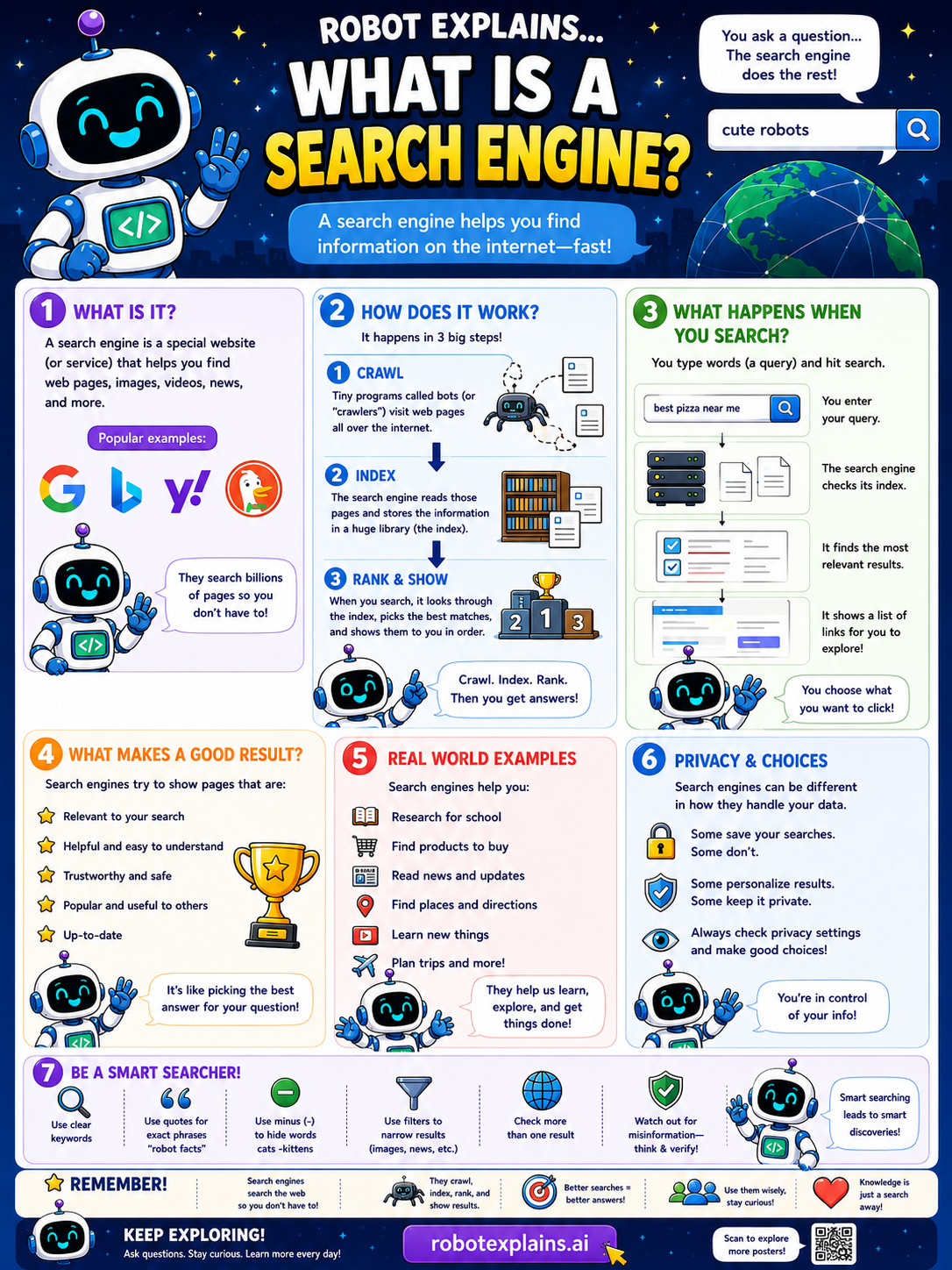
A search engine is a special website or service that helps you find web pages, images, videos, news, and more. Popular examples include Google, Bing, and DuckDuckGo. They search billions of pages so you don't have to!
How does it work? In three big steps. Crawl: programs called bots (or "crawlers") visit web pages all over the internet. Index: the search engine reads those pages and stores the information in a huge library called the index. Rank and show: when you search, it looks through the index, picks the best matches, and shows them to you in order. Crawl, index, rank, then you get answers!
What happens when you search? You type words (a query) and hit search. The search engine checks its index, finds the most relevant results, and shows you a list of links to explore. Then you choose what to click!
What makes a good result? It's relevant to your search, helpful and easy to understand, trustworthy and safe, useful to others, and up to date. It's like picking the best answer for your question.
Search engines also make different privacy choices, some save your searches, some keep them private, and some personalize results. Always check privacy settings and make good choices, you're in control of your info.
Be a smart searcher: use clear keywords, use quotes for exact phrases ("robot facts"), use a minus sign to hide words (cats -kittens), use filters to narrow results, check more than one result, and watch for misinformation, think and verify.
Remember: search engines search the web so you don't have to, they crawl, index, and rank, better searches get better answers, and knowledge is just a search away!
What to remember
- A search engine helps you find things on the internet.
- It crawls pages, indexes them, then ranks the best results.
- Clear keywords get better answers.
- Watch for misinformation, think and verify.
Words to know
- Search engine
- A service that finds web pages for you.
- Query
- The words you type to search.
- Crawl
- Bots visiting and reading web pages.
- Index
- The search engine's giant library of pages.
For grown-ups
A search engine crawls the web with bots, builds an index of what it finds, and ranks results by relevance and quality for a given query. Understanding crawl/index/rank, plus query operators and source-checking, makes anyone a more effective and safer searcher.
Want the full story? These go deeper: