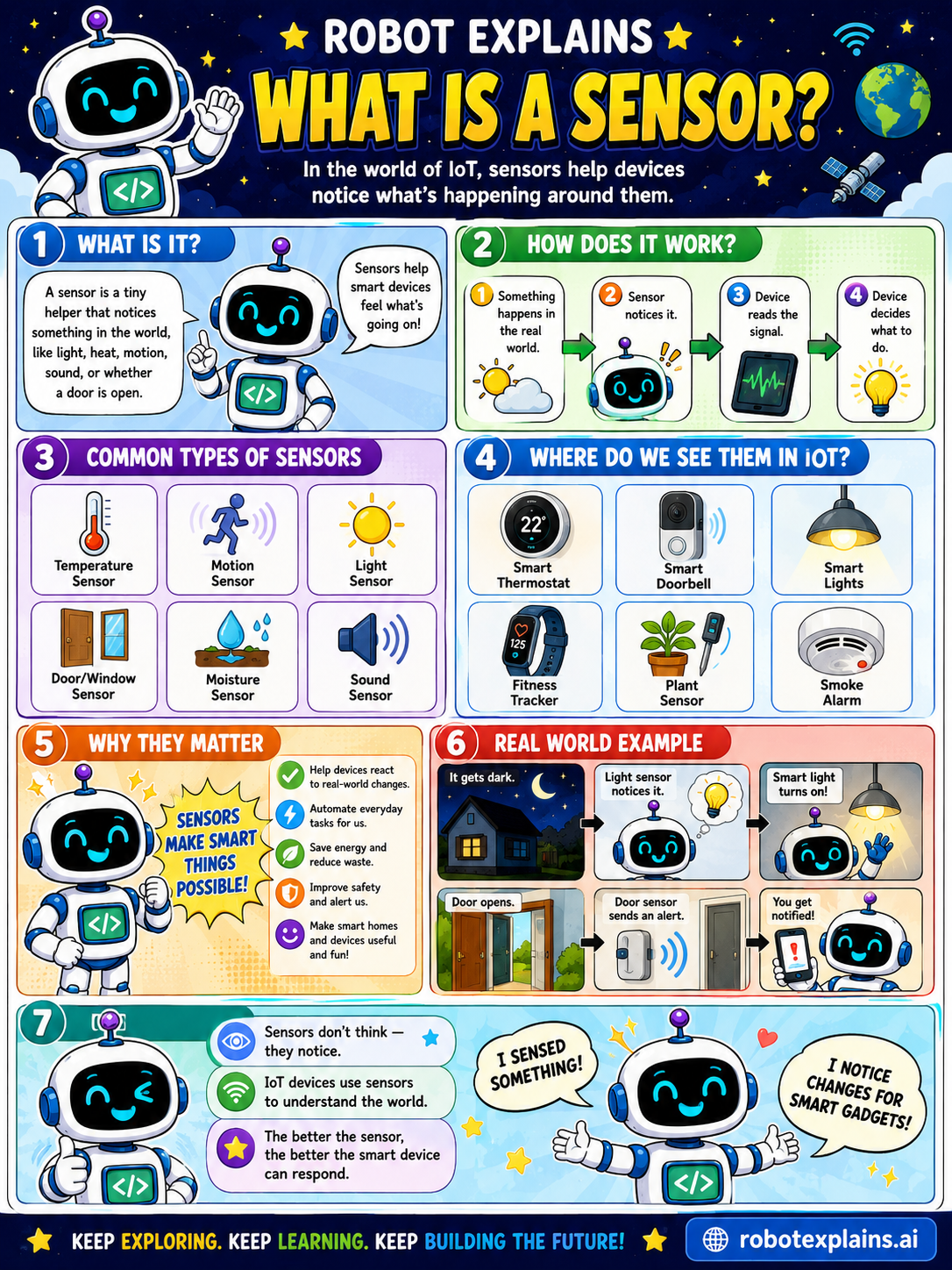
A sensor is a tiny helper that notices something in the world, like light, heat, motion, sound, or whether a door is open. Sensors help smart devices feel what's going on.
How does it work? Something happens in the real world, the sensor notices it, the device reads the signal, and the device decides what to do.
Common types of sensors: temperature sensors, motion sensors, light sensors, door and window sensors, moisture sensors, and sound sensors.
Where do we see them in IoT? Smart thermostats, smart doorbells, smart lights, fitness trackers, plant sensors, and smoke alarms.
Why do they matter? Sensors help devices react to real-world changes, automate everyday tasks, save energy and reduce waste, improve safety and alert us, and make smart homes and devices useful and fun. Sensors make smart things possible!
Here is a real example. It gets dark, a light sensor notices, and the smart light turns on. A door opens, a door sensor sends an alert, and you get notified.
Remember: sensors notice, they don't think. IoT devices use sensors to understand the world, and the better the sensor, the better the smart device can respond.
What to remember
- A sensor notices something in the real world.
- The device reads the signal and decides what to do.
- Sensors let smart devices react to changes.
- Sensors notice, they don't think.
Words to know
- Sensor
- A part that notices something in the world.
- Signal
- The information a sensor sends to the device.
- Motion sensor
- Notices movement nearby.
- Automate
- Make something happen on its own.
For grown-ups
A sensor converts a real-world condition, light, temperature, motion, sound, moisture, into a signal a device can read and act on. Sensors are the input layer of IoT: they let devices perceive their environment and trigger automations, but they only detect, the logic and decisions live in software.
Want the full story? These go deeper: