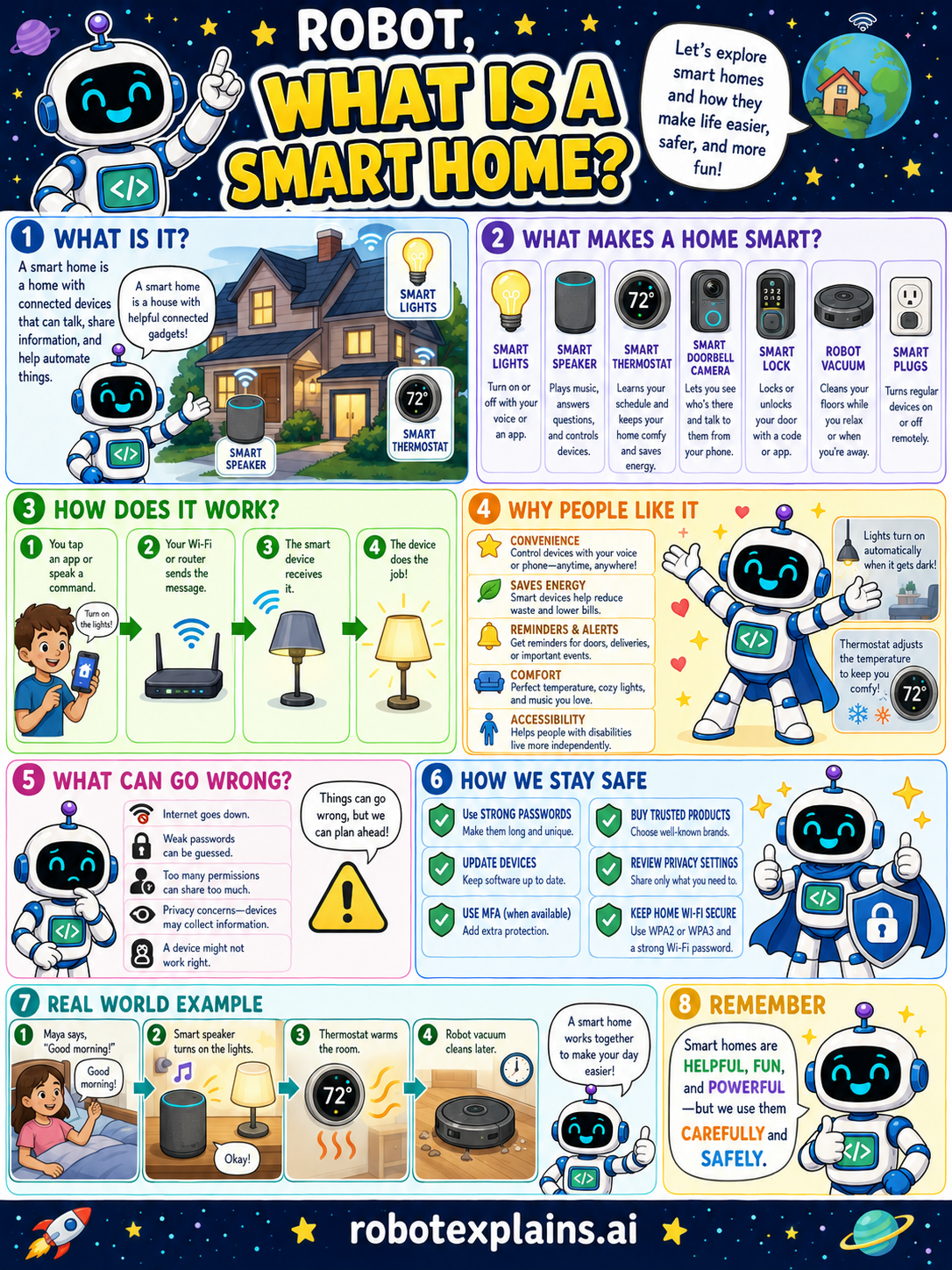
A smart home is a home with connected devices that can talk, share information, and help automate things, like smart lights, speakers, and thermostats.
What makes a home smart? Smart lights (turn on or off with your voice or app), a smart speaker (plays music, answers questions, controls devices), a smart thermostat (learns your schedule and saves energy), a smart doorbell camera (see and talk to who's there from your phone), a smart lock (lock or unlock with a code or app), a robot vacuum, and smart plugs (control devices even when you're away).
How does it work? You tap an app or speak a command, your Wi-Fi or router sends the message, the device receives it, and the device does the job.
Why do people like it? Convenience (control devices by voice or phone, anytime), saving energy, reminders and alerts, comfort, and accessibility, which helps people with disabilities live more independently.
What can go wrong? The internet can go down, weak passwords can be guessed, too many permissions can share too much, and devices may collect information. But we can plan ahead.
How do we stay safe? Use strong passwords, update devices, use MFA when available, buy trusted products, review privacy settings, and keep your home Wi-Fi secure (WPA2 or WPA3 with a strong password).
Remember: smart homes are helpful, fun, and powerful, but we use them carefully and safely.
What to remember
- A smart home connects devices that help automate things.
- You control them by voice or an app.
- They add convenience, save energy, and send alerts.
- Use strong passwords, updates, and a secure Wi-Fi.
Words to know
- Smart home
- A home with connected, controllable devices.
- Automate
- Letting things happen on their own.
- Voice control
- Telling a device what to do out loud.
- Secure Wi-Fi
- A protected home network (WPA2/WPA3).
For grown-ups
A smart home is a residence with networked devices, lighting, climate, locks, cameras, appliances, controllable remotely or by voice and able to automate routines. Benefits are convenience, energy savings, and accessibility; risks are privacy and network exposure, so use strong unique passwords, MFA, updates, and a secured (WPA2/WPA3) network.
Want the full story? These go deeper: