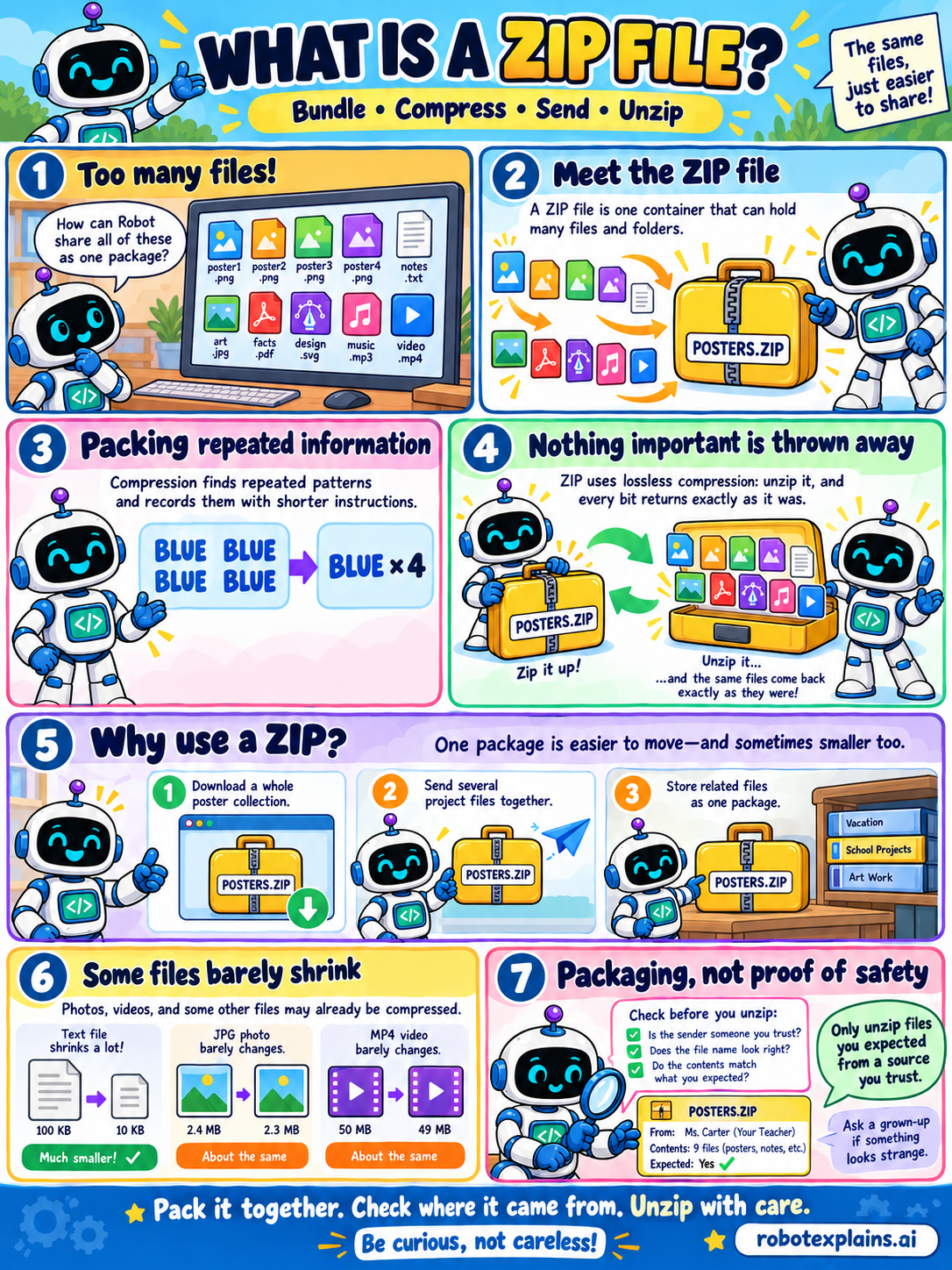
A ZIP file is like a suitcase for your files — one package that holds a lot of things at once. Let's unzip the idea!
What is a ZIP file? A ZIP file is one container that can hold many files and folders inside it. Instead of sending ten separate pictures, some notes, and a video, you can pack them all into a single file and share just that one.
Why would you make a bundle? Imagine Robot wants to share a whole poster collection, a school project with lots of parts, or a folder of artwork. Sending each file one by one is slow and easy to mess up. Packing everything into one ZIP means there's just one thing to download, send, or save.
Does zipping make things smaller? Often, yes. Compression looks for repeated information and records it with shorter instructions. If a file says "BLUE BLUE BLUE BLUE," compression can write that as "BLUE times 4." The computer follows those instructions to rebuild the original, so the bundle takes up less space.
Is anything lost when you zip? No. A ZIP uses lossless compression. That's a fancy way of saying: when you unzip it, every single file comes back exactly as it was — nothing important is thrown away. Zip it up, unzip it later, and it's all still there.
Do all files shrink the same amount? Not quite. A plain text file can shrink a lot — maybe from 100 KB down to 10 KB. But photos, videos, and music are usually already compressed, so a JPG photo or an MP4 video barely changes size inside a ZIP. That's normal! The ZIP is still handy because it keeps everything together in one package.
So why use a ZIP? Three big reasons: it's easier to download a whole collection at once, easier to send several project files together, and easier to store related files as one neat package.
One careful thing to remember: a ZIP is just packaging. It tells you that files are bundled together — it does not prove those files are safe. Before you unzip something, check a few things: Is the sender someone you trust? Does the file name look right? Do the contents match what you expected? If a ZIP shows up out of nowhere, or something looks strange, ask a grown-up before you open it.
What should we remember? A ZIP holds many files in one container. Zipping can make a bundle smaller and easier to share. Unzipping brings everything back exactly as it was. Some files barely shrink because they're already compressed. And a ZIP is packaging, not proof of safety — pack it together, check where it came from, and unzip with care. Be curious, not careless!
What to remember
- A ZIP file is one container that holds many files and folders.
- Zipping can make the bundle smaller and easier to share.
- Unzipping returns every file exactly as it was — nothing important is lost.
- Some files, like photos and videos, barely shrink because they are already compressed.
- A ZIP is just packaging — check who it came from before you open it.
Words to know
- ZIP file
- One file that bundles many files and folders together.
- Compression
- Recording repeated patterns with shorter instructions to save space.
- Lossless
- Nothing is thrown away — unzipping brings every bit back exactly.
- Unzip
- Opening a ZIP to get the original files back out.
For grown-ups
A ZIP is an archive format that bundles multiple files into a single container and applies lossless compression (classically the DEFLATE algorithm). Lossless matters: decompression reproduces the input byte-for-byte, which is why it's safe for documents, code, and data — unlike the lossy compression already baked into JPEG or MP4, which is why those files barely shrink again inside a ZIP. The convenience of 'one file, many things' is exactly what makes archives a common malware-delivery wrapper, so the mechanism and the caution belong together: a ZIP tells you nothing about whether its contents are safe. Verify the sender and expect the contents before you extract, and be wary of archives that arrive unexpectedly.
Want the full story? These go deeper: