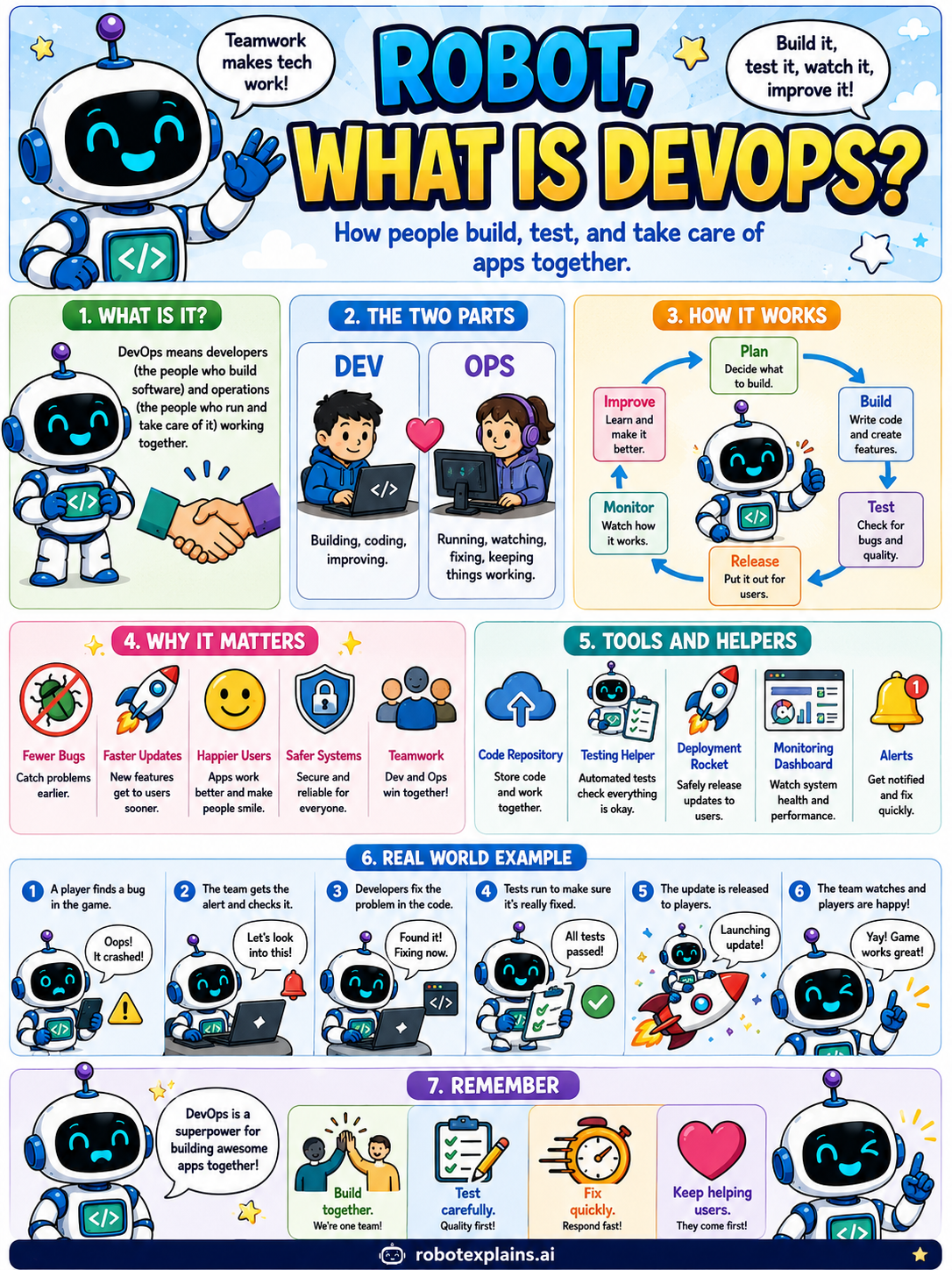
DevOps is how people build, test, and take care of apps together. The big idea: teamwork makes tech work.
It is made of two parts. Dev (developers) are the people who build the software, doing the building, coding, and improving. Ops (operations) are the people who run it, watching, fixing, and keeping things working. DevOps means they work together.
Here is how it works, as a loop. Plan what to build, build the code and features, test to check for bugs and quality, release it for people to use, monitor how it works, and improve it, then around again.
Why does it matter? Fewer bugs (problems get caught earlier), faster updates, happier users, safer and more reliable systems, and great teamwork.
Teams use helpers like a code repository (to store and share code), automated testing, deployment tools to release updates safely, and monitoring dashboards to watch system health.
Here is a real-style example. A player finds a bug in a game. The team gets the alert, finds the problem, and fixes it. Tests run to make sure it is really fixed, the update is released to players, and the team keeps watching. The game works great.
Remember: build together, test carefully, fix quickly, and keep helping users.
What to remember
- DevOps means Dev (builders) and Ops (runners) working together.
- The loop: plan, build, test, release, monitor, improve.
- It means fewer bugs and faster, safer updates.
- Teamwork makes technology work.
Words to know
- DevOps
- Developers and operations working together as one team.
- Dev
- Building, coding, and improving the app.
- Ops
- Running, watching, and keeping it working.
- Release
- Putting a new version out for people to use.
For grown-ups
DevOps is a culture and set of practices that unite development and operations to deliver software faster and more reliably, through automation, continuous integration/delivery, monitoring, and tight feedback loops. The goal is shorter, safer release cycles with shared ownership of quality and uptime.
Want the full story? These go deeper: