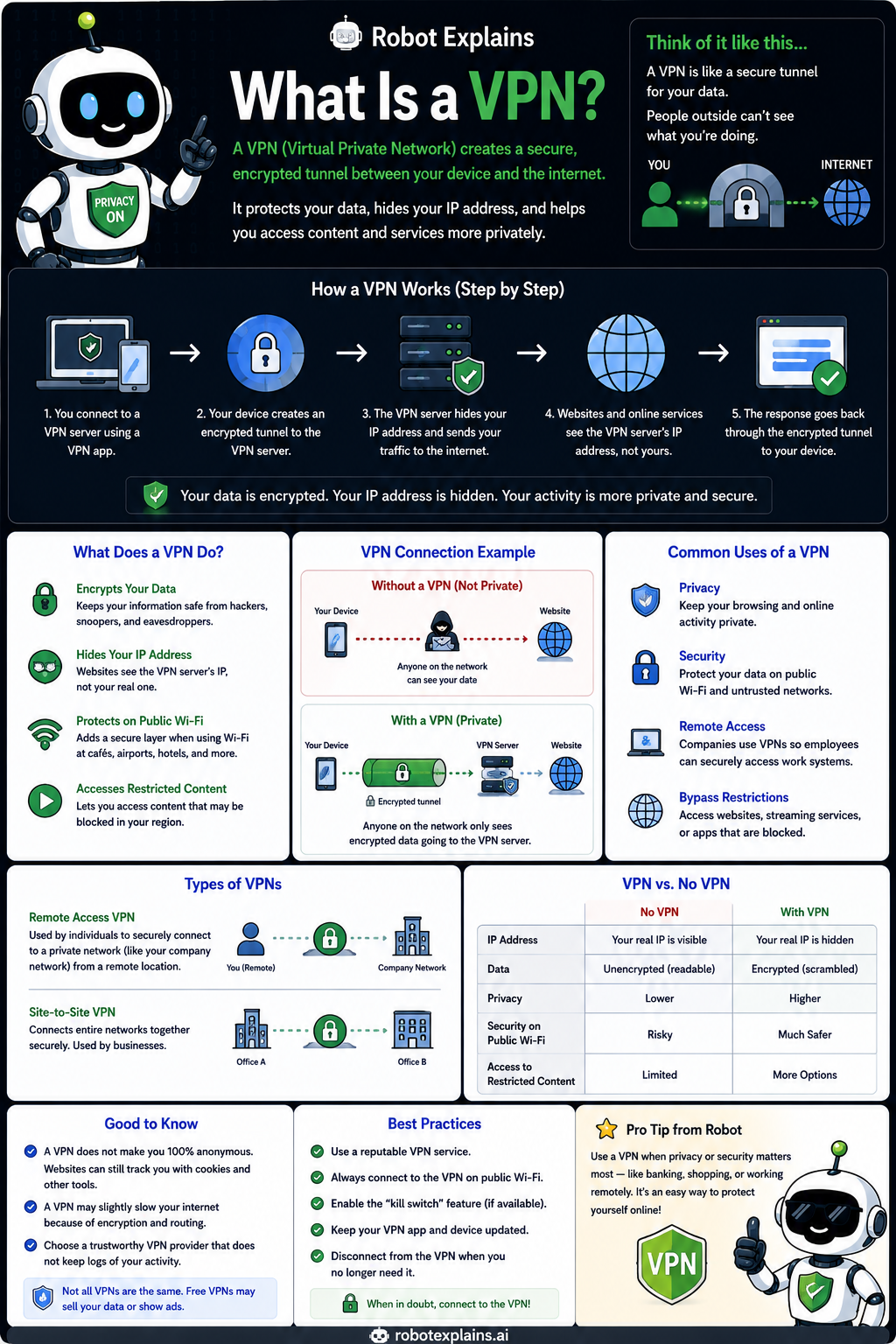
A VPN (Virtual Private Network) creates a secure, encrypted tunnel between your device and the internet.
Think of it like a secret tunnel for your data. People outside cannot see what you are doing.
Here is how it works. Your device connects to a VPN app, which builds an encrypted tunnel to a VPN server. The server gives your traffic a new address, then websites and online services see the server's address instead of yours, and their replies come back through the encrypted tunnel.
So a VPN does a few helpful things: it encrypts your data, hides your IP address, protects you on public Wi-Fi, and can let you reach content that is blocked in your region.
There are different kinds, like remote-access VPNs (one person connecting in) and site-to-site VPNs (linking whole networks).
Remember: a VPN encrypts your traffic and hides your address, it is great on public Wi-Fi, and you should pick a VPN service you trust.
What to remember
- A VPN encrypts your traffic and hides your IP address.
- It is like a private tunnel for your data.
- It is extra helpful on public Wi-Fi.
- Use a reputable VPN service you trust.
Words to know
- VPN
- Virtual Private Network: a secure, encrypted tunnel.
- Encrypted tunnel
- A scrambled path your data travels through.
- IP address
- The number that shows where you are online.
- Public Wi-Fi
- Shared networks where extra protection helps.
For grown-ups
A VPN tunnels and encrypts traffic between your device and a VPN server, masking your IP and protecting data in transit, especially valuable on untrusted networks. It shifts trust to the provider, so choose a reputable one; free VPNs may monetize your data.
Want the full story? These go deeper: