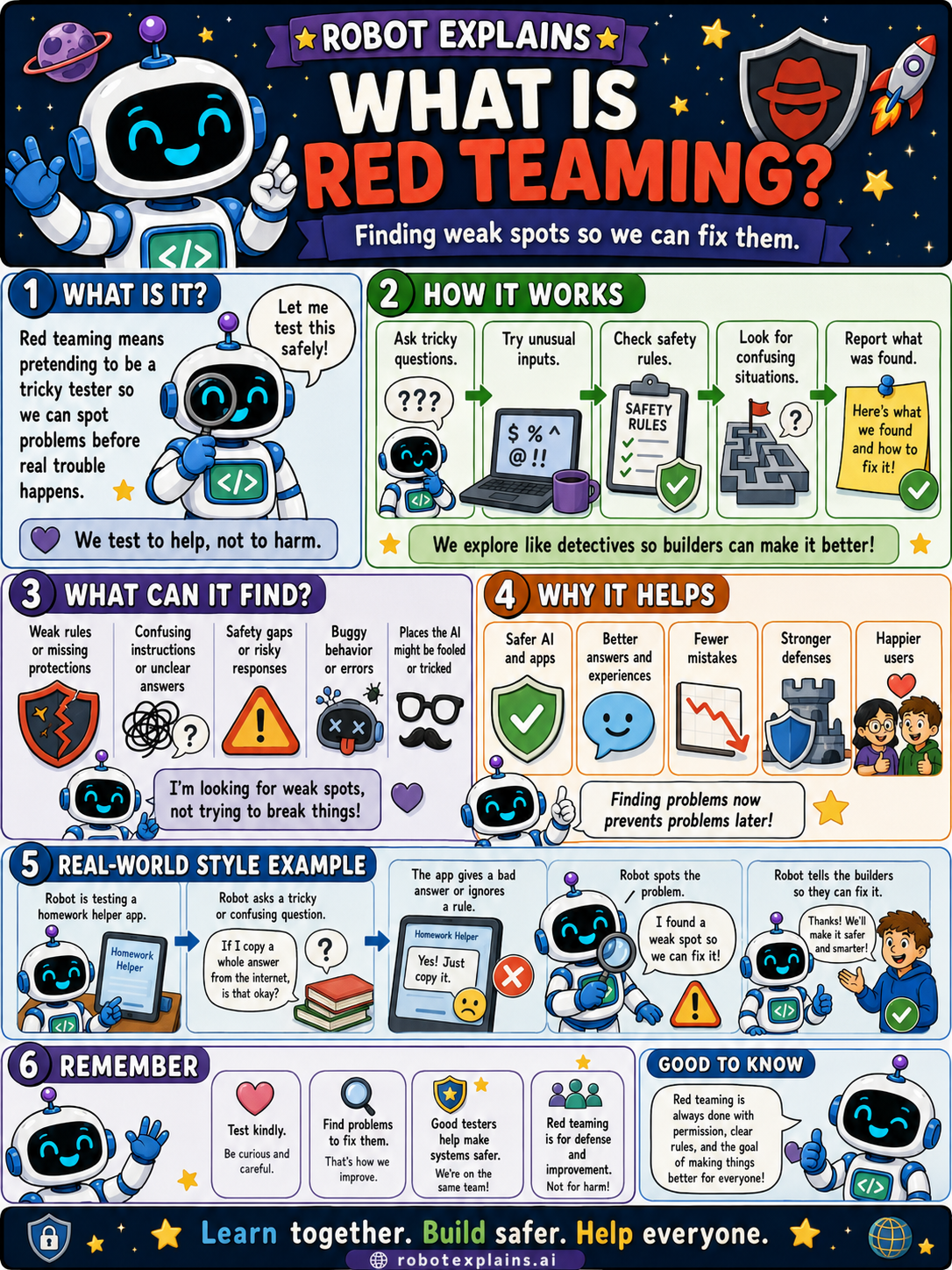
Red teaming means pretending to be a tricky tester so we can spot real trouble before it happens. The motto: we test to help, not to harm.
How does it work? Testers ask tricky questions, try unusual inputs, check the safety rules, look for confusing situations, and then report what they found and how to fix it. They explore like detectives, so the builders can make things better.
What can it find? Weak rules or missing protections, confusing instructions or unclear answers, safety gaps or risky responses, and buggy behavior or errors.
Why does it help? It leads to safer AI and apps, better experiences, fewer mistakes, stronger defenses, and happier users. Finding problems now prevents problems later.
Here is a real-style example. A robot tests a homework-helper app and finds that it just copies answers. It tells the builders, so they can fix it.
Good to know: red teaming is always done with permission, clear rules, and the goal of making things safer for everyone.
Remember: test kindly, find problems to improve, good testers help make systems safer, and red teaming is for defense, not harm.
What to remember
- Red teaming means testing to find weak spots, to help.
- Testers try tricky questions and unusual inputs.
- It is done with permission and clear rules.
- Finding problems now prevents problems later.
Words to know
- Red teaming
- Friendly testing that hunts for weak spots.
- Weak spot
- A gap or flaw that could be misused.
- Permission
- Red teaming is always agreed to first.
- Defense
- The goal: making things safer.
For grown-ups
Red teaming is authorized adversarial testing, probing systems (including AI and LLMs) with tricky inputs and edge cases to surface weaknesses before real attackers do. For AI it targets safety, jailbreaks, and harmful outputs. It is constructive and scoped: done with permission, clear rules, and the goal of fixing what it finds.
Want the full story? These go deeper: