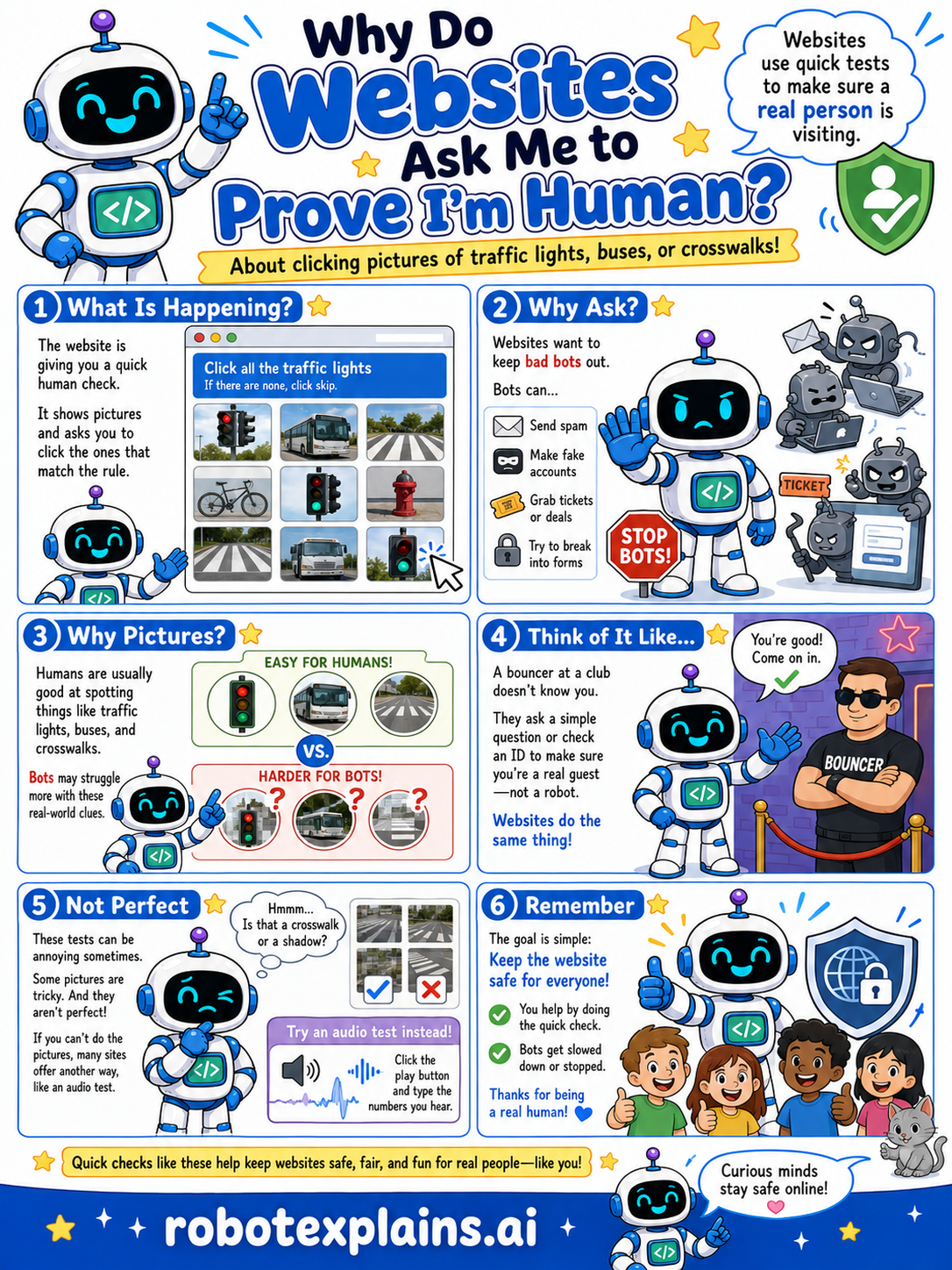
Sometimes a website asks you to click pictures of traffic lights, buses, or crosswalks. This is a quick human check.
What is happening? The website is giving you a little test. It shows pictures and asks you to click the ones that match the rule. This checks that a real person is visiting.
Why ask? Websites want to keep bad bots out. Bots are programs that can send spam, make fake accounts, grab tickets or deals, and try to break into forms.
Why pictures? Humans are usually good at spotting things like traffic lights, buses, and crosswalks. Bots may struggle with real-world clues, so the test is easy for you but harder for them.
Think of it like a club. A bouncer doesn't know you, so they ask a simple question or check an ID to make sure you're a real guest, not a robot. Websites do the same thing.
Not perfect. These tests can be a little annoying, and sometimes tricky. If you can't do the pictures, many sites offer an audio test instead.
Remember: the goal is simple, keep the website safe for everyone. You help by doing the quick check, and bots get slowed down or stopped. Thanks for being a real human, and curious minds stay safe online!
What to remember
- Websites use quick checks to make sure a real person is visiting.
- These checks help keep out bad bots.
- Pictures are easy for humans but tricky for bots.
- The goal is to keep the website safe and fair for everyone.
Words to know
- CAPTCHA
- A quick test that checks if you are a real person.
- Bot
- A computer program that acts on its own, sometimes for bad reasons.
- Spam
- Unwanted junk messages bots can send.
- Verify
- To check that something is real or true.
For grown-ups
These challenges are CAPTCHAs — tests easy for humans but hard for automated programs (bots). Sites use them to block spam, fake account creation, scalping, and credential abuse. Image-recognition, checkbox, and audio variants exist; audio options also improve accessibility. They are imperfect and sometimes annoying, but they raise the cost of abuse. For kids: it's a friendly bouncer checking your ID so the site stays safe and fair.
Want the full story? These go deeper: