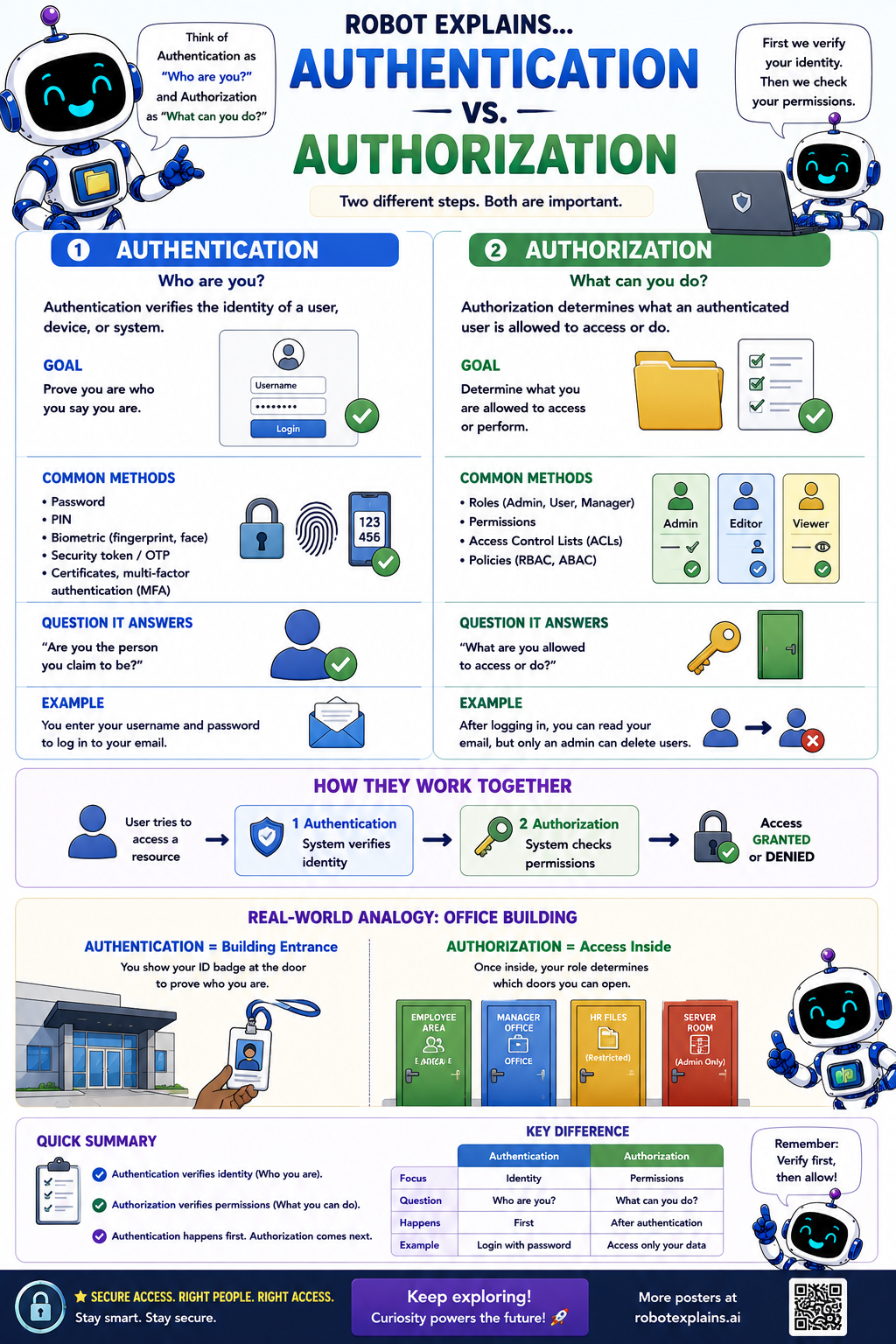
Authentication and authorization are two different steps, and both are important. The easy way to remember it: authentication is "Who are you?" and authorization is "What can you do?"
Authentication verifies the identity of a user, device, or system. The goal is to prove you are who you say you are. Common methods include a password, a PIN, biometrics (fingerprint or face), a security key or one-time code, and multi-factor authentication. It answers the question, "Are you who you claim to be?" Example: you enter your username and password to log in.
Authorization determines what an authenticated user is allowed to access or do. The goal is to decide what you're allowed to do. Common methods include roles (admin, user, manager), permissions, access control lists, and policies. It answers, "What are you allowed to access or do?" Example: after logging in, you can read your own email, but only an admin can delete other users.
How they work together: you try to access a resource, authentication verifies your identity first, then authorization checks your permissions, and access is granted or denied.
Think of an office building. Authentication is the building entrance, you show your ID badge to prove who you are. Authorization is access inside, once you're in, your role decides which doors you can open.
Remember: authentication checks identity (who you are), authorization checks permissions (what you can do), and authentication always comes first. Verify first, then allow.
What to remember
- Authentication = proving who you are.
- Authorization = what you're allowed to do.
- Authentication comes first, then authorization.
- Together they keep accounts and data secure.
Words to know
- Authentication
- Proving you are who you say you are.
- Authorization
- Deciding what you're allowed to do.
- Permission
- An action you're allowed to take.
- Role
- A set of permissions (like admin or viewer).
For grown-ups
Authentication verifies identity (who you are, via password, biometric, MFA); authorization determines what an authenticated identity may access or do (via roles, permissions, ACLs, policies). Authentication happens first, then authorization. Conflating them is a common security mistake; both are needed for access control.
Want the full story? These go deeper: