A quick tap and your phone pays, opens a door, or buys a bus ride. How do two devices talk just by getting close? That's NFC — Near Field Communication. Let's peek inside a tap!
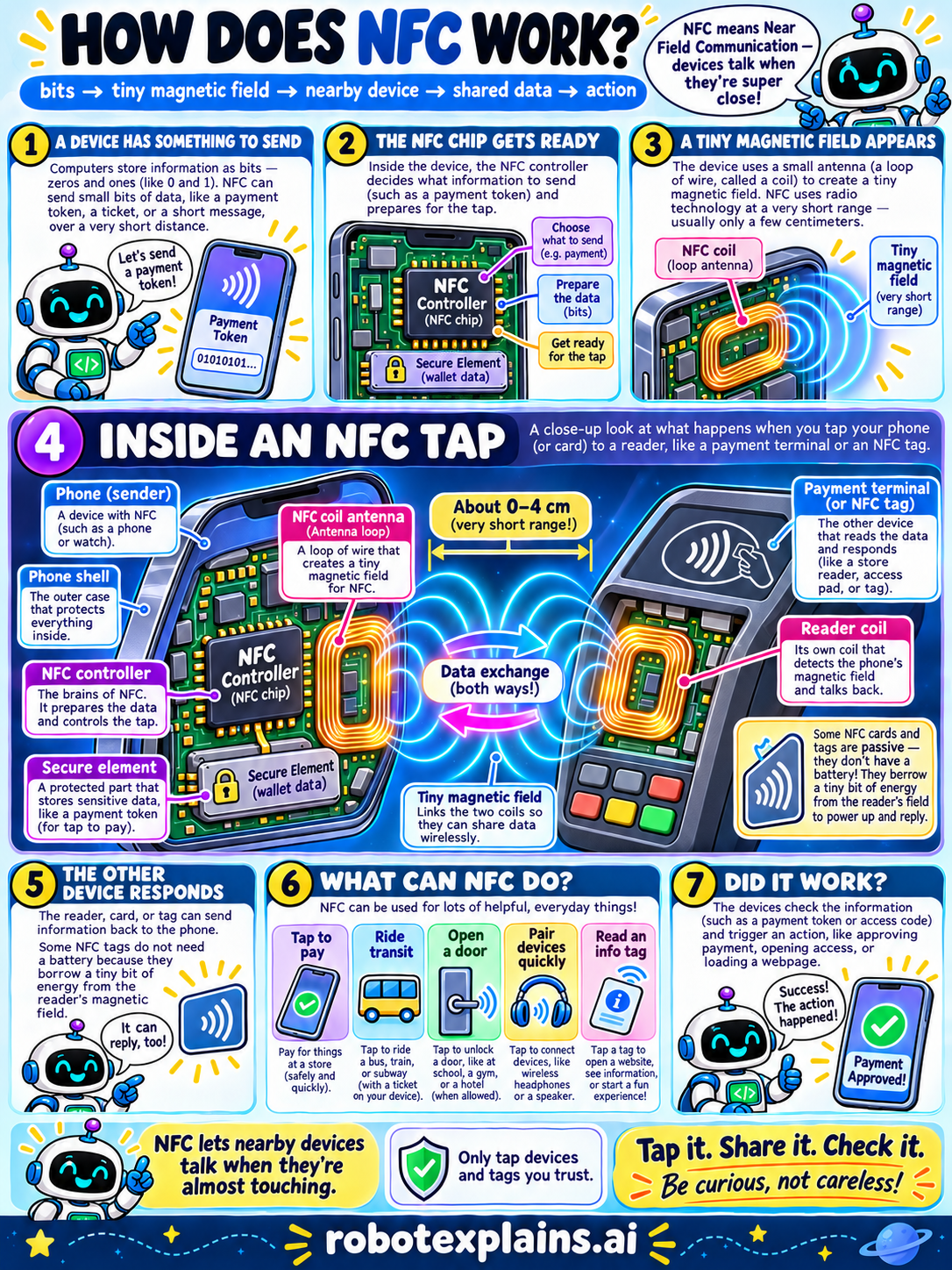
Where does it start? A device has something to send. Computers store information as bits — zeros and ones. NFC can send small bits of data, like a payment token, a ticket, or a short message, over a very short distance.
First, the NFC chip gets ready. Inside the device, the NFC controller decides what to send (like a payment token) and prepares the data. A protected part called the secure element holds sensitive things, like your wallet data, so they stay safe.
Next: a tiny magnetic field appears. The device uses a small antenna — a loop of wire called a coil — to create a tiny magnetic field. NFC uses radio technology at a very short range, usually only a few centimeters. That short range is a safety feature all by itself!
Now the close-up: inside an NFC tap. On one side is the phone (the sender), with its coil antenna, NFC controller, and secure element. On the other side is a reader — maybe a payment terminal, an access pad, or an NFC tag — with its own coil. Hold them about 0–4 cm apart and the two coils link through that tiny magnetic field, so they can exchange data — and it goes both ways! Clever trick: some NFC cards and tags are passive — they have no battery! They borrow a tiny bit of energy from the reader's field to power up and reply.
Then the other device responds. The reader, card, or tag sends information back to the phone. (Remember, passive tags do this using only the energy they borrowed — no battery needed.)
What can NFC do? Lots of helpful, everyday things! Tap to pay at a store, ride transit on a bus or train, open a door at school or a hotel, pair devices quickly like headphones or a speaker, and read an info tag to open a website or start a fun experience.
Last question: did it work? The devices check the information — like a payment token or an access code — and trigger an action: approving a payment, opening access, or loading a webpage. Beep — success! The action happened.
What should we remember? Tap it, share it, check it. NFC lets nearby devices talk when they're almost touching, using a tiny magnetic field to trade a little data. It's fast and handy — just only tap devices and tags you trust. Be curious, not careless!
What to remember
- NFC means Near Field Communication — devices talk only when they're almost touching (about 0–4 cm).
- A tiny coil makes a small magnetic field, and the other device's coil feels it to share data.
- NFC sends only small bits of data, like a payment token, a ticket, or a short message.
- Some NFC cards and tags are passive — they have no battery and borrow energy from the reader's field.
- Only tap devices and tags you trust.
Words to know
- NFC
- Near Field Communication: short-range wireless for devices that are almost touching.
- Coil antenna
- A loop of wire that makes a tiny magnetic field for NFC.
- NFC controller
- The chip that prepares the data and controls the tap.
- Secure element
- A protected part that stores sensitive data, like a payment token.
- Passive tag
- An NFC tag or card with no battery that borrows power from the reader.
For grown-ups
NFC is a short-range (typically a few centimeters) subset of RFID operating at 13.56 MHz. The active device drives a coil antenna to create an oscillating magnetic field; the second coil couples to it inductively, which both carries the modulated data and — for passive cards and tags — supplies the small amount of power they need to respond, so they work without a battery. An NFC controller handles the protocol, and a tamper-resistant secure element (or host-based emulation backed by tokenization) stores sensitive credentials so the real card number is never exposed. The very short range is itself a safety feature: a device has to be right next to the reader to communicate. This mechanism is what makes the tap-to-pay and tap-to-pay-safety lessons make sense.
Want the full story? These go deeper: