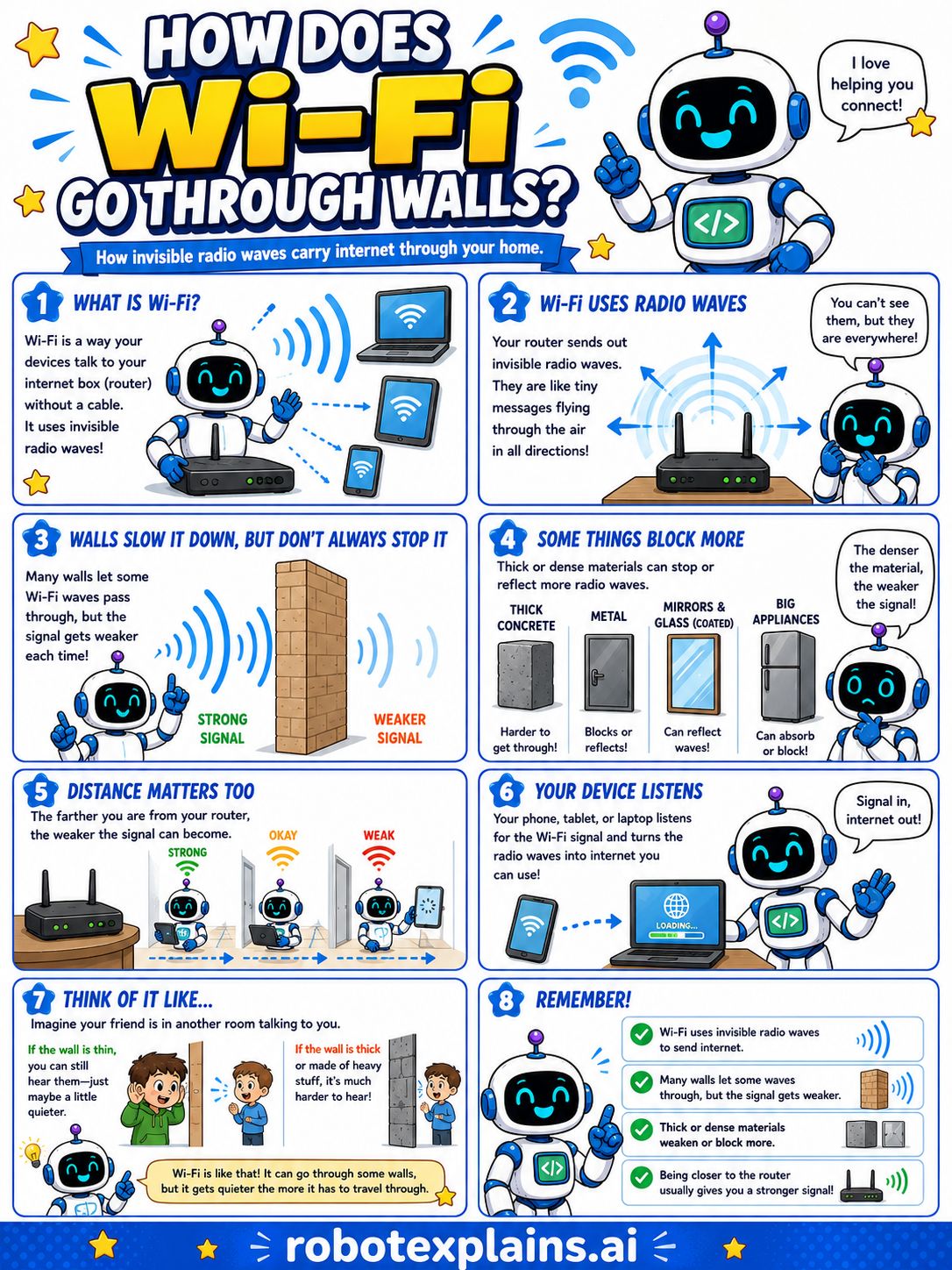
Wi-Fi can go through walls because it uses invisible radio waves to carry internet through your home.
What is Wi-Fi? Wi-Fi is a way your devices talk to your internet box (router) without a cable. It uses invisible radio waves.
Wi-Fi uses radio waves. Your router sends out invisible radio waves in all directions. You can't see them, but they're everywhere, carrying tiny messages flying through the air.
Walls slow it down, but don't always stop it. Many walls let some Wi-Fi waves pass through, but the signal gets weaker each time it does.
Some things block more. Thick or dense materials can stop or reflect more radio waves. Thick concrete is hard to get through, metal blocks or reflects, mirrors and coated glass can reflect waves, and big appliances can absorb or block them.
Distance matters too. The farther you are from your router, the weaker the signal can become.
Your device listens. Your phone, tablet, or laptop listens for the Wi-Fi waves and turns them into internet you can use.
Think of it like a friend in another room talking to you. If the wall is thin, you can still hear them, just a little quieter. If the wall is thick, it's harder to hear.
Remember: Wi-Fi uses invisible radio waves, many walls let some through but the signal gets weaker, thick or dense materials block more, and being closer to the router usually gives a stronger signal.
What to remember
- Wi-Fi uses invisible radio waves to send internet.
- Many walls let some signal through, but it gets weaker.
- Thick or dense materials block more of the signal.
- Being closer to the router gives a stronger signal.
Words to know
For grown-ups
Wi-Fi uses radio waves, which travel through and around many materials but lose strength (attenuate) as they pass through obstacles. Dense materials — thick concrete, metal, mirrored or coated glass, and large appliances — attenuate or reflect signals far more than drywall. Distance and interference also reduce strength. The kid-level idea: invisible waves can sneak through walls, but the thicker the wall, the weaker the signal.
Want the full story? These go deeper: