YouTube videos load fast because your video arrives in little pieces, super fast!
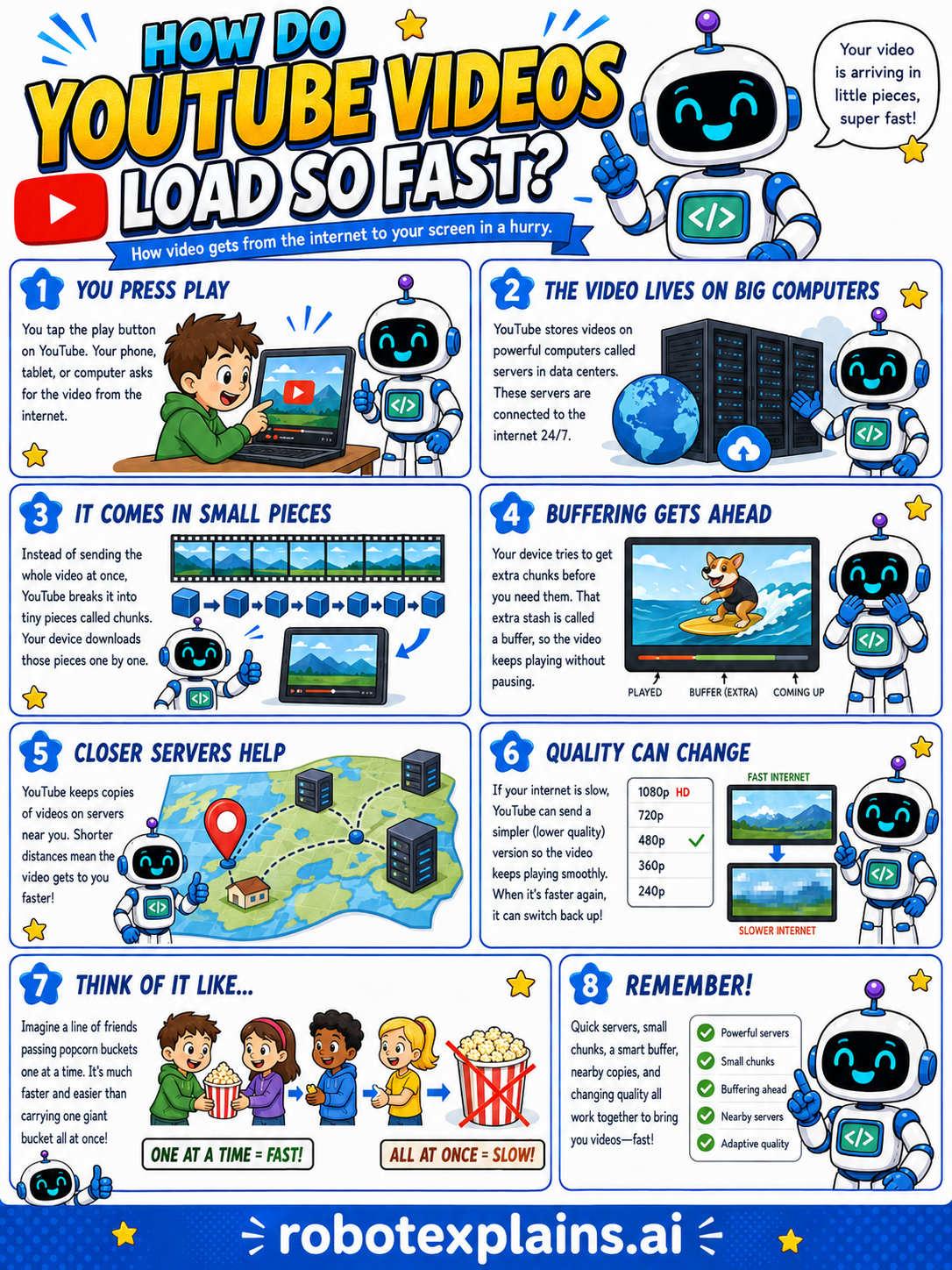
You press play. You tap the play button. Your phone, tablet, or computer asks for the video from the internet.
The video lives on big computers. YouTube stores videos on powerful computers called servers in data centers. These servers are connected to the internet all day, every day.
It comes in small pieces. Instead of sending the whole video at once, YouTube breaks it into tiny pieces called chunks. Your device downloads those pieces one by one.
Buffering gets ahead. Your device tries to grab extra chunks before you need them. This extra stash is called a buffer, and it keeps playing without pausing.
Closer servers help. YouTube keeps copies of videos on servers near you. Shorter distances mean the video gets to you faster.
Quality can change. If your internet is slow, YouTube can send a simpler (lower quality) version so the video keeps playing smoothly. When it's faster again, it can switch back up.
Think of it like a line of friends passing popcorn buckets one at a time. It's much faster and easier than one person carrying every bucket at once.
Remember: powerful servers, small chunks, a smart buffer, nearby copies, and changing quality all work together to bring you video, fast!
What to remember
- Videos live on powerful computers called servers.
- They arrive in small pieces, not all at once.
- Your device buffers extra pieces ahead of time.
- Closer servers and changing quality keep it smooth.
Words to know
- Server
- A powerful computer that stores and sends videos.
- Streaming
- Playing a video as it arrives, piece by piece.
- Buffer
- Extra pieces saved ahead so playback stays smooth.
- Chunk
- One small piece of the video.
For grown-ups
Video streaming delivers media as a sequence of small segments rather than one large file. Players buffer ahead to absorb network variability; content delivery networks (CDNs) cache copies on servers physically near users to cut latency; and adaptive bitrate streaming switches quality up or down based on available bandwidth. The kid-level idea: small pieces, a smart buffer, nearby copies, and adjustable quality work together so the video plays fast.
Want the full story? These go deeper: