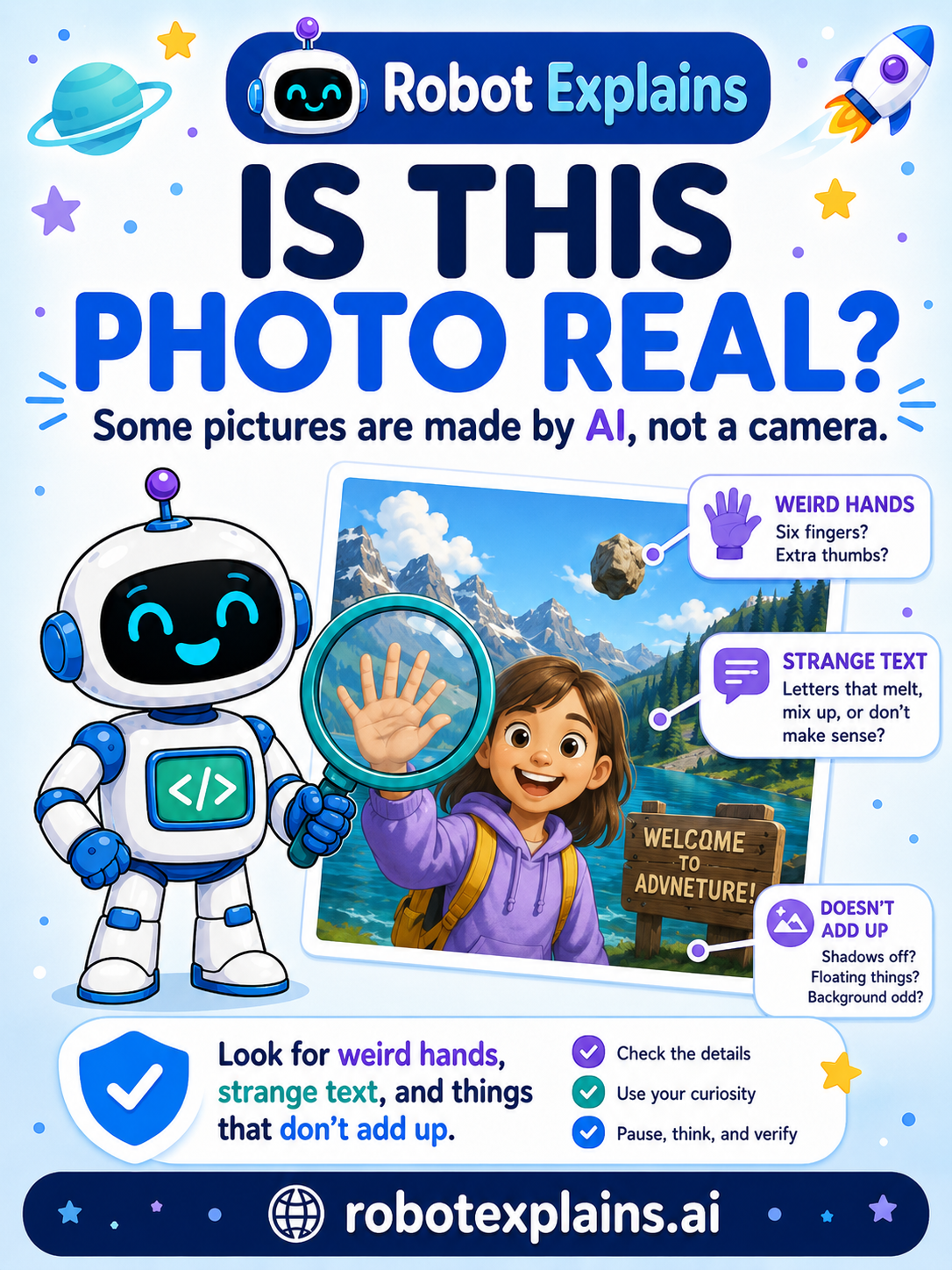
That photo of a cat riding a dragon over your school? Amazing… and definitely not real. Today, AI can make pictures of things that never happened — so a good question to keep in your pocket is: is this photo real?
How can a photo be "fake"? A camera captures something that was actually in front of it. An AI image is different: you type a description, and the computer invents a picture to match. Nothing was photographed — it was generated. Some are obvious fun; others look almost real.
Clues to look for. AI is good, but it still slips up. Zoom in and check:
- Hands and fingers — too many, too few, or bent the wrong way.
- Text — letters on signs or shirts often look melty or made-up.
- Details that don't add up — jewelry that merges into skin, backgrounds that bend, shadows going the wrong way.
- Too perfect — skin, light, and everything just a little too flawless.
The bigger habit. Clues help, but they won't always be there. The stronger move is the same as with any surprising thing online: check where it came from. A real news photo shows up in trusted places. A picture that only exists in one random post is worth doubting.
Green, yellow, red.
- 🟢 Green: a picture a friend clearly made "with AI" for fun.
- 🟡 Yellow: an amazing photo from someone you don't know — look closer.
- 🔴 Red: a shocking image used to make you angry or scared — stop and check with a grown-up.
Remember: a picture is no longer proof by itself. Look for the clues, then check the source. Be curious, not careless!
What changed?
Every tap changes something. The trick isn't fear — it's noticing. After you say “yes,” ask: what just changed?
- Believed an AI photo was realyou might trust an event that never happened
- Re-posted it as truethe fake picture spreads further
- Looked for the clues firstyou catch the fake before you share it
What to remember
- AI can make pictures that were never photographed.
- Check hands, text, and details that don't add up.
- A perfect, amazing photo deserves a second look.
- Ask where it came from before you believe it.
Explain it back
You understand something best when you can teach it. Finish these out loud — to a friend, a grown-up, a little brother or sister, or even the mirror:
- An AI-made photo is…
- Two clues I can look for are…
- If a photo seems too amazing to be real, I should…
Words to know
- AI image
- A picture created by a computer program, not taken by a camera.
- Generated
- Made by AI from a text description.
- Artifact
- A small glitch AI leaves behind, like a warped hand.
- Verify
- To check whether something is really true.