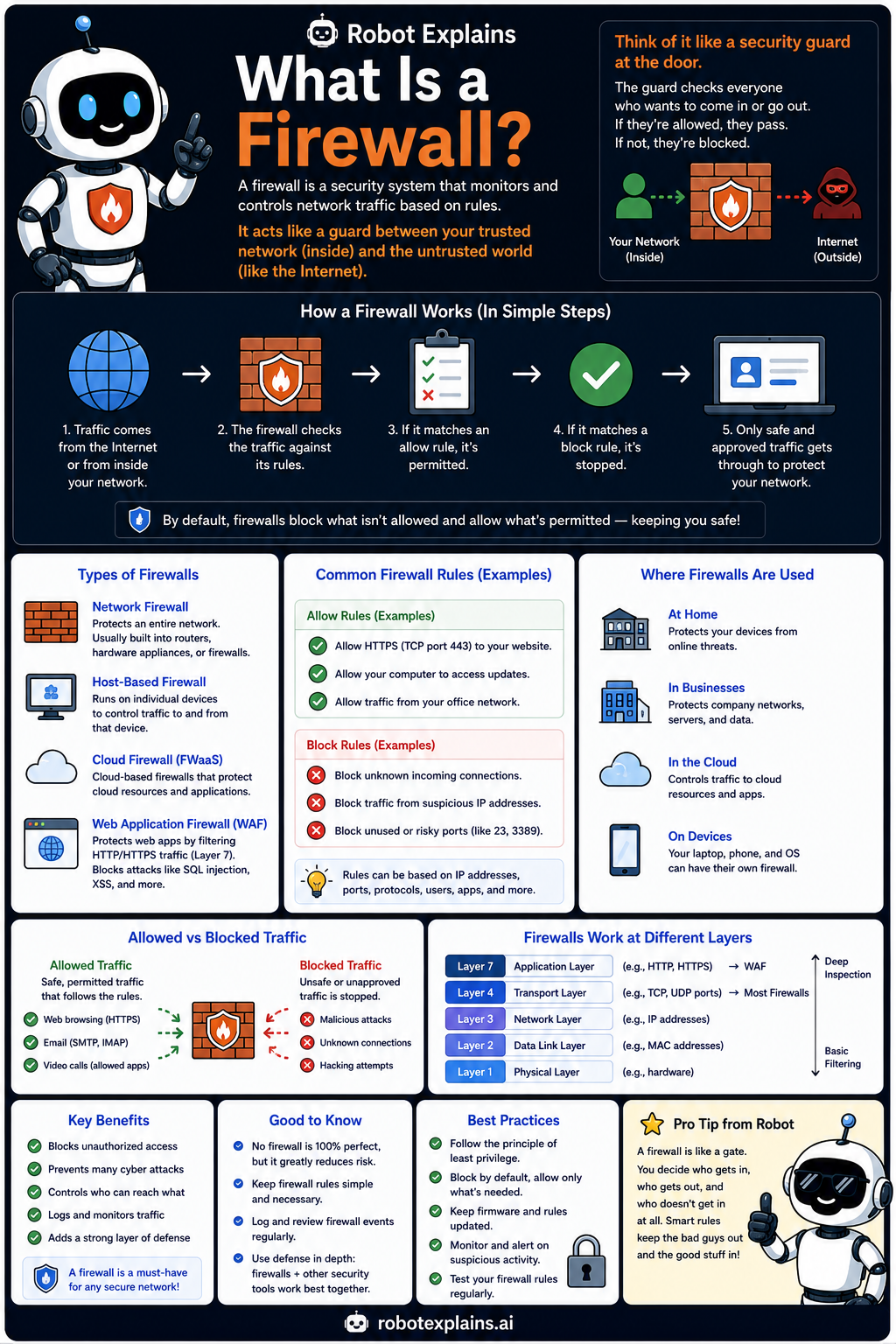
A firewall is a security system that watches network traffic and decides what is allowed in or out, based on rules.
Think of it like a security guard at a door. The guard checks everyone who wants to come in or go out. If they are allowed, they pass. If not, they are blocked.
Here is how it works. Traffic arrives, the firewall checks it against its rules, and if it matches an allow rule it is permitted, but if it matches a block rule it is stopped. Only safe, approved traffic gets through.
The simple default keeps you safe: block what is not allowed, and allow only what is permitted.
Firewalls come in a few kinds: ones that protect a whole network, ones that run on a single device, cloud firewalls, and web application firewalls that protect websites.
Remember: a firewall checks traffic against rules, guards the edge of your network, blocks what is not allowed by default, and is a must-have for staying safe.
What to remember
- A firewall checks traffic against rules and allows or blocks it.
- It guards the line between your network and the internet.
- By default it blocks what is not allowed.
- It is a must-have for keeping a network safe.
Words to know
- Firewall
- A security system that controls network traffic by rules.
- Rule
- An instruction that allows or blocks certain traffic.
- Inbound / outbound
- Traffic coming in versus going out.
- WAF
- A web application firewall that protects websites.
For grown-ups
A firewall enforces an allow/deny policy on traffic between zones of differing trust, by port, protocol, and IP, or at higher layers by application and content. Variants include network, host-based, cloud, and web application firewalls. Default-deny inbound is the safe baseline.
Want the full story? These go deeper: