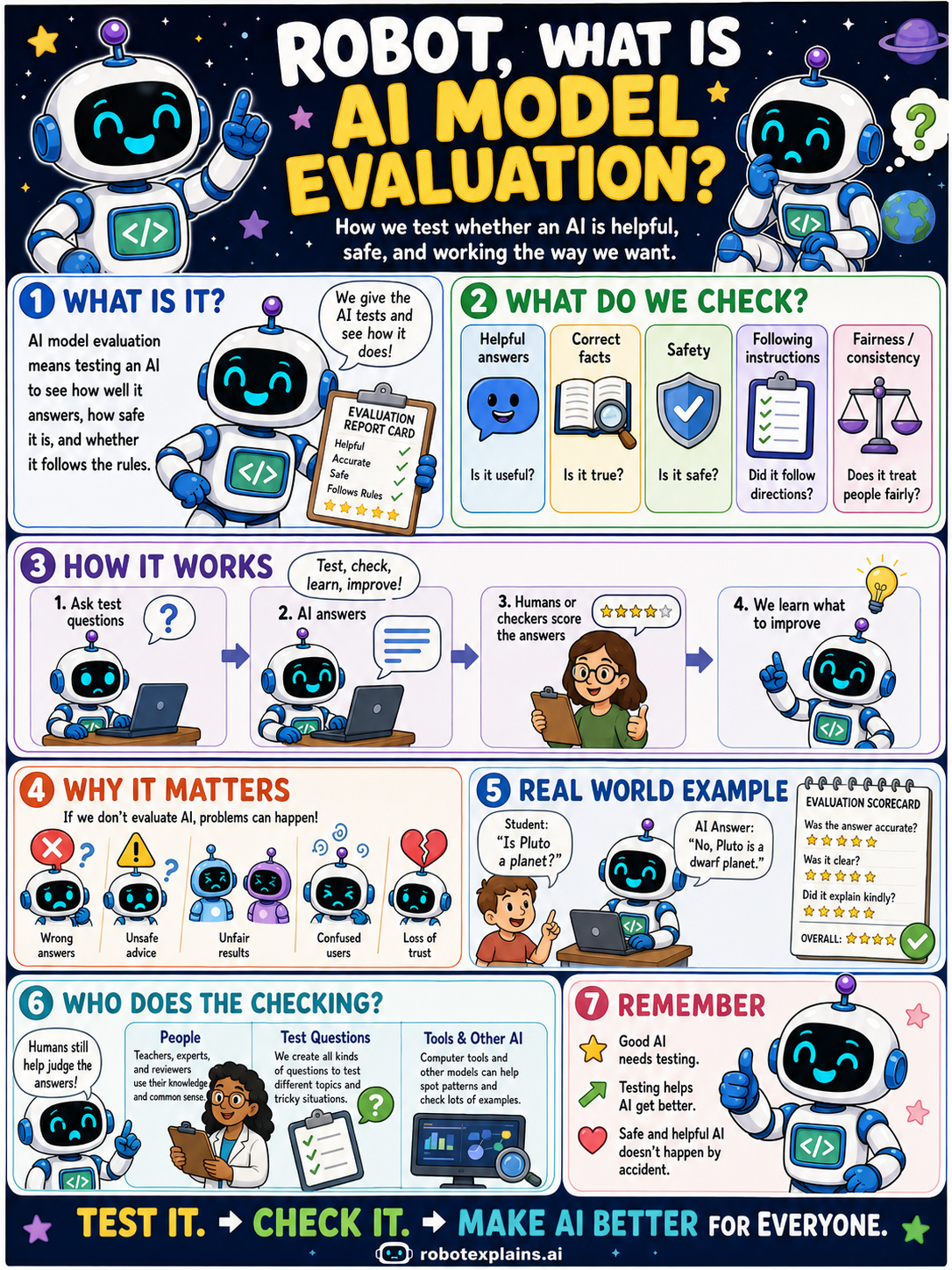
AI model evaluation means testing an AI to see how well it works, how safe it is, and whether it follows the rules. We give the AI tests and see how it does, like a report card for the AI.
What do we check? Helpful answers (is it useful?), correct facts (is it true?), safety (is it safe?), following instructions (did it follow directions?), and fairness and consistency (does it treat people fairly?).
How does it work? Ask test questions, the AI answers, humans or checkers score the answers, and we learn how to improve. Test, check, learn, improve.
Why does it matter? If we don't evaluate AI, problems can happen, wrong answers, unsafe advice, unfair results, confused users, and loss of trust.
Here is a real example. A student asks, "Is Pluto a planet?" The AI answers, "No, Pluto is a dwarf planet." Then an evaluation scorecard checks: was the answer correct? Was it safe? Was it kind? And gives it an overall rating.
Who does the checking? People (teachers, experts, and everyday people), sets of test questions, and special tools and other AI.
Remember: good AI needs testing, testing helps it get better, and safe, helpful AI doesn't happen by accident. Test it, check it, make AI better for everyone.
What to remember
- Evaluation tests how well an AI works.
- We check if answers are helpful, correct, safe, and fair.
- People and tools score the answers to find problems.
- Safe, helpful AI doesn't happen by accident, it's tested.
Words to know
- Evaluation
- Testing how well an AI works.
- Benchmark
- A standard set of tests to score against.
- Accuracy
- How often the answers are correct.
- Fairness
- Treating people equally and without bias.
For grown-ups
Model evaluation measures quality against defined criteria, accuracy, helpfulness, safety, instruction-following, fairness, and consistency, using held-out test sets, benchmarks, and human review. It is how teams catch failures before release and track improvement; for LLMs it also includes safety and red-team evaluations.
Want the full story? These go deeper: