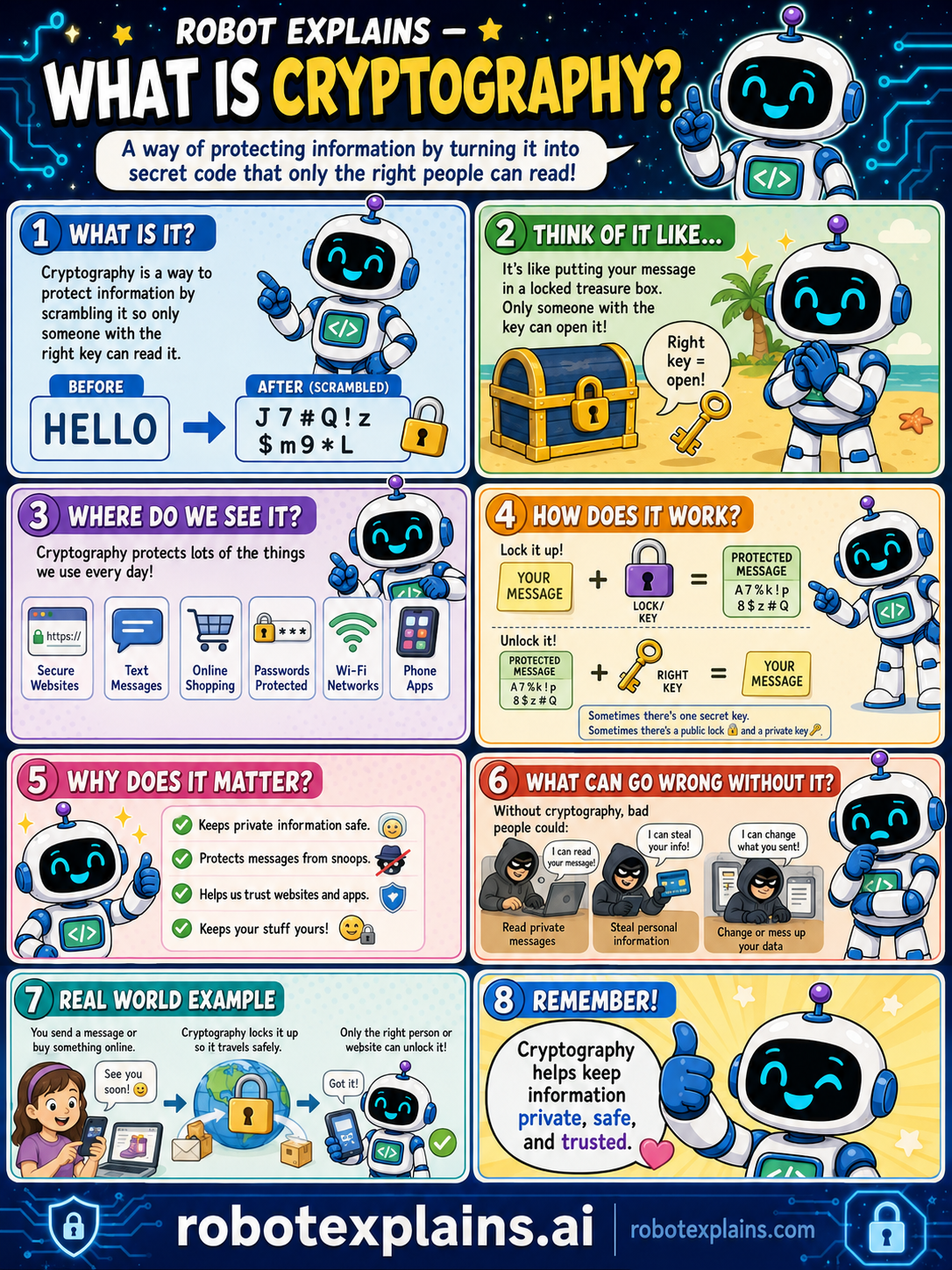
Cryptography is a way of protecting information by turning it into secret code that only the right people can read.
Think of it like putting your message in a locked treasure box. Only someone with the right key can open it.
Where do we see it? Cryptography protects lots of things you use every day: secure websites (HTTPS), text messages, online shopping, saved passwords, Wi-Fi networks, and phone apps.
How does it work? You lock it up by combining your message with a key to make a protected (scrambled) message. To read it, you unlock it by using the right key to turn the protected message back into your message. Sometimes there's one secret key; sometimes there's a public lock and a private key.
Why does it matter? It keeps private information safe, protects messages from snoops, helps us trust websites and apps, and keeps your stuff safe online.
What could go wrong without it? Bad actors could read your private messages, steal your personal info, or change and mess up your data. Cryptography helps stop all of that.
Here's a real example. You send a message or buy something online. Cryptography locks it up so it travels safely, and only the right person or website can unlock it.
Remember: cryptography turns information into secret code, only the right key unlocks it, and it helps keep information private, safe, and trusted.
What to remember
- Cryptography turns information into secret code.
- Only someone with the right key can read it.
- It keeps private information safe and trusted.
- It protects messages, websites, and your stuff online.
Words to know
- Cryptography
- Protecting information by turning it into secret code.
- Key
- The secret that locks and unlocks the code.
- Scramble
- Mixing up a message so it can't be read.
- Encryption
- The cryptography step that scrambles a message.
For grown-ups
Cryptography is the science of securing information using mathematical techniques, primarily encryption (confidentiality), plus hashing (integrity) and digital signatures (authenticity). Keys control who can read or verify data. It underpins HTTPS/TLS, secure messaging, and stored-password protection; its strength rests on sound algorithms and key management.
Want the full story? These go deeper: