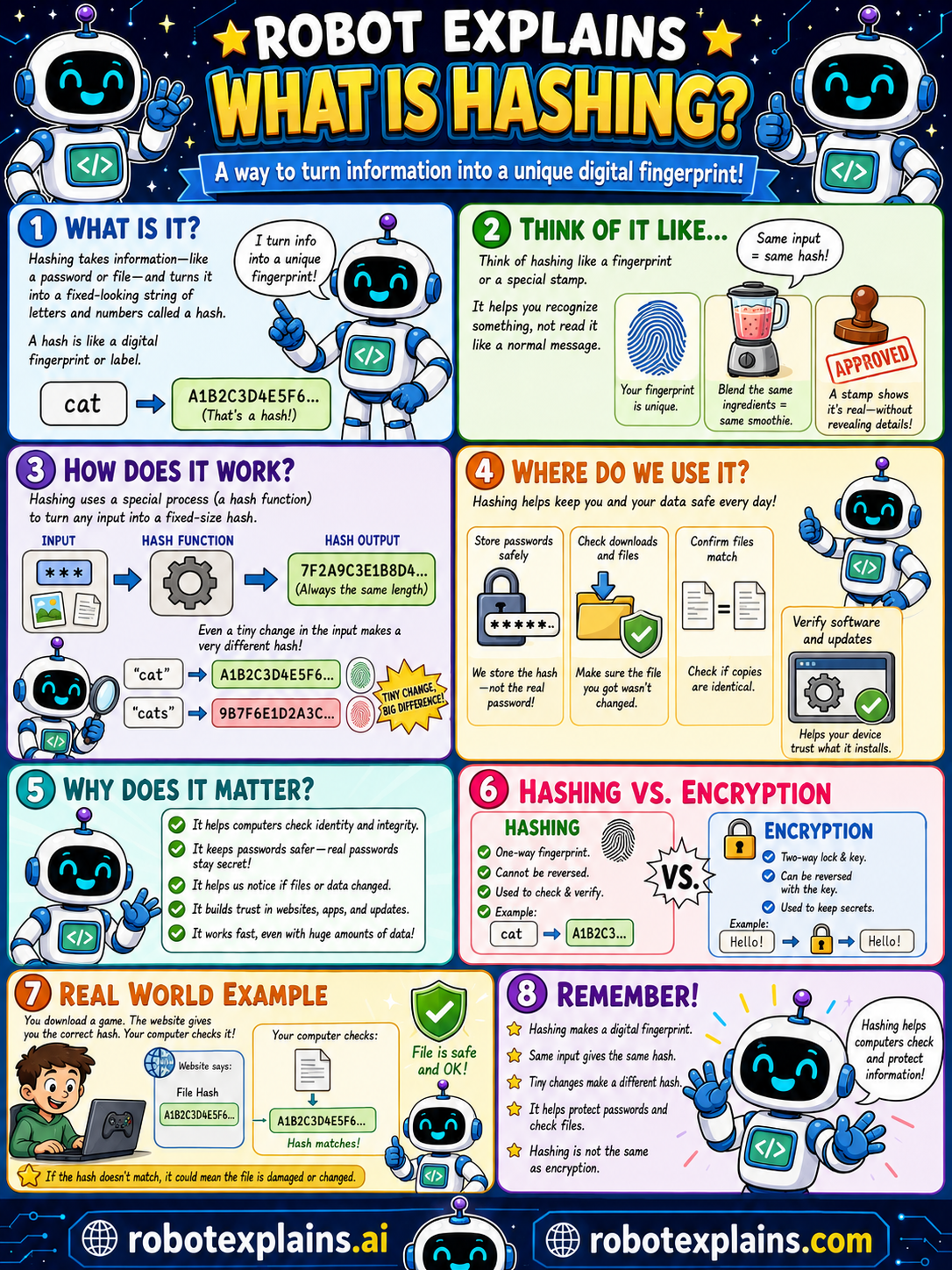
Hashing takes information, like a password or a file, and turns it into a fixed-length string of letters and numbers called a hash. A hash is like a digital fingerprint or label.
Think of it like a fingerprint for a special shape. It helps you recognize something, but you can't read the normal message back from it.
How does it work? Information goes into a special process (a hash function) that turns any input into a fixed-size hash. Even a tiny change in the input makes a very different hash, so "cat" and "cats" produce totally different fingerprints.
Where do we use it? Hashing keeps you and your data safe every day: it stores passwords safely (the site keeps the hash, not your real password), checks downloads and files (to confirm they weren't changed), and verifies software and updates so you can trust what you install.
Why does it matter? It helps computers check identity and integrity, it keeps passwords safer than storing the real ones, it helps us notice if a file or data was changed, and it works fast even on huge amounts of data.
Hashing vs encryption: hashing is one-way, you can't reverse it, and it's used to check and verify. Encryption is two-way, it can be reversed with the right key, and it's used to keep secrets.
Here's a real example. You download a file. The website gives you the file's hash. Your computer checks: if the hashes match, the file is safe and unchanged. If they don't match, the file may be damaged or tampered with.
Remember: hashing makes a digital fingerprint, the same input gives the same hash, you can't turn a hash back into the original, and it helps protect passwords and check data.
What to remember
- Hashing turns information into a unique digital fingerprint.
- The same input always makes the same hash.
- You can't turn a hash back into the original (one-way).
- It checks if files or data have changed, and protects passwords.
Words to know
- Hashing
- Turning info into a fixed-size fingerprint.
- Hash
- The fingerprint that hashing produces.
- One-way
- You can't reverse a hash back to the input.
- Integrity
- Checking that data hasn't changed.
For grown-ups
A hash function maps any input to a fixed-size value deterministically; cryptographic hashes are one-way and collision-resistant. Hashing verifies integrity (same input -> same hash; any change -> different hash) and protects stored passwords (hashed, ideally salted, never plaintext). It's distinct from encryption, which is reversible with a key.
Want the full story? These go deeper: