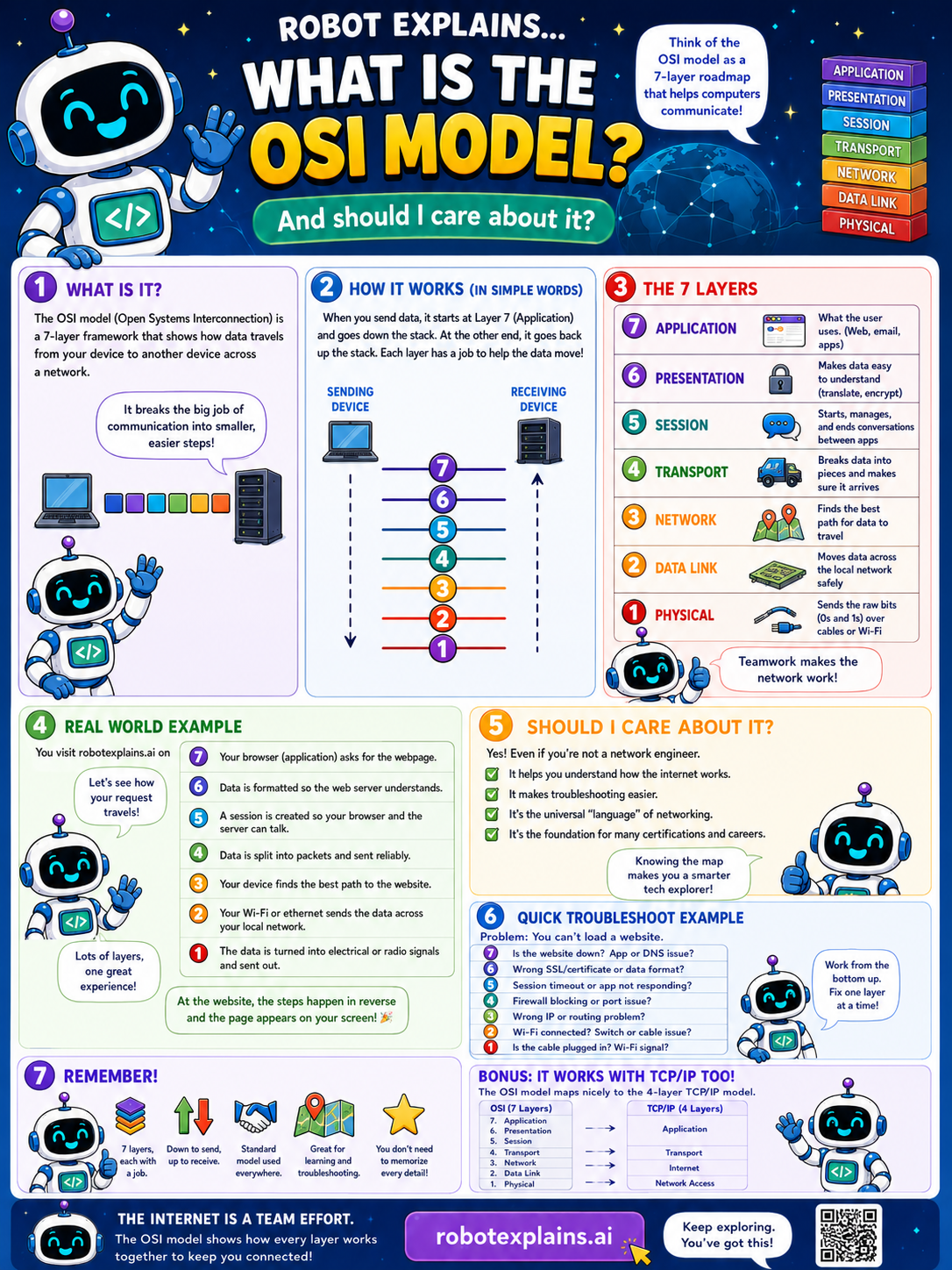
The OSI model (Open Systems Interconnection) is a 7-layer roadmap that shows how data travels from your device to another device across a network. It breaks the job of communication into smaller, easier steps.
How does it work? When you send data, it starts at Layer 7 (Application) and goes down the stack. At the other end, it goes back up the stack. Each layer has a job to help the data move.
The 7 layers, from top to bottom: Application (what you see, like apps and email), Presentation (formats, translates, and encrypts data), Session (starts, keeps, and ends conversations), Transport (breaks data into pieces and makes sure it arrives), Network (finds the path, like a map for data), Data Link (moves data across the local link), and Physical (the raw bits over wires, cables, or Wi-Fi). Teamwork makes the network work!
Should you care about it? Yes, even if you're not a network engineer. It helps you understand how the internet works, makes troubleshooting easier, is the universal "language" of networking, and is the foundation for many certifications and careers.
Here's a handy trick. If a website won't load, you can check one layer at a time, from the bottom up: Is the cable plugged in or Wi-Fi connected? Is your IP and routing okay? Is a firewall blocking it? Is the site itself down? Working layer by layer makes problems easier to solve.
The OSI model also maps neatly onto the 4-layer TCP/IP model that the real internet uses.
Remember: 7 layers, each with a name, data goes up and down the stack, it's a standard used everywhere, and you don't need to memorize every detail. The internet is a team effort!
What to remember
- The OSI model has 7 layers, each with a job.
- Data goes down the layers to send, and up to receive.
- It's a shared 'language' for how networks work.
- It's great for learning and troubleshooting.
Words to know
- OSI model
- A 7-layer map of how networks communicate.
- Layer
- One step in the stack, with its own job.
- Stack
- The 7 layers working together.
- Packet
- A small piece of data sent over a network.
For grown-ups
The OSI model is a 7-layer reference framework (Physical, Data Link, Network, Transport, Session, Presentation, Application) describing how networked systems communicate. It's conceptual, real stacks use TCP/IP, but it's invaluable for teaching and for troubleshooting layer by layer.
Want the full story? These go deeper: