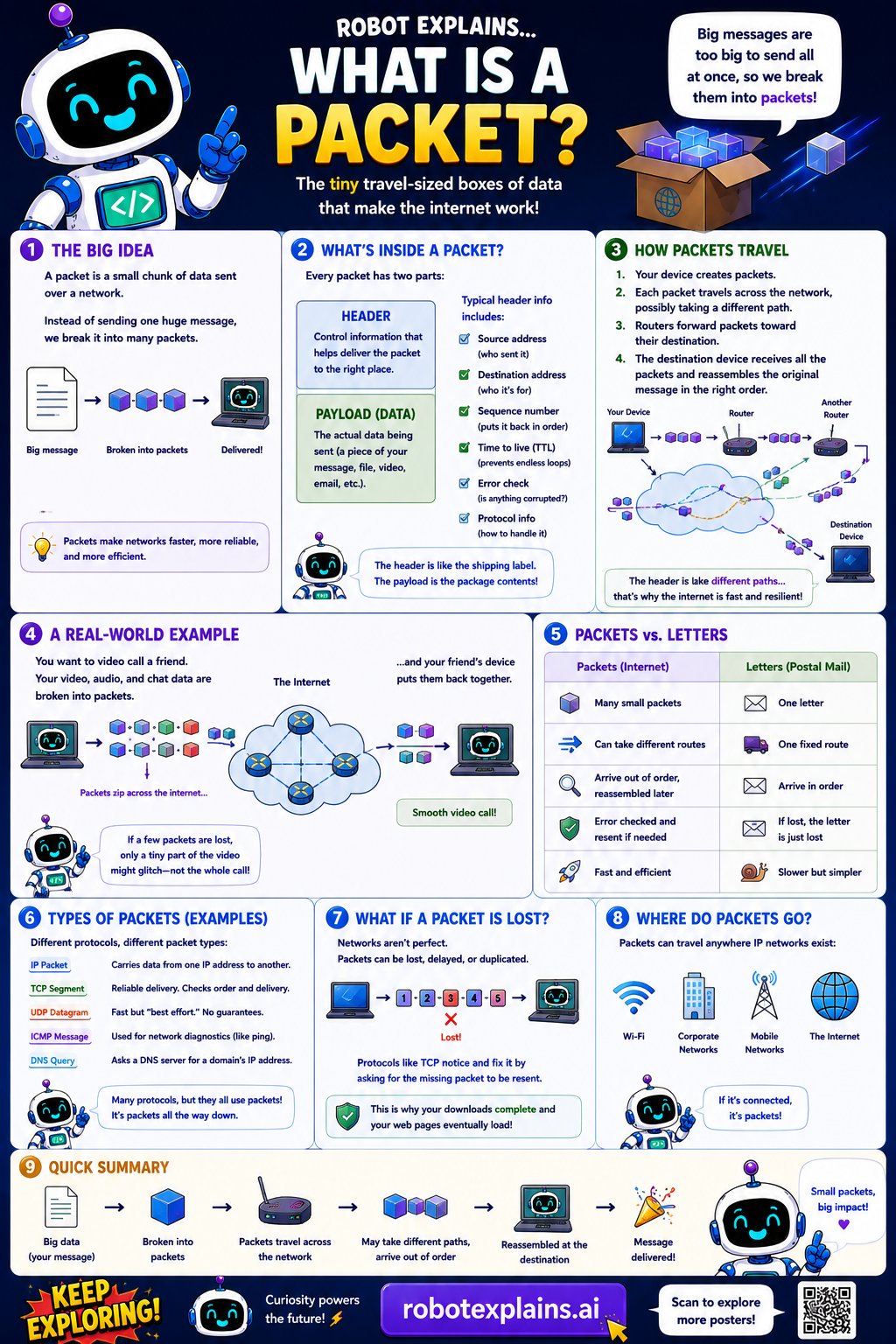
A packet is a small chunk of data sent over a network. Instead of sending one huge message, we break it into many packets. They're the tiny travel-sized boxes of data that make the internet work!
What's inside a packet? Every packet has two parts. The header holds control information that helps deliver it to the right place, like the source and destination addresses, the order it goes in, and error checks. The payload is the actual data being sent, a piece of your message, video, email, or more. The header is like the shipping label, and the payload is the package contents.
How do packets travel? Your device creates packets, and each one travels across the network, possibly taking a different path. Routers forward packets toward their destination, and the destination device receives all the packets and reassembles the original message in the right order.
Here's a real example. You want to make a video call. Your video, audio, and chat data are broken into packets and sent across the internet. If a few packets are lost, only a tiny part of the video might glitch, not the whole call. That's why the internet is fast and resilient!
Packets vs letters: sending many small packets is like sending many postal letters, they can take different routes, may arrive out of order, and get checked and resent if needed, which is efficient and reliable.
What if a packet is lost? Networks aren't perfect, packets can be lost, delayed, or duplicated. Protocols like TCP notice and re-send the missing pieces, so your downloads complete and your web pages load.
Remember: big data is split into packets, packets travel across the network (sometimes by different paths), they're reassembled at the destination, and small packets make a big impact!
What to remember
- A packet is a small chunk of a bigger message.
- Big data is broken into many packets to travel.
- Each packet has a header (address info) and a payload (the data).
- Packets can take different routes and are reassembled at the end.
Words to know
- Packet
- A small piece of data sent over a network.
- Header
- Address and control info on a packet.
- Payload
- The actual data inside a packet.
- Reassemble
- Putting the packets back in order.
For grown-ups
Networks move data as packets: a message is split into small units, each with a header (source/destination, sequence, checksums) and a payload. Packets may take different routes and arrive out of order; protocols like TCP reorder them, detect loss, and request retransmission. Packetizing is what makes shared networks efficient and resilient.
Want the full story? These go deeper: