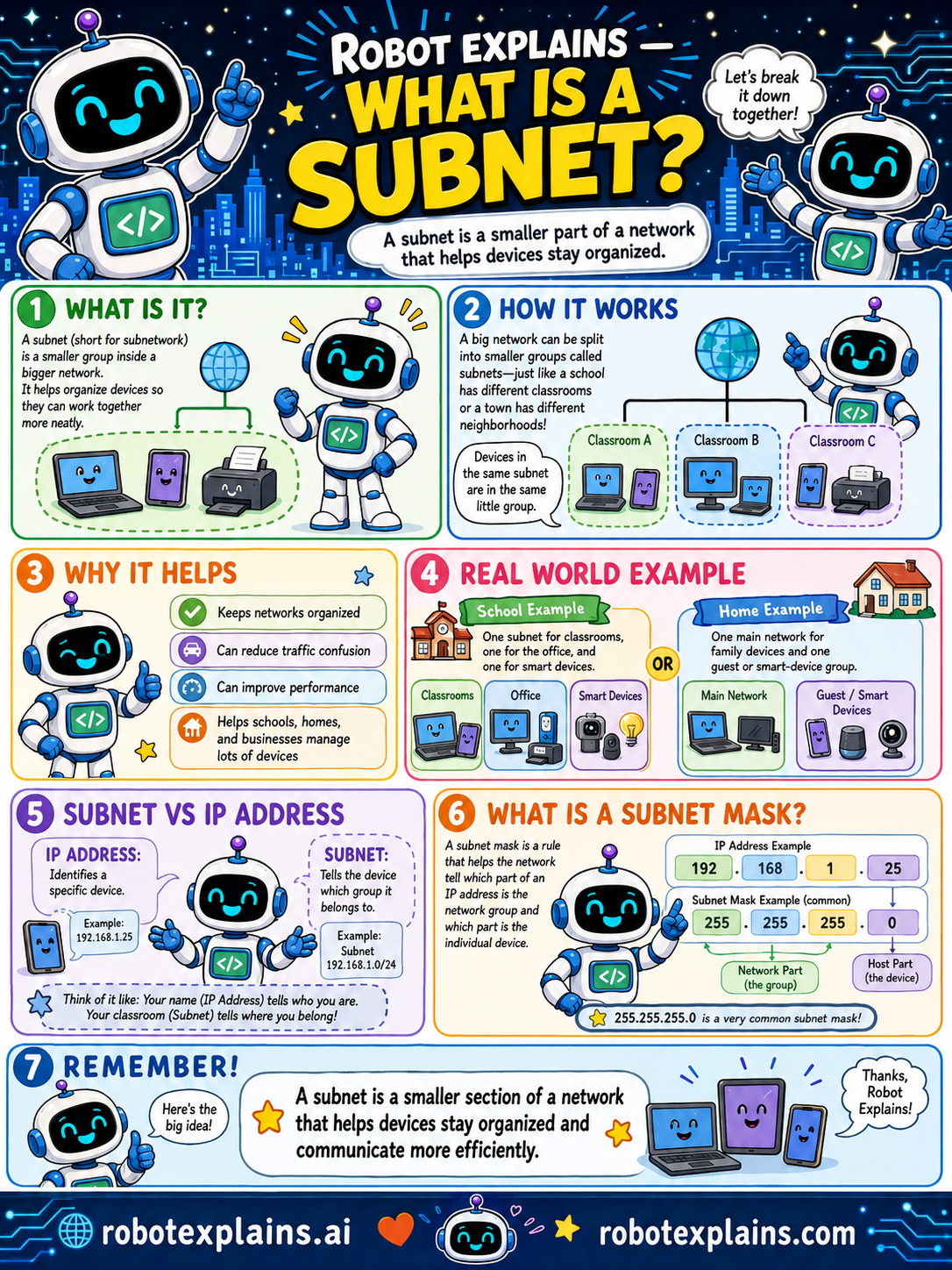
A subnet (short for subnetwork) is a smaller group inside a bigger network. It helps organize devices so they can work together more neatly.
How does it work? A big network can be split into smaller groups called subnets, just like a school has different classrooms, or a town has different neighborhoods. Devices in the same subnet are in the same little group.
Why does it help? It keeps networks organized, can reduce traffic confusion, can improve performance, and helps schools, homes, and businesses manage lots of devices.
Here's a real example. At a school, there might be one subnet for classrooms, one for the office, and one for smart devices. At home, there might be one main network for family devices, and a separate group for guests or smart devices.
Subnet vs IP address: an IP address identifies a specific device, while a subnet tells the device which group it belongs to.
What's a subnet mask? It's a rule that helps the network tell which part of an IP address is the network part (the group) and which part is the individual device. A very common one is 255.255.255.0.
Remember: a subnet is a smaller section of a network that helps devices stay organized and communicate more efficiently.
What to remember
- A subnet is a smaller group inside a bigger network.
- It keeps devices organized, like classrooms in a school.
- It can reduce confusion and improve performance.
- A subnet mask marks the network part of an address.
Words to know
- Subnet
- A smaller group inside a bigger network.
- Subnet mask
- A rule marking the network part of an IP.
- Network
- Devices connected so they can share.
- IP address
- The address that identifies a device.
For grown-ups
A subnet divides a larger IP network into smaller logical segments, improving organization, performance (smaller broadcast domains), and security. The subnet mask (e.g., 255.255.255.0) marks which bits of an IP are the network portion versus the host portion.
Want the full story? These go deeper: