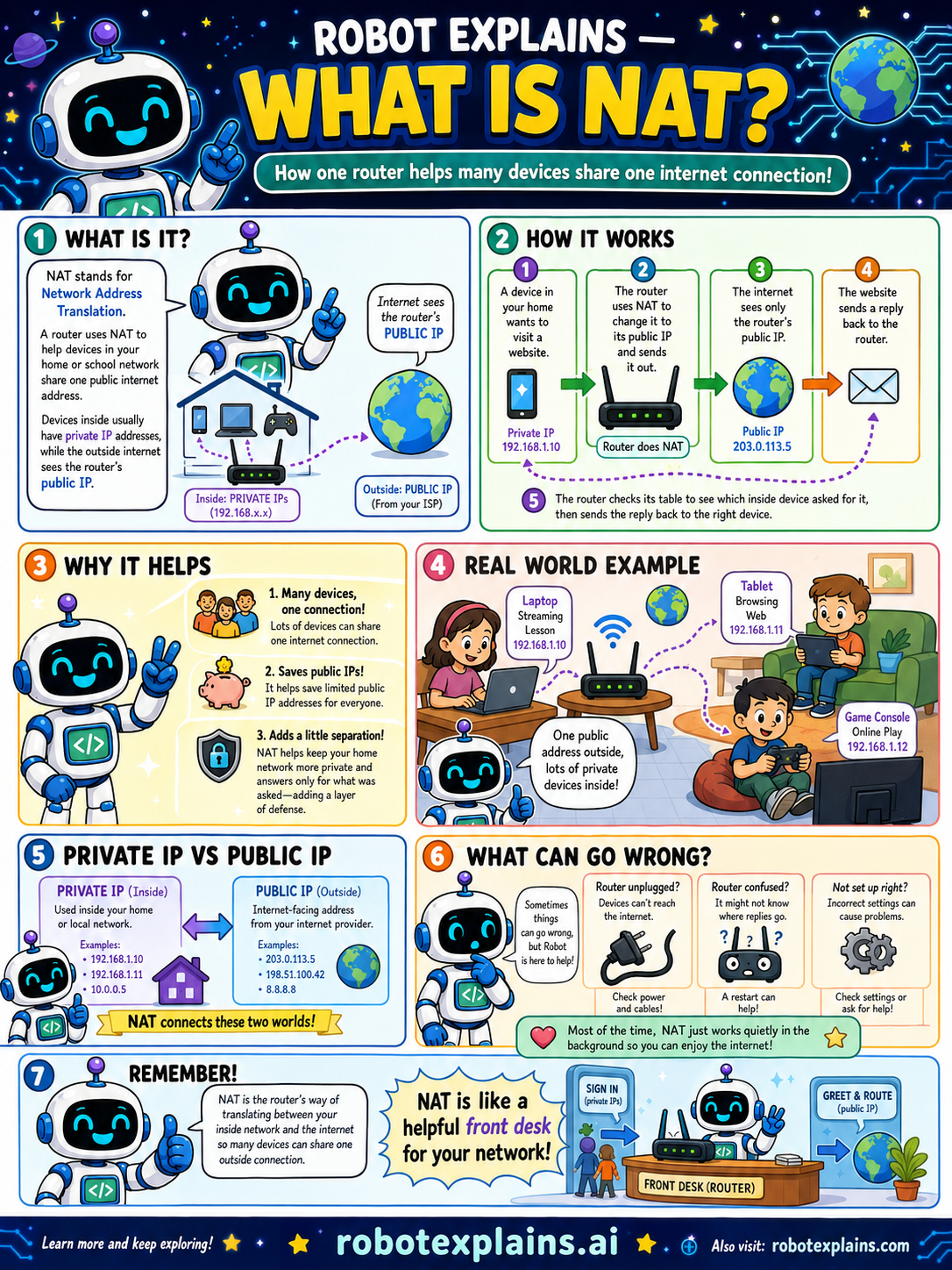
NAT stands for Network Address Translation. A router uses NAT to help all the devices in your home or school share one public internet address. Devices inside usually have private IPs, while the outside world sees the router's public IP.
How does it work? A device inside wants to visit a website. The router changes the request to use the router's public IP and sends it out. The internet sees only the public IP. When the website replies, the router checks its table to see which inside device asked for it, then sends the reply to the right device.
Why does it help? Many devices, one connection. It saves public IP addresses (there are only so many to go around). And it adds a little protection, because NAT only answers for things that were asked for inside.
Private IP vs Public IP: a private IP is used inside your home or local network. A public IP is your internet-facing address from your provider. NAT connects these two worlds!
Here's a real example. A laptop streaming a lesson, a tablet browsing, and a game console playing online, all share one public IP, with lots of devices inside.
What can go wrong? Sometimes setup can have hiccups (a router unplugged or misconfigured), but it's fixable. Most of the time, NAT works quietly in the background so you can enjoy the internet.
Remember: NAT lets many devices share one public address, inside devices use private IPs while the world sees one public IP, the router tracks who asked for what, and it's like a helpful front desk for your network.
What to remember
- NAT lets many devices share one public internet address.
- Inside devices use private IPs; the world sees one public IP.
- The router tracks which device asked for what.
- It saves addresses and adds a little privacy.
Words to know
- NAT
- Network Address Translation, shares one public IP.
- Private IP
- An address used inside your network.
- Public IP
- Your network's address on the internet.
- Router
- The device that does the translating.
For grown-ups
NAT maps many private (internal) addresses to one (or few) public addresses at the router, conserving scarce IPv4 space and providing some isolation (unsolicited inbound traffic has no mapping). The router keeps a translation table to route replies back to the right internal host.
Want the full story? These go deeper: