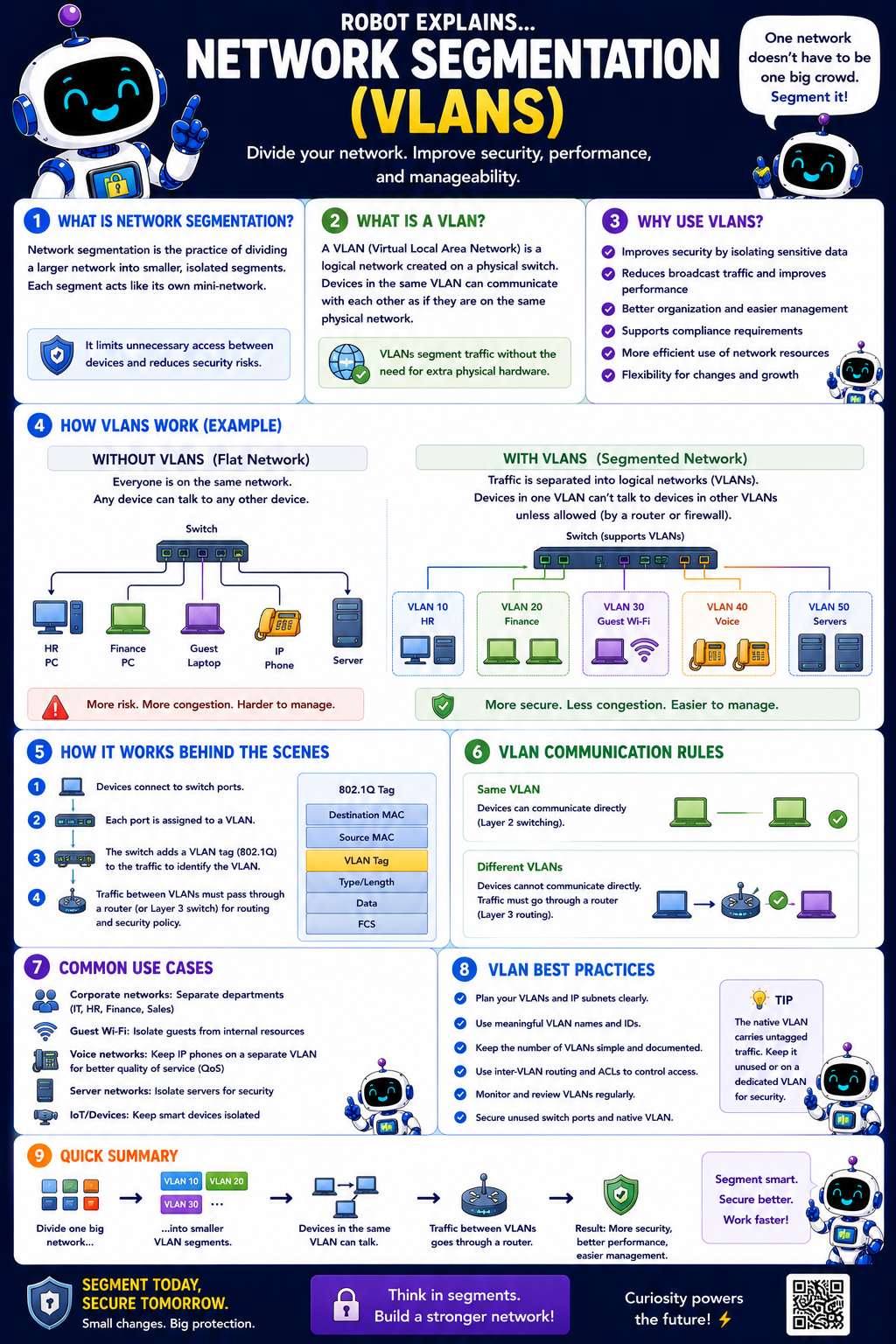
Network segmentation is the practice of dividing a larger network into smaller, isolated segments. A VLAN (Virtual Local Area Network) is a logical network created on a physical switch. Devices in the same VLAN can talk as if they're on the same physical network, even though the traffic stays separate, without needing separate physical hardware. The big idea: one network doesn't have to be one big crowd, you can segment it!
Why use VLANs? They improve security by isolating sensitive data, reduce extra "broadcast" traffic and improve performance, make management easier, support compliance, and give flexibility to grow and change.
How do VLANs work? Without VLANs, everyone is on one flat network, more congestion and harder to manage. With VLANs, traffic is divided into logical groups (like HR, Finance, Guest Wi-Fi, Voice, and Servers). Devices in one VLAN can't talk to devices in another VLAN unless it's allowed, through a router or firewall. More secure, less congestion, easier to manage.
Behind the scenes: devices connect to switch ports, each port is assigned to a VLAN, and the switch adds a VLAN "tag" (802.1Q) so the network knows which VLAN the traffic belongs to. Traffic between VLANs must go through a router (or Layer-3 switch) for routing and security rules.
Common uses: separating departments in a company, keeping guest Wi-Fi away from internal resources, putting IP phones on their own VLAN, isolating servers, and keeping IoT smart devices separate.
A few best practices: plan your VLANs and IP scheme clearly, use meaningful names and IDs, keep it simple and documented, use routing rules to control access, and secure unused switch ports.
Remember: divide one big network into smaller VLANs, devices in the same VLAN talk directly, traffic between VLANs goes through a router, and the result is more security, better performance, and easier management. Segment smart!
What to remember
- VLANs split one physical network into separate logical groups.
- Devices in the same VLAN talk directly; across VLANs needs a router.
- They improve security, performance, and manageability.
- Common uses: guest Wi-Fi, IoT, and separating departments.
Words to know
- VLAN
- A Virtual Local Area Network, a logical segment.
- Network segmentation
- Dividing a network into smaller parts.
- Switch
- The device that assigns ports to VLANs.
- Isolation
- Keeping segments separate for safety.
For grown-ups
A VLAN logically segments a switched network so groups of ports/devices share a broadcast domain independent of physical layout (tagged via 802.1Q). Inter-VLAN traffic must traverse a router or Layer-3 switch, where ACLs enforce policy. Segmentation limits lateral movement and broadcast scope, key for security (isolating IoT/guest) and performance.
Want the full story? These go deeper: