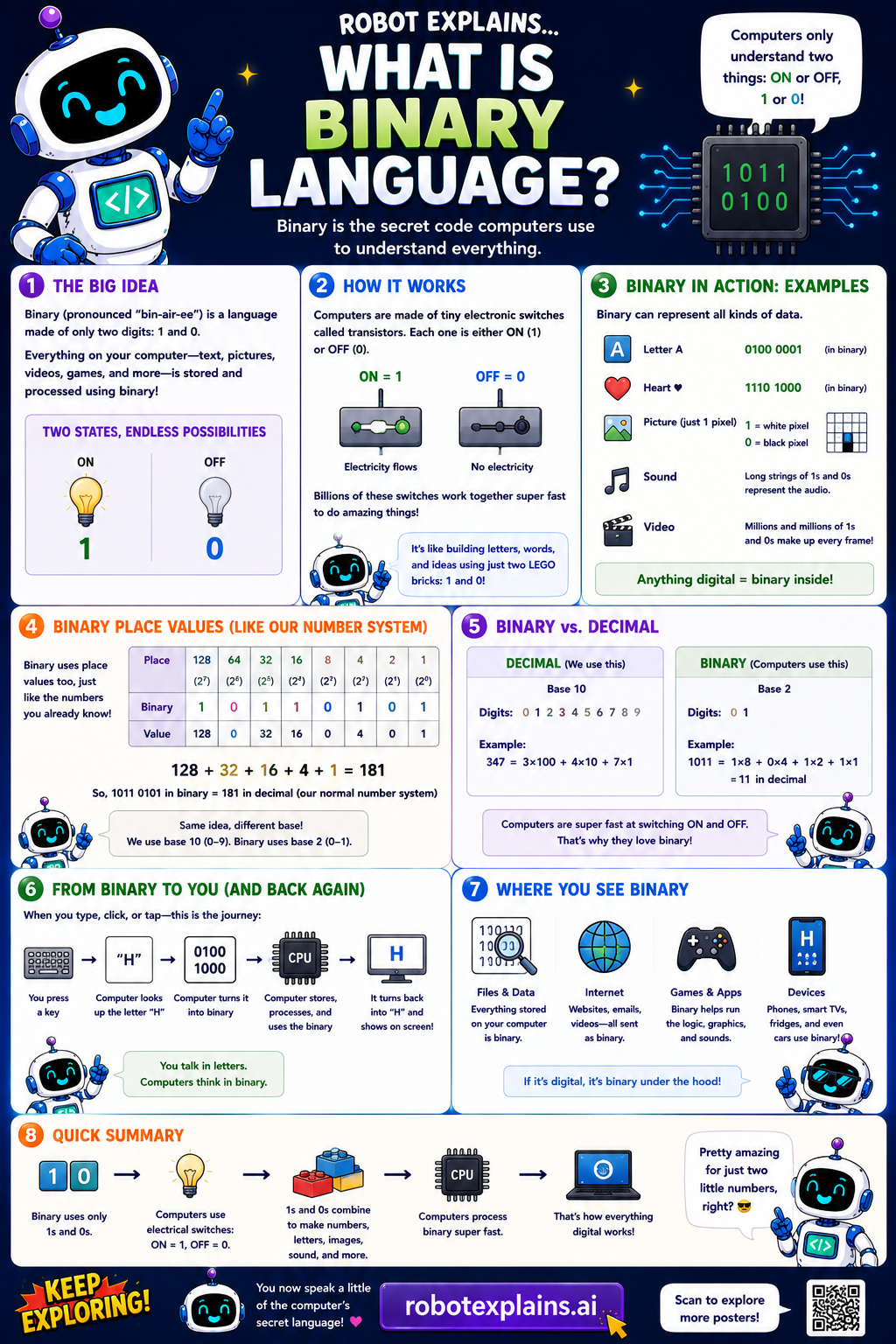
Binary (pronounced "bin-air-ee") is a language made of only two digits, 0 and 1. Everything on your computer, text, pictures, videos, and more, is stored and processed using binary. Computers only understand two things: on (1) and off (0).
How does it work? Computers are made of tiny electronic switches called transistors. Each one is either on (1) or off (0). On means electricity flows, off means it doesn't. Billions of these switches work together super fast to do amazing things, like building blocks, words, and ideas using just two LEGO shapes!
Binary in action: a single letter A might be 01000001, a heart emoji a longer string of bits, and a tiny picture dot (pixel) a pattern of 1s and 0s. Sound becomes long strings of 1s and 0s too. Anything digital is binary inside!
Binary place values work like our number system, but instead of ones, tens, and hundreds, the spots double: 1, 2, 4, 8, 16, 32, 64, 128. So 10110101 adds up to 128 + 32 + 16 + 4 + 1 = 181.
Binary vs decimal: decimal (the way we count) uses 10 digits (0-9), that's base 10. Binary (the way computers count) uses 2 digits (0-1), that's base 2. Computers are super fast at switching between them, that's why they love binary!
From binary to you and back: you press a key, the computer turns it into binary, processes it, and shows it back to you as letters, pictures, and sound. You talk in letters, computers think in binary.
Where do you see binary? In files and data, on the internet, in games and apps, and in all your devices. If it's digital, it's binary under the hood!
Remember: binary uses only 0s and 1s, computers use electrical switches (on = 1, off = 0) to make numbers, letters, images, sound, and more, and that's how everything digital works.
What to remember
- Binary uses only two digits: 0 and 1.
- Computers store everything as on (1) and off (0).
- Tiny switches flip super fast to do amazing things.
- Text, pictures, and sound are all binary inside.
Words to know
- Binary
- A code made of just two digits, 0 and 1.
- Bit
- One binary digit: a single 0 or 1.
- On / off
- 1 means on, 0 means off.
- Base 2
- A number system using only 0 and 1.
For grown-ups
Binary is base-2: every value is expressed with bits (0/1), physically represented as on/off states (transistors). All digital data, numbers, text, images, audio, is encoded in binary, and computation is vast numbers of fast switch operations. Place values double (1, 2, 4, 8, …), the counterpart to base-10.
Want the full story? These go deeper: